Introduction
Energy costs rank among the top two operating expenses for commercial and industrial facilities, yet most organizations lack real-time visibility into where that energy is being wasted. Utility bills arrive monthly, but inefficiencies accumulate daily—costing thousands in preventable waste.
In 2025, rising utility rates are making this worse. The U.S. Energy Information Administration reports that commercial electricity costs jumped 6.8% year-over-year to 13.19 cents/kWh, while industrial rates climbed 7.5% to 8.44 cents/kWh.
Combined with ESG mandates like the SEC's climate disclosure rules and increasing power reliability demands, energy management software (EMS) has shifted from a nice-to-have to a mission-critical tool for facility managers across sectors, from commercial real estate to remote industrial sites.
The global Energy Management Systems market reflects this urgency, projected to grow from USD 60.61 billion in 2025 to USD 158.55 billion by 2033, representing a CAGR of 12.7%. This guide breaks down the top EMS platforms available in 2025, what to look for when evaluating them, and how the right tool can meaningfully reduce costs across your facilities.
Key Takeaways
- Energy Management Software helps facilities track, analyze, and optimize energy consumption in real time, with leading solutions cutting energy costs by up to 80%
- Top 2025 tools combine real-time monitoring, utility bill management, analytics dashboards, and building automation or microgrid integration
- Top platforms reviewed: EnergyCAP, Schneider Electric EcoStruxure, Honeywell Forge, Siemens Energy Manager, and Innovus Power GridGenius EMCS
- Selection depends on facility type, existing infrastructure, renewable energy needs, and whether you operate on-grid, off-grid, or hybrid
- Software-only analytics platforms and hardware-integrated energy control systems serve different needs — know whether you need visibility into consumption or active control over dispatch before choosing
What Is Energy Management Software for Facilities Management?
Energy Management Software (EMS) is a system that monitors, collects, analyzes, and controls energy consumption data across a facility or portfolio of facilities. The purpose is to reduce waste, cut costs, and improve sustainability performance — with decisions backed by real consumption data rather than estimates.
EMS vs. Building Automation Systems
While often confused, EMS and Building Automation Systems (BAS) serve distinct purposes. A BAS automates building functions — HVAC, lighting, access control — affecting energy use indirectly through operational efficiency. An EMS is purpose-built to directly optimize energy consumption, tracking usage at the asset or meter level, managing utility billing, and supporting compliance reporting.
In 2025, these systems are increasingly converging. Modern platforms like Schneider Electric's EcoStruxure and Siemens Desigo CC now incorporate native energy management modules, giving facility managers a single interface for both operational control and energy optimization.
The EMS Spectrum
Today's EMS landscape spans a wide spectrum:
- Cloud-based utility bill management platforms that audit invoices and track multi-site consumption
- IoT-enabled monitoring systems providing real-time dashboards and analytics
- Integrated Energy Management Control Systems (EMCS) embedded within microgrid architectures that actively dispatch power across renewable, storage, and backup generation sources
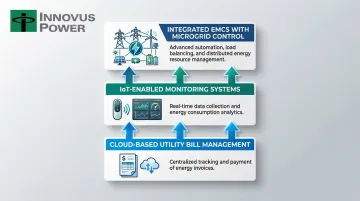
The sections below evaluate the strongest options across each tier, so facility managers can match the right tool to their site's complexity and budget.
Best Energy Management Software and Tools for Facilities Management in 2025
These five tools were evaluated based on real-time monitoring capability, integration with existing building or energy infrastructure, analytics depth, scalability, and suitability for diverse facility types. Each represents a distinct approach to energy management: from software-only analytics to hardware-integrated control systems.
EnergyCAP
EnergyCAP is a leading cloud-based utility bill management and energy intelligence platform serving corporate campuses, government agencies, higher education institutions, and large multi-site commercial portfolios. It functions as a centralized hub for utility data, vendor information, and facility energy metrics.
What makes EnergyCAP stand out: It excels at utility bill auditing—identifying billing errors and overcharges. One county government recovered $336,697 through EnergyCAP's auditing capabilities. The platform also provides multi-site energy benchmarking, greenhouse gas tracking, and generates structured data that sustainability teams need for ESG and ENERGY STAR reporting. It's the strongest choice for organizations managing energy spend across dozens or hundreds of locations.
| Feature | Details |
|---|---|
| Key Features | Utility bill auditing, interval data management, ENERGY STAR benchmarking, GHG tracking, budgeting and forecasting, weather normalization |
| Best For | Multi-site portfolio managers, corporate sustainability leaders, government and higher education facility teams |
| Pricing / Deployment | Custom pricing per meter per year; cloud-based (web platform) |
Schneider Electric EcoStruxure
Schneider Electric's EcoStruxure is an IoT-enabled open platform for energy and building management, covering electrical distribution, power quality monitoring, and sustainability management. It's widely deployed in commercial buildings, data centers, industrial facilities, and critical infrastructure globally.
What makes EcoStruxure stand out: Its strength lies in power quality management—detecting harmonics, voltage sags, and electrical anomalies that cause asset damage and inefficiency. It integrates with Schneider's hardware layer (metering, switchgear, UPS) for granular circuit-level visibility. The platform supports ISO 50001, ISO 50002, and ISO 50006 compliance and provides automated waveform analysis to identify voltage disturbances at the root cause. It's the right fit for facilities where electrical infrastructure health directly drives operational uptime.
| Feature | Details |
|---|---|
| Key Features | Power quality monitoring, real-time energy dashboards, demand management, sustainability reporting, integration with BMS and SCADA |
| Best For | Industrial facilities, data centers, commercial campuses with Schneider electrical infrastructure |
| Pricing / Deployment | Available upon request; modular platform (hardware + software) |
Honeywell Forge Energy Management
Honeywell Forge is a cloud-based connected building platform that focuses on optimizing the energy envelope of a facility—HVAC, lighting, and chillers—using AI-driven controls and IoT sensor data. It serves commercial real estate, hospitality, healthcare, and large institutional facilities.
What makes Honeywell Forge stand out: Automated demand control allows it to reduce energy draw in unoccupied spaces without manual intervention. The AI layer learns occupancy patterns and proactively adjusts building systems. At Bluewater Health, the system delivered a 12.97% reduction in energy use and 11.71% reduction in natural gas use over four months, without capital-intensive hardware replacements. It's most effective for facilities with variable occupancy: hotels, hospitals, and office campuses.
| Feature | Details |
|---|---|
| Key Features | AI-driven HVAC and lighting optimization, occupancy-based demand control, fault detection and diagnostics, sustainability dashboards, remote building management |
| Best For | Hotels, hospitals, commercial office buildings, campuses with complex HVAC systems |
| Pricing / Deployment | Available upon request; cloud-based with on-site hardware integration |
Siemens Desigo CC / Energy Manager
Siemens offers integrated building management through Desigo CC, paired with its Energy Manager module, providing real-time energy monitoring and control tightly coupled with building automation. It's natively compatible with Siemens meters, drives, and PLCs, making it a powerful choice for automation-heavy environments.
What makes Siemens stand out: It provides granular data down to the individual circuit breaker and integrates energy consumption data directly with building automation workflows. The Energy Manager module is compliant with ISO 50001 and features machine-learning algorithms for anomaly detection in energy consumption data. For facilities already running Siemens automation infrastructure, the native integration eliminates data translation layers and delivers actionable insights faster.
| Feature | Details |
|---|---|
| Key Features | Circuit-level energy monitoring, BAS integration, real-time dashboards, energy reporting, alarm and fault management, SCADA connectivity |
| Best For | Automated industrial facilities, large commercial buildings, and campuses with existing Siemens automation infrastructure |
| Pricing / Deployment | Available upon request; modular (hardware-native + software) |
Innovus Power GridGenius EMCS
Innovus Power's GridGenius EMCS (Energy Management Control System) is a proprietary real-time control engine at the core of Innovus Power's microgrid solutions. It manages the dynamic interaction of solar, wind, stored energy, utility grid, and dispatchable generation assets.
Unlike conventional software-only EMS tools, GridGenius achieves up to 90–100% renewable energy penetration without curtailment — a threshold most platforms can't reach.
What makes GridGenius EMCS stand out: Purpose-built for facilities that cannot afford interruptions, GridGenius serves remote communities, mining operations, oil and gas facilities, resorts, military installations, and commercial and industrial sites. Where most EMS platforms monitor consumption, GridGenius actively dispatches energy in real time using power electronics and control software. Its vendor-agnostic design works across all underlying power technologies without bias toward any single hardware vendor.
In a Canadian Arctic community with 550 residents, GridGenius achieved 20–50% fuel savings while replacing 2–3 fixed-speed generators with a single variable speed unit. With 24/7 remote monitoring and management support worldwide, it delivers utility-grade power quality while reducing energy costs by up to 80% and cutting CO₂ emissions alongside fuel costs.
| Feature | Details |
|---|---|
| Key Features | Real-time microgrid control, up to 90–100% renewable penetration, vendor-agnostic multi-source energy management, variable speed generator optimization, 24/7 remote monitoring and management, proprietary modeling and simulation tools |
| Best For | Remote, off-grid, or hybrid microgrid facilities: mining, oil & gas, resorts, military, agriculture, remote communities, commercial and industrial facilities seeking energy independence |
| Pricing / Deployment | Custom pricing; integrated hardware + software microgrid platform with global deployment capability (250kW to 200+MW) |
How We Chose the Best Energy Management Tools
Each tool was evaluated against criteria that reflect how facilities actually operate — not just vendor marketing claims. The assessment covered:
- Real-time monitoring capability and data granularity
- Integration depth with existing BAS, SCADA, meters, and energy generation assets
- Analytics and reporting quality for actionable decision-making
- Scalability across single sites and multi-facility portfolios
- Track record serving relevant facility types and energy architectures
Common Selection Mistakes
Facility managers often select EMS tools based purely on brand recognition or upfront software cost, rather than evaluating total cost of ownership, integration complexity, and whether the tool addresses their specific energy challenge. A platform excellent at utility bill aggregation may offer zero capability for real-time renewable energy dispatch—and vice versa.
The Critical Selection Factors
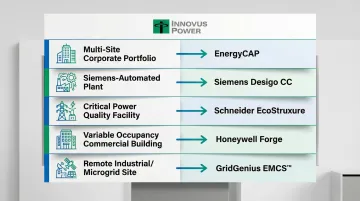
Facility type and energy architecture drive every other decision. The same platform that works well for a corporate real estate portfolio will fail in a remote industrial microgrid — and vice versa:
- Multi-site corporate portfolios need utility bill aggregation and benchmarking (EnergyCAP)
- Siemens-automated plants need native BAS integration (Siemens Desigo CC)
- Facilities with critical power quality requirements need advanced electrical monitoring (Schneider EcoStruxure)
- Commercial buildings with variable occupancy need AI-driven HVAC optimization (Honeywell Forge)
- Remote industrial facilities with renewable generation need an intelligent control system for real-time power dispatch across multiple sources (GridGenius EMCS)
Software-only platforms excel at analytics and reporting for grid-connected multi-site portfolios. Facilities managing distributed or renewable energy sources require an integrated EMCS platform — because active control, not passive monitoring, determines performance.
Conclusion
The best energy management software for facilities management in 2025 is not a single product—it's the one that matches your facility's energy architecture, operational complexity, and sustainability goals.
Software-only platforms like EnergyCAP excel at utility bill auditing and multi-site benchmarking. Building-integrated systems like Honeywell Forge and Schneider EcoStruxure optimize HVAC and electrical infrastructure. Native automation platforms like Siemens Desigo CC deliver seamless integration for facilities already running compatible hardware.
Facilities managing distributed energy resources, renewable integration, or microgrid infrastructure have different requirements entirely. Integrated EMCS platforms give operators direct, real-time control over energy dispatch—not just visibility into consumption after the fact.
Before finalizing any EMS decision, evaluate against these criteria:
- Real-time control capability — can it dispatch energy, or only report on it?
- Infrastructure compatibility — does it integrate with your existing hardware?
- Vendor support model — what does ongoing technical support look like?
- Long-term scalability — can it grow as your energy mix evolves?
For facilities seeking to maximize renewable integration while maintaining utility-grade power quality, Innovus Power's GridGenius EMCS is deployed across remote Arctic communities, mining operations, and commercial facilities worldwide. Reach out to Innovus Power to assess whether a GridGenius-powered microgrid solution fits your facility's power architecture.
Frequently Asked Questions
Frequently Asked Questions
What is the best energy management software?
The best EMS depends on your facility type. EnergyCAP leads for utility bill management, while Schneider EcoStruxure, Honeywell Forge, and Siemens Desigo CC suit facilities with integrated building automation. For sites with microgrids or distributed renewables, Innovus Power's GridGenius EMCS provides active energy dispatch control that software-only platforms can't match.
What is the best software for facility management?
Facility management software spans CMMS, CAFM, IWMS, and capital planning — EMS is just one category within it. For energy-specific needs, EnergyCAP, Honeywell Forge, and Schneider EcoStruxure are widely used. The right choice depends on whether your priority is maintenance, space optimization, or energy cost reduction.
What are the top 5 BMS systems?
Top BMS platforms in 2025 include Schneider Electric EcoStruxure, Siemens Desigo CC, Honeywell BMS, Johnson Controls Metasys, and ABB Ability Building Analyzer. BMS automates building functions like HVAC and lighting, while EMS is purpose-built for energy optimization — the two are increasingly integrated in modern facilities.
What is the difference between a BAS and an EMS?
A BAS controls building functions — HVAC, lighting, security — to support occupant comfort, with energy savings as a secondary benefit. An EMS is built specifically to monitor, analyze, and optimize energy consumption at the meter or asset level, supporting utility management and sustainability reporting. In 2025, the two are converging, but their primary functions and ROI focus remain distinct.
Can energy management software integrate with renewable energy systems?
Most conventional EMS platforms can monitor renewable generation as a data input but aren't built to actively control dispatch across multiple sources. Dedicated EMCS platforms — like Innovus Power's GridGenius EMCS — are purpose-built for mixed-source facilities, enabling real-time dispatch across renewables, storage, and backup generation to maximize renewable penetration and minimize costs.
What features should facility managers look for in energy management software in 2025?
Key features to evaluate include:
- Real-time monitoring and anomaly detection
- Multi-site or multi-meter data aggregation
- Utility bill management and auditing
- Integration with existing BAS or SCADA systems
- Sustainability and GHG reporting capabilities
- Active energy dispatch control (essential for on-site generation or microgrids)
Scalability and the vendor's support model are also critical for long-term ROI.