Key Takeaways
- U.S. electricity prices rose 37.1% between 2016 and March 2026, putting energy cost management at the top of the agenda for facilities and operations
- 100% renewable microgrids integrate solar/wind generation, battery storage, and intelligent controls to cut or eliminate grid dependence
- Advanced energy management systems enable up to 90–100% renewable penetration without sacrificing power stability
- Power outages cost American businesses roughly $150 billion per year — resilience has a measurable dollar value
- Remote operations, critical infrastructure, and energy-intensive commercial facilities consistently show the strongest return on investment
Why Traditional Power Is No Longer Reliable or Affordable
The centralized grid model was built for a different era. Power generated hundreds of miles away travels through aging transmission lines before reaching your facility — every mile of that journey is a potential failure point. Extreme weather events, equipment failures, and surging demand from data centers and electrification are compounding the pressure on infrastructure that was never designed to handle today's load profile.
NERC's 2025 Long-Term Reliability Assessment found that 13 of 23 North American assessment areas face resource adequacy challenges over the next decade. That's a structural problem, not an anomaly — and it's worsening as electrification demand accelerates.
Fossil fuel dependency compounds the problem. When natural gas prices swing, wholesale electricity follows — there's no buffer between fuel markets and your energy bill:
- In 2022, U.S. natural gas prices surged from $3.70/MMBtu in January to nearly $10/MMBtu by August
- New England wholesale electricity averaged $160/MWh in January of that year
- Natural gas set marginal power prices in PJM 84.3% of the time in the first nine months of 2023
For any operation tied to the grid, fuel volatility is electricity volatility.
What Is a 100% Renewable Energy Microgrid?
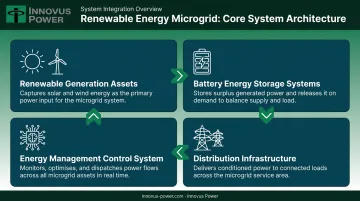
A renewable energy microgrid is a self-contained power system that generates, stores, and distributes electricity using clean energy sources — solar, wind, hydro, or a combination — and can operate connected to or fully independent of the utility grid.
The Four Core Components
| Component | Role |
|---|---|
| Renewable generation assets | Solar arrays, wind turbines, or hydro units produce electricity from clean sources |
| Battery energy storage systems (BESS) | Capture excess generation and dispatch it when production drops |
| Energy management control system (EMCS) | The operational brain — balances supply, demand, and storage in real time |
| Distribution infrastructure | Delivers stable power to on-site loads at the required voltage and frequency |
What "100% Renewable Penetration" Actually Means
This phrase gets misused constantly. A system that runs primarily on diesel with some solar panels bolted on is not a 100% renewable microgrid — it's a diesel system with a renewable supplement.
True 100% renewable penetration means the system meets all on-site electricity demand from clean sources without relying on fossil fuels for baseload power. That requires:
- Proper generation sizing matched to actual on-site demand
- Adequate storage capacity to cover gaps when production drops
- Intelligent controls that manage variability in real time
- No curtailment — surplus energy is stored or redirected, not wasted
The Stability Challenge: How Renewable Microgrids Deliver Consistent Power
The most common objection to renewable microgrids is predictable: "What happens when the sun isn't shining or the wind isn't blowing?" It's a fair question, and the answer lies in system design rather than energy source.
Battery Storage as the Bridge
Battery energy storage systems capture renewable generation during peak production periods and dispatch it precisely when generation drops. This isn't theoretical — Kodiak Island, Alaska reached 99.7% renewable electricity using hydro, wind, a 3 MW/2 MWh battery bank, and two 1 MW flywheels. The storage system provides 30–90 seconds of bridging power during generation transitions, eliminating the diesel the island previously burned through — 2.8 million gallons per year.
Intelligent Control as the Nervous System
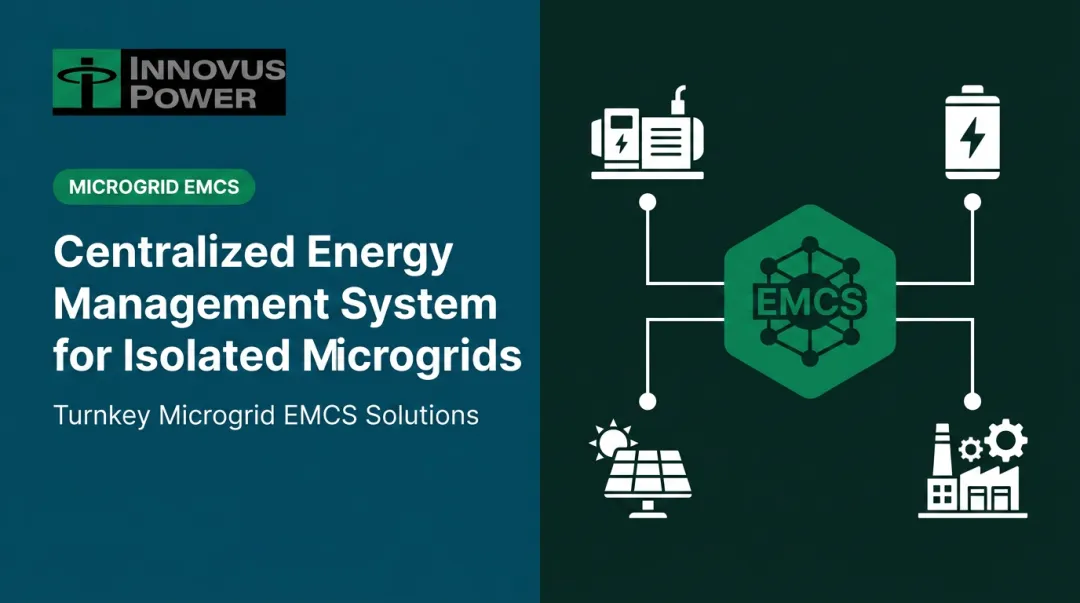
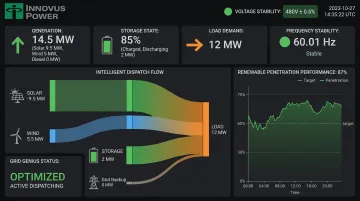
Storage handles the energy, but the energy management control system (EMCS) is what keeps everything synchronized in real time. Innovus Power's GridGenius EMCS continuously monitors generation output, load demand, and storage state, automatically dispatching energy to maintain stable voltage and frequency.
The system operates in grid-forming or grid-following mode, adapting to conditions as they change. Its PowerBridge Intelligence component takes optimization further:
- Redirects surplus energy to thermal loads rather than curtailing it
- Fills generation deficits with stored energy before activating backup generation
- Maintains stable voltage and frequency through generation transitions
The result: up to 90–100% renewable penetration without curtailment — achieved not by hoping the wind blows, but by designing a system smart enough to handle variability.
Backup Generation and Islanding
Well-designed systems include dispatchable backup generation (variable-speed generators or hydrogen-fueled units) as a last resort for extended low-generation periods. Innovus Power's variable-speed generator technology decouples engine speed from electrical frequency, allowing backup units to run at low loads without wasting fuel or increasing wear.
When the utility grid fails, a properly configured renewable microgrid detects the event and automatically separates, or "islands," to continue supplying power without interruption. The GridGenius Energy Center's grid-forming capability lets the microgrid independently establish voltage and frequency references, maintaining stable power delivery through the transition. For facilities where downtime isn't an option, this capability is non-negotiable.
The Full Spectrum of Benefits: Beyond Just Keeping the Lights On
Dramatic Cost Reduction and Long-Term Price Stability
On-site renewable generation replaces purchased electricity with power that, once the system is installed, costs nothing per kilowatt-hour to produce. The economic case compounds over time as utility rates continue rising while microgrid energy costs stay flat.
Kodiak Island's transition to renewables eliminated $7 million per year in fuel costs and actually reduced customer electricity rates. The Falkland Islands saw rates drop from $0.42/kWh to $0.30/kWh — a $0.12/kWh reduction — after wind integration cut diesel use by 1.4 million liters annually.
Innovus Power's platform targets up to 80% reductions in power costs, with flat energy costs stretching decades into the future. For businesses currently paying commercial rates that have risen 33.5% in a decade, that predictability alone changes how facilities budget decades out.
Resilience and Power Quality
The financial exposure from grid dependency is substantial:
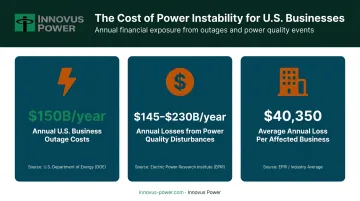
- DOE data puts power outage costs to American businesses at around $150 billion per year
- EPRI estimates U.S. power-quality disturbance costs at $145–$230 billion annually
- Average annual losses per affected business reach $40,350, with some facilities absorbing $78,000–$93,000 or more
A 100% renewable microgrid doesn't just prevent outages. It can deliver superior power quality compared to grid supply — stable voltage and frequency that reduces stress on sensitive equipment, lowers maintenance costs, and extends the service life of electrical and electronic systems. Innovus Power systems maintain utility-grade power quality specifications across all operating conditions, including during high renewable penetration scenarios.
Environmental and Regulatory Benefits
Eliminating or dramatically reducing fossil fuel consumption directly reduces a facility's Scope 2 greenhouse gas emissions — the indirect emissions associated with purchased electricity. The EPA's Greenhouse Gas Reporting Program covers facilities emitting above 25,000 metric tons CO₂e per year, representing roughly 85–90% of U.S. GHG emissions.
For covered facilities, a renewable microgrid isn't just a sustainability initiative — it's a compliance tool. That same asset also satisfies growing ESG scrutiny from investors and stakeholders, functioning as both a risk management instrument and a verifiable sustainability credential.
Who Needs a 100% Renewable Microgrid? Key Use Cases
Remote and Off-Grid Operations
Remote communities and industrial sites face the starkest economics. Diesel-generated power in remote Alaska commonly costs $0.50 to over $1.00/kWh — up to ten times the national average. DOE's Alaska Microgrid Partnership targets 50% diesel reduction across approximately 200 isolated microgrid systems. The ROI case is straightforward.
Mining operations, Arctic industrial sites, and island communities share the same profile:
- Fuel costs that are 5–10x mainland rates
- Supply chains too fragile for reliable diesel resupply
- Zero tolerance for outages in safety-critical environments
Innovus Power serves these locations with Rapid Deployment Flex Microgrid (RDFM) units — complete systems packaged in 40-foot mobile platforms built for challenging Arctic deployments.
Critical Infrastructure
Military bases, medical facilities, airports, and emergency services face a different calculation: power continuity isn't primarily a cost question, it's a life-safety question. These operators need guaranteed uptime, superior power quality, and islanding capability that activates without manual intervention.
Commercial and Industrial Users
Resorts, greenhouses, agriculture, and manufacturing operations sit in a compelling middle ground. Energy costs represent a significant share of operating expenses, and sustainability credentials matter to customers and investors alike. Facilities with large thermal loads — greenhouses, food processing, industrial drying — gain an extra edge. Innovus Power systems can redirect surplus renewable generation to heat requirements, squeezing additional value from every kilowatt produced.
What to Look for in a Renewable Microgrid Solution
Not all microgrid providers are equal. A few factors separate solutions that deliver on their promise from those that don't.
Vendor-agnostic design — Providers with preferred vendor relationships design around product availability, not your site's actual requirements. Look for genuine expertise across solar, wind, hydro, storage, and control technologies. Innovus Power holds no bias toward any technology or manufacturer — every system starts with the customer's requirements, not a preferred parts list.
Proprietary modeling and simulation — Before committing capital, you need to see how the system performs under real-world conditions for your specific site. A provider should model renewable penetration levels, energy costs, and power quality outcomes before a single component is specified. Innovus Power's Grid Design Services use proprietary modeling tools to evaluate power certainty, power quality, and cost of energy for each configuration.
Long-term operational partnership — A microgrid is a 20–30 year asset. The provider you choose should be capable of optimizing the system as your energy needs evolve — not just delivering hardware and stepping back.
Innovus Power's 24/7 remote monitoring and management service covers deployed systems worldwide, tracking power quality, storage performance, and generation output continuously. With over 30 years in microgrid development, that operational infrastructure is built for the long haul.
Frequently Asked Questions
What makes a microgrid truly "100% renewable"?
A 100% renewable microgrid meets all on-site electricity demand from clean energy sources without relying on fossil fuels for baseload power. This is achieved through proper sizing of generation assets and storage, combined with intelligent control systems that manage variability — not by supplementing a diesel system with solar panels.
How do renewable microgrids stay stable when the sun isn't shining or the wind isn't blowing?
Stability comes from three layers: battery storage that bridges generation gaps, energy management software that continuously balances supply and demand, and appropriately sized backup generation for extended low-generation periods. Kodiak Island's 99.7% renewable system demonstrates this working at scale.
How much does a 100% renewable energy microgrid cost?
Installed costs vary significantly by size and configuration. NREL's cost study reports averages of $4.0M/MW for commercial microgrids and $2.1M/MW for community microgrids, with soft costs and storage representing major cost components. The more useful comparison is levelized cost of energy over the project lifespan, where microgrids consistently outperform continued grid dependence and fossil fuel exposure.
Can a renewable microgrid completely replace a utility grid connection?
Yes, in off-grid configurations common in remote locations. Grid-tied microgrids operate connected to the utility under normal conditions but island automatically during outages. The right configuration depends on site location, load profile, and resilience requirements — both approaches achieve meaningful energy independence.
What industries benefit most from 100% renewable microgrids?
Remote and off-grid operations (mining, Arctic communities, island facilities), critical infrastructure operators (military, medical, emergency services), and energy-intensive commercial and industrial users (agriculture, manufacturing, resorts) have the strongest ROI case and the greatest operational need.
How long does it take to design and deploy a renewable energy microgrid?
Timelines vary by project complexity, permitting, and site conditions. DOE's C-MAP program estimates community microgrid technical assistance completes within 18–24 months. Thorough upfront modeling and simulation before procurement is the most effective way to reduce deployment risk and avoid costly redesigns.