Introduction
When the grid fails, the costs are immediate. Industrial downtime runs up to $500,000 per hour, and 44% of industrial decision-makers report monthly equipment-related interruptions. For the 770 million people globally still without reliable electricity access, energy independence is an operational necessity — not a future aspiration.
Remote communities, mining operations, and off-grid facilities are no longer asking whether to pursue independent power. They're asking which system best fits their load profile, budget, and long-term resilience goals.
The off-grid power landscape has changed significantly over the past decade. Options now range from standalone diesel generators to intelligent hybrid microgrids that combine solar, wind, battery storage, and dispatchable backup under centralized control. Choosing the right system requires comparing reliability, lifecycle cost, scalability, and renewable integration — this guide covers all of it.
Key Takeaways
- Off-grid power systems operate independently of the central grid, from diesel gensets to intelligent hybrid microgrids
- Solar-battery systems offer zero fuel costs but face intermittency challenges requiring significant storage
- Wind power continues at night but demands strong, consistent wind resources and backup infrastructure
- Diesel generators remain common, but fuel costs run $3–$5/gallon in remote areas and carbon footprints are substantial
- Intelligent hybrid microgrids achieve up to 80% fuel reduction and 90%+ renewable penetration without curtailment
What Is an Off-Grid Power System?
An off-grid power system generates electricity independently of the central utility grid. These systems serve remote communities, mining operations, military bases, resorts, agricultural facilities, and medical centers where grid extension is impractical or cost-prohibitive.
The technology spectrum ranges widely. At one end sit standalone single-source systems—a diesel genset or solar-only array. At the other end, advanced multi-source microgrids integrate solar, wind, battery storage, and dispatchable backup under intelligent Energy Management Control Systems (EMCS) that optimize dispatch in real time.
Your choice of architecture determines three outcomes that define long-term project success: reliability, total cost of ownership, and sustainability performance. The five system types below cover the full range of technologies deployed across remote communities, industrial sites, and critical infrastructure worldwide.
Best Off-Grid Power Systems: A Complete Comparison
These five system types cover the complete technology landscape for commercial, industrial, and remote-community off-grid power. Each is evaluated for reliability, scalability, cost profile, and renewable integration capability.
Solar PV + Battery Storage Systems
Solar PV paired with lithium-ion or LiFePO4 battery storage dominates low-to-medium load off-grid applications—from remote telecom towers to off-grid resorts. Over 10,800 commercial solar-battery systems were installed globally in 2023 alone.
Key advantages:
- Zero fuel cost once installed, with low ongoing maintenance
- Modular scalability — arrays expand as load requirements grow
- Battery costs have dropped sharply; the global average LCOE for battery storage hit $104/MWh in 2023
Critical limitations: Solar generates nothing at night and delivers reduced output during overcast periods. Reliable 24/7 operation demands significant battery capacity. Increasing battery autonomy from one day to three days can raise LCOE from $0.23/kWh to $0.58/kWh. High-latitude regions face severe seasonal deficits, requiring either massive storage oversizing or hybrid backup with wind or diesel.
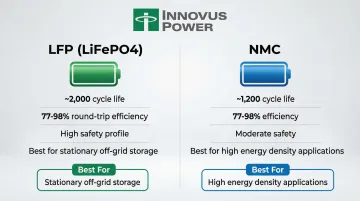
Battery Performance Comparison:
| Battery Type | Cycle Life (80% DoD) | Round-Trip Efficiency | Safety Profile | Best Application |
|---|---|---|---|---|
| LFP (LiFePO4) | ~2,000 cycles | 77-98% | High | Stationary off-grid storage |
| NMC | ~1,200 cycles | 77-98% | Moderate | High energy density applications |
| Attribute | Details |
|---|---|
| Power Capacity / Scalability | Typically 1 kW to several MW depending on array and storage size; modular but land-intensive |
| Best Use Cases | Remote cabins, telecom infrastructure, agricultural pumping, small commercial facilities with predictable daytime loads |
| Key Limitation | Weather-dependent generation; requires significant battery backup for 24/7 reliability; high upfront capital cost for large storage banks |
Wind-Based Off-Grid Systems
Wind turbines deliver proven off-grid power in high-wind regions—Arctic communities, coastal installations, and open mining or agricultural sites. Unlike solar, wind generation continues at night and during overcast conditions.
Real-world performance: Kotzebue, Alaska operates a community microgrid with 2.4 MW wind capacity, 0.5 MW solar, and 1 MW battery storage. Wind generation exceeded 4,000 MWh in 2020, meeting up to 80% of demand at peak times and displacing ~250,000 gallons of diesel annually.
Glencore's Raglan Mine in northern Canada runs 6 MW of wind power paired with 3 MW battery storage, abating 4 million liters of diesel and avoiding 6,800 tonnes of CO2 emissions annually. That represents roughly 40% wind penetration at the site.
Key challenges: Wind output is highly site-specific and variable. Turbines require land clearance, regular mechanical maintenance, and specialized engineering in extreme climates (freeze-back pilings for permafrost, cold-temperature battery packages). Installation costs carry logistics premiums in remote areas—Kotzebue chose two 1 MW turbines over a single 2.5 MW unit due to crane limitations and foundation costs.
| Attribute | Details |
|---|---|
| Power Capacity / Scalability | Small turbines: 1–100 kW; utility-scale wind: 1+ MW; scaling requires additional land and storage infrastructure |
| Best Use Cases | Remote Arctic and coastal communities, open-terrain mining and agricultural sites, wind-solar hybrid microgrids |
| Key Limitation | Wind variability requires backup or storage; high installation cost in remote areas; site-dependent resource assessment required |
Diesel & Fossil Fuel Generator Systems
Diesel and natural gas gensets remain the most widely deployed off-grid power source globally. Diesel generators provide over 30% of off-grid power in developing countries and account for 40% of installed capacity in off-grid zones. Industrial users represent 41.9% of the global diesel generator market.
Why they persist: Dispatchable, on-demand power output regardless of weather conditions. Well-understood technology, highly scalable from 5 kW to multiple MW, and fast to deploy.
Critical drawbacks escalating pressure to transition:
- Fuel cost volatility: Remote diesel prices ranged from $3-$5 per gallon in Kotzebue, Alaska in 2021—far above urban rack prices
- Carbon footprint: Diesel emits approximately 3.2 kg CO2 per liter consumed
- Maintenance burden: One remote community experienced over 30 outages in a single year from aging diesel generators before hybridization
- Economic opportunity cost: Replacing diesel with off-grid solar could save $6.3-$12.5 billion in fuel costs globally and avoid 8.3-16.6 Mt CO2e annually
| Attribute | Details |
|---|---|
| Power Capacity / Scalability | Highly scalable from 5 kW to multiple MW; fast to deploy; well-understood technology |
| Best Use Cases | Emergency backup, temporary construction sites, locations with no feasible renewable resource; legacy remote industrial operations |
| Key Limitation | Fuel cost volatility; highest carbon footprint of any off-grid option; ongoing maintenance and fuel logistics costs |
Intelligent Hybrid Microgrid Systems
Intelligent hybrid microgrids integrate multiple generation sources—solar, wind, hydro, battery storage, and dispatchable backup—under a centralized Energy Management Control System (EMCS) that dynamically optimizes dispatch, minimizes fuel use, and maximizes renewable penetration. For sites that can't afford single-source failure, this architecture delivers both redundancy and efficiency.
Market momentum: The global microgrid market reached $99.76 billion in 2025 and is projected to hit $406.23 billion by 2033—a 19.7% CAGR. Remote microgrids are growing fastest at 20.2% annually.
Why hybrid microgrids outperform single-source alternatives:
- Select the best available components for each application — no proprietary hardware lock-in
- Achieve up to 90-100% renewable energy penetration without curtailment
- Cut fuel consumption by up to 80% compared to diesel-only systems
- Maintain operational continuity at isolated sites through 24/7 remote monitoring
Documented hybrid microgrid performance:
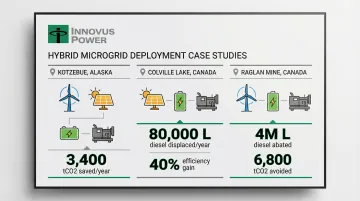
| Site | Configuration | Key Outcomes |
|---|---|---|
| Kotzebue, Alaska | Wind (2.4 MW) + Solar (0.5 MW) + Battery (1 MW) + Diesel | ~20% renewable penetration; 3,400 tCO2 saved/year |
| Colville Lake, Canada | Solar (132.5 kW) + Battery (200 kWh) + Diesel | Displaces ~80,000 L diesel/year; 40% efficiency gain |
| Raglan Mine, Canada | Wind (6 MW) + Battery (3 MW) + Diesel | Abates 4 million L diesel/year; 6,800 tCO2 avoided |
Innovus Power's GridGenius EMCS takes this integration further by supporting any energy technology combination—solar, wind, hydro, battery storage, diesel, natural gas, or hydrogen fuel cells—within a single control architecture. Because the platform isn't tied to any specific manufacturer's hardware, system designers select components based on site performance requirements rather than vendor partnerships.
A Canadian Arctic community with 550 residents deployed a GridGenius system that replaced 2-3 fixed-speed gensets with one variable-speed unit running 24/7, achieving 20-50% fuel savings (excluding solar impact) and extending maintenance cycles while maintaining superior power quality even as the solar plant was expanded.
| Attribute | Details |
|---|---|
| Power Capacity / Scalability | Scalable from community-scale (10s of kW) to large industrial installations (10s of MW); expandable to grow with load demand |
| Best Use Cases | Remote communities, mining and resource extraction, oil and gas facilities, resorts and hotels, military bases, agricultural operations, medical facilities |
| Key Differentiator | Intelligent EMCS optimizes all sources in real time; up to 80% fuel and cost reduction; utility-grade power quality; 24/7 remote support |
Hydrogen & Fuel Cell Systems
Solid oxide fuel cells (SOFCs) and hydrogen fuel cell systems offer high efficiency and very low emissions—currently deployed in specialized industrial, data center, and high-reliability applications requiring consistent baseload power.
Emerging applications: Bloom Energy is developing green hydrogen microgrids in India, integrating floating solar with electrolyzers and fuel cells. When paired with renewable energy sources, hydrogen systems can deliver 100% zero-CO2 operation for 24/7 power needs.
Current limitations:
- High capital cost: Micro-CHP SOFC systems cost approximately €34,000/kW in 2015-2016, with projections to drop to €3,500/kW by 2030
- Fuel supply infrastructure: Green hydrogen production costs are declining but require significant investment in electrolyzers and cheap renewable electricity
- Limited deployment scale: Technology is still maturing for broad off-grid industrial deployment compared to solar-wind-battery hybrids
Future viability: As electrolyzer costs fall and renewable electricity becomes cheaper, hydrogen fuel cells become viable zero-emission baseload candidates—especially for sites with biogas resources or those targeting full carbon elimination.
| Attribute | Details |
|---|---|
| Power Capacity / Scalability | Commercial units typically 100 kW to several MW; modular and stackable |
| Best Use Cases | High-reliability industrial facilities, data centers, biogas-rich agricultural sites, decarbonization-focused corporate campuses |
| Key Limitation | High upfront cost; hydrogen fuel supply infrastructure required; technology still maturing for broad off-grid industrial deployment |
How to Choose the Right Off-Grid Power System
The most common mistake buyers make is selecting a system on lowest upfront cost. A diesel genset may look cheaper to install, but once you factor in volatile fuel costs (especially where remote transport premiums apply), the lifetime economics tell a different story.
The right metric is levelized cost of energy (LCOE) — total cost per kilowatt-hour across the system's 20-30 year life.
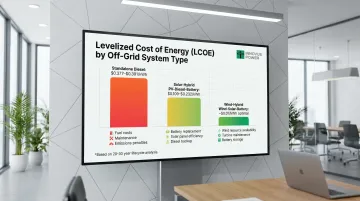
Comparative LCOE ranges demonstrate the economic case:
| System Type | LCOE Range ($/kWh) | Key Cost Drivers |
|---|---|---|
| Standalone Diesel | $0.377 - $0.391 | Fuel delivery, maintenance, efficiency losses |
| Solar-Hybrid (PV-Diesel-Battery) | $0.109 - $0.232 | Battery capex, solar resource, diesel backup |
| Wind-Hybrid (Wind-Solar-Battery) | ~$0.07 (Optimal) | Wind resource quality, autonomy sizing |
Four Primary Evaluation Factors
1. Site Resource Assessment
Accurate design requires validated resource data:
- Solar: Use Global Solar Atlas or NASA POWER for satellite-derived irradiance data
- Wind: Global Wind Atlas provides high-resolution wind resource mapping
- On-site measurement recommended for final investment decisions due to micro-climatic variations
2. Load Profile and Peak Demand Requirements
Understand your power consumption patterns:
- Continuous baseload vs. variable demand
- Peak load magnitude and frequency
- Critical loads requiring uninterrupted power
- Seasonal variations in energy use
3. Fuel Logistics and Access Constraints
In remote locations, fuel delivery costs can exceed the fuel itself. Consider:
- Transport routes and frequency
- Storage capacity and safety requirements
- Price volatility and long-term availability
- Alternative fuel options (natural gas, biogas, hydrogen)
4. Required Reliability Standards
A medical facility demands different reliability than a seasonal resort:
- Acceptable outage frequency and duration
- Backup power requirements
- Power quality specifications for sensitive equipment
- Regulatory compliance requirements
Scalability and Future-Proofing
Systems that lock you into a single manufacturer's components become liabilities when that vendor discontinues a product line or falls behind on technology. Vendor-agnostic design solves this — you can swap, upgrade, or expand without rebuilding from scratch.
Modular architectures make phased expansion practical. In one Arctic community deployment, Innovus Power's GridGenius platform allowed a solar plant expansion to be added later without redesigning the original system. Key capabilities that modular design enables:
- Add renewable capacity as budgets allow
- Integrate new storage chemistries as costs decline
- Upgrade control software without hardware replacement
- Scale generation to match community or industrial load growth
Value of Remote Monitoring and Management
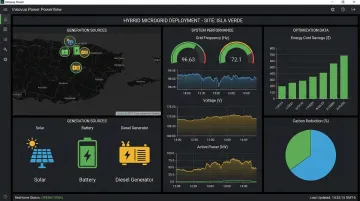
For remote sites, 24/7 monitoring isn't a luxury — it's how you catch performance degradation before it becomes an outage. SCADA or EMCS-based oversight catches faults early, optimizes dispatch in real time, and reduces the need for costly on-site service visits.
Innovus Power's PowerView platform delivers this remotely: performance monitoring, system optimization, and software updates across worldwide deployments, keeping systems running at their designed efficiency throughout their service life.
Conclusion
No single off-grid power technology is universally superior. The right system depends on location, load scale, sustainability goals, and total cost of ownership. However, intelligent hybrid microgrid architectures consistently deliver the best long-term performance across most commercial and industrial use cases.
Prioritize LCOE, scalability, and renewable integration capability over upfront cost when evaluating systems. Work with a provider that has proven expertise across all key power technologies—solar, wind, hydro, battery storage, diesel, and emerging options like hydrogen fuel cells—rather than one with a vested interest in a single product or vendor.
Innovus Power's GridGenius platform is built on over 30 years of microgrid experience across remote communities, mining, oil and gas, military, and commercial applications worldwide. With no bias toward any single vendor or technology, it's designed to maximize renewable penetration—up to 90–100%—while cutting fuel costs by as much as 80% and maintaining utility-grade power quality.
Frequently Asked Questions
What is the best off-grid electricity source?
There is no single best source—the optimal choice depends on site resources, load requirements, and budget. For most commercial and industrial applications, an intelligent hybrid microgrid combining solar, storage, and dispatchable backup with smart energy management delivers the best combination of reliability, renewable penetration, and lowest LCOE.
What is the difference between an off-grid and a hybrid power system?
An off-grid system has no utility grid connection; a hybrid system may be grid-connected but includes local generation and storage. In commercial applications, "hybrid" typically means multiple generation sources (solar, wind, storage, backup generator) operating under intelligent control—not the same as a grid-tied residential hybrid.
Will a 400W solar panel run a fridge?
A 400W solar panel can generate enough daily energy to run a standard household refrigerator under good sun conditions, but only if paired with adequate battery storage to cover nighttime and cloudy periods. Commercial and industrial applications require much larger arrays and storage systems sized through professional load and resource assessment.
What is the 33% rule in solar panels?
The 33% rule suggests a solar system should not be loaded beyond one-third of its peak rated capacity, accounting for efficiency losses, cloudy days, and aging. In professionally engineered microgrid systems, professional engineers size systems using detailed energy modeling rather than simplified rules of thumb.
How much does a commercial off-grid power system cost?
Costs range from tens of thousands of dollars for simple diesel gensets to several million for fully engineered hybrid microgrids serving mining, remote communities, or industrial sites. Upfront capital cost should always be weighed against long-term LCOE and fuel savings over the system's operational life.
Can an off-grid power system be expanded as energy needs grow?
Well-designed microgrid systems are modular and scalable; additional generation sources, storage capacity, or load connections can be added over time. Vendor-agnostic systems built around an intelligent EMCS are significantly easier to expand than single-source or proprietary-architecture systems.