Introduction
When a mine site loses power 400 miles from the nearest grid connection, or a data center goes dark during peak demand, the generator brand on-site determines whether operations continue or stop entirely. Frequent outages and rising utility costs have pushed backup and prime power from a convenience into a core operational requirement. The generator market spans emergency standby systems, continuous prime power for mining and oil and gas, and off-grid solutions for remote communities—making the right brand choice a direct operational and financial decision.
The global industrial generator market was valued at USD 22.53 billion in 2025 and is projected to reach USD 38.22 billion by 2034, growing at a CAGR of 6.10%. That growth is driven by grid unreliability, industrial expansion, and surging demand from remote operations. The U.S. Department of Energy has warned of a potential 100-fold increase in severe power outages by 2030—a figure that puts brand selection squarely in the category of risk management. This guide covers the leading generator manufacturers, what sets them apart, and how to match their capabilities to your operation's specific power needs.
TL;DR
- Global generator demand is growing fast, driven by industrial expansion, grid unreliability, and off-grid power needs
- Top manufacturers—Caterpillar, Cummins, Kohler-SDMO, Generac, and Taylor Power Systems—each serve distinct power ranges and industries
- Selection factors include power output (kW/kVA), fuel type, application fit, certifications, and after-sales support
- The industry is shifting toward hybrid and microgrid-integrated solutions that reduce fuel dependency and cut operating costs
- For complex or remote applications, how generation fits into a broader energy system matters as much as the generator itself
What Is the Generator Market and Why Does It Matter?
Industrial and commercial generators convert mechanical energy into electrical power for standby, prime, or continuous use across mining, healthcare, data centers, military, and remote communities. They serve as the backbone of operations where grid power is unreliable, unavailable, or cost-prohibitive.
Market drivers reshaping the landscape:
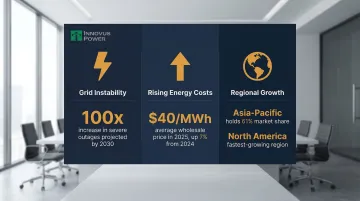
- Grid instability surge: The U.S. faces a potential 100-fold increase in longer, more severe power outages by 2030 under current policies
- Rising electricity costs: Wholesale electricity prices are forecast to average $40 per MWh in 2025, up 7% from 2024
- Regional growth: Asia-Pacific dominated with 61% market share in 2024, while North America is projected to expand at the fastest CAGR through 2034
As outages grow more frequent and energy costs climb, operators are moving past standalone diesel backup — pairing generators with storage, renewables, and automated control systems to cut fuel consumption and reduce grid dependence. Platforms like Innovus Power's GridGenius™ manage these hybrid systems as a single coordinated unit, delivering up to 80% fuel consumption reductions while maintaining utility-grade power quality.
This shift is reflected in the market: North America's microgrid sector is projected to grow at a CAGR of 10.43% from 2025 to 2033, driven by demand for hybrid solutions that combine traditional generation with renewable sources and intelligent controls.
Top Generator Manufacturers and Leading Brands
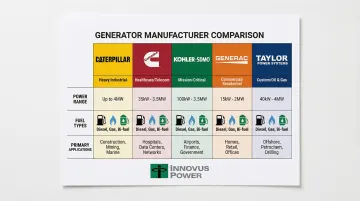
These five manufacturers represent the most widely deployed generator brands across industrial, commercial, and critical infrastructure applications. Each profile covers power range, fuel types, and core applications — use them to match the right manufacturer to your project requirements.
Caterpillar
Caterpillar stands as one of the world's largest construction and power generation equipment manufacturers, offering diesel and gas generator sets with a broad power range. Their global distribution and service network spans every major industrial market, making parts availability and technical support accessible even in remote locations.
Key strengths:
- Wide kVA range specifically engineered for heavy industrial and mining applications
- Emissions-compliant engine technology meeting EPA Tier 4 Final standards
- Cat Connect remote monitoring capability for asset management and predictive maintenance
- Robust build quality designed for 20,000 to 30,000 operating hours (up to 30 years of service life)
- Low long-term maintenance costs due to durable construction and widespread parts availability
| Specification | Details |
|---|---|
| Power Range | 6 ekW to 5,720 ekW (7.5 to 7,150 kVA) diesel; gas options available |
| Fuel Types | Diesel, natural gas, bi-fuel options |
| Key Applications | Mining, oil and gas, data centers, construction, utilities, continuous power operations |
Cummins
Cummins is a globally recognized power generation manufacturer offering diesel and alternative-fueled generator sets with extensive power capabilities. Their segmented business model covers Components, Distribution, New Power, and Power Systems, providing comprehensive support across the power generation lifecycle.
Why buyers choose Cummins:
- Broad dealer and service network spanning multiple countries ensures local support
- Strong presence in healthcare and telecom backup power applications
- Expanding portfolio of cleaner power technologies including hydrogen and natural gas platforms
- Support for alternative fuels like Hydrotreated Vegetable Oil (HVO) for reduced emissions
- Proven track record in data centers, mining, and water treatment facilities
| Specification | Details |
|---|---|
| Power Range | 15 to 3,750 kVA (approximately 12 kW to 3,000 kW) |
| Fuel Types | Diesel, natural gas, propane, bi-fuel, hydrogen (emerging) |
| Key Applications | Healthcare, data centers, telecom, marine, residential standby, commercial facilities |
Kohler-SDMO
Kohler-SDMO ranks among the top three generator manufacturers globally, specializing in both portable and industrial generators across a wide kVA range. Their French engineering heritage combined with international service reach positions them well for complex, tailor-made power plant solutions.
Notable capabilities:
- KD Series offers some of the most powerful diesel generator sets available (800 kW to 4,000 kW)
- Focus on tailor-made power plant solutions for complex client requirements
- Long-term operability guarantees for worldwide facilities
- Specialized expertise in mission-critical applications requiring uninterrupted power
- Strong presence in airport, hospital, and large-scale industrial installations
| Specification | Details |
|---|---|
| Power Range | 1 kVA to 4,500 kVA (KD Series: 800 kW to 4,000 kW) |
| Fuel Types | Diesel, natural gas, rental fleet options |
| Key Applications | Airports, data centers, hospitals, large-scale industrial, utilities |
Generac
Generac is one of the most recognized generator brands in North America, with over 60 years in the market since its founding in 1959. Their diverse product lineup spans residential, commercial, industrial, and portable generators, giving them broad reach across both consumer and industrial segments.
Where Generac stands out:
- Early leadership in affordable residential standby power expanded access to backup generation across North America
- Industrial bi-fuel and gaseous generator offerings up to 2 MW with expanding large-megawatt solutions for data centers
- PowerManager digital controllers and transfer switch ecosystem simplifies system integration
- Strong dealer network across North America ensures rapid service response
- Manufacturing footprint expanding in Wisconsin to support commercial and industrial growth
| Specification | Details |
|---|---|
| Power Range | Up to 2,000 kW industrial/commercial (2 MW), with large-megawatt solutions expanding |
| Fuel Types | Diesel, natural gas, propane, bi-fuel |
| Key Applications | Residential standby, commercial facilities, construction, disaster response, light industrial |
Taylor Power Systems
Taylor Power Systems is a U.S.-based manufacturer with over 30 years of experience since 1986, serving commercial, industrial, healthcare, telecommunications, and oil and gas sectors. All units are designed, engineered, and manufactured in Clinton, Mississippi.
Core differentiators:
- Custom engineering capability for engineered-to-order generator sets
- Large manufacturing footprint in Mississippi enables domestic production and support
- Reputation for designing reliable generator sets for challenging environments and critical applications
- Flexible configurations for both standby and prime power requirements
- Strong presence in oil and gas operations where reliability in harsh conditions is essential
| Specification | Details |
|---|---|
| Power Range | Diesel: 8 kW to 2,000 kW; Natural Gas/LP: 25 kW to 800 kW |
| Fuel Types | Diesel, natural gas, propane; standby and prime power configurations |
| Key Applications | Oil and gas, healthcare, telecommunications, industrial, transportation, agriculture |
How We Chose the Best Generator Manufacturers
A common mistake buyers make is selecting a brand based on name recognition alone. Whether the manufacturer's product range and support infrastructure actually match your operational environment matters far more than a familiar logo on the nameplate.
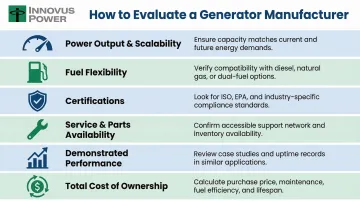
Key evaluation factors:
- Power output and scalability: kW/kVA range should align with both current and projected load requirements
- Fuel flexibility: System should accommodate diesel, natural gas, propane, bi-fuel, and future fuels like hydrogen
- Certifications: Look for ISO 8528, EPA Tier 4 Final, NFPA 110, and UL 2200 compliance for safety and regulatory adherence
- Service and parts availability: Technical support and replacement parts should be accessible within hours, not weeks
- Demonstrated performance: Proven results in demanding sectors — mining, remote operations, oil and gas — back up reliability claims
- Total cost of ownership: Upfront cost is only 20-30% of lifecycle expenses; fuel consumption, maintenance, and downtime costs dominate
The generator itself is only part of the equation. Integration capability — whether the system can be monitored, controlled, and optimized remotely — becomes critical for off-grid or multi-site operations where on-site technical staff are limited. Systems built to integrate with microgrid platforms can reduce fuel consumption by up to 80% while incorporating renewable energy sources like solar or wind.
Conclusion
Choosing the right generator manufacturer comes down to fit: your operational environment, load demands, and long-term energy strategy matter more than brand recognition alone. Caterpillar and Cummins lead in heavy industrial applications with extensive global support networks. Kohler-SDMO covers mission-critical, high-output facilities. Generac serves commercial and light industrial operations across North America. Taylor Power Systems handles custom-engineered solutions for demanding or non-standard applications.
Whichever manufacturer you shortlist, weigh these factors before committing:
- Scalability to accommodate future load growth
- Fuel flexibility to adapt to changing fuel availability and costs
- Total cost of ownership over the equipment's 20-30 year lifespan
- Post-installation support capabilities, including remote monitoring and on-call technical expertise
For operations where standalone generators are no longer enough — where fuel costs are climbing, renewable integration is a goal, or reliability demands have grown — a microgrid approach changes the equation. Innovus Power's GridGenius™ Microgrid Platform is vendor-agnostic, meaning it works alongside generator assets from Caterpillar, Cummins, Kohler, and others rather than replacing them. The platform has demonstrated up to 80% reductions in fuel consumption, covers power ranges from 250 kW to 200+ MW, and includes 24/7 remote monitoring and management worldwide.
Frequently Asked Questions
What generators are manufactured in the USA?
Prominent U.S.-based generator manufacturers include Generac (Wisconsin), Cummins (Indiana), Taylor Power Systems (Mississippi), and Caterpillar (Texas). Many global brands also maintain U.S. manufacturing or assembly facilities to serve the North American market and ensure faster parts availability.
What is the most reliable generator brand for heavy industrial use?
Caterpillar and Cummins are consistently cited for industrial reliability due to their broad power ranges, global parts availability, and proven track records in demanding sectors like mining and oil and gas. Both offer units designed for 20,000+ operating hours with extensive service networks.
What fuel types do commercial generators use?
Commercial generators primarily use diesel, natural gas, propane, and bi-fuel configurations. Fuel choice impacts operating cost, emissions, storage requirements, and availability in remote locations. Emerging options include hydrogen and Hydrotreated Vegetable Oil (HVO) for reduced emissions.
What is the difference between standby and prime power generators?
Standby generators are sized for emergency backup use, typically limited to 200 hours per year with intermittent operation. Prime power generators are designed for continuous or near-continuous operation as the primary power source, with unlimited annual hours. Remote sites and industrial operations requiring uninterrupted uptime must use prime-rated equipment.
How do I choose the right generator manufacturer for my industry?
Key selection factors include:
- Power output requirements (confirmed through load analysis)
- Fuel availability at your site
- Environmental conditions: temperature extremes, altitude, humidity
- Required certifications: EPA, NFPA, UL
- After-sales service reach and parts availability
- Compatibility with renewable or microgrid infrastructure
What power output range do industrial generators typically cover?
Industrial generators range from a few kilowatts for small commercial backup to over 5,700 kW for large-scale operations, with specialized systems exceeding this range. Sizing requires a capacity analysis that accounts for starting loads, future expansion, and redundancy requirements.