Introduction
When the power goes out, you're already dealing with enough — the last thing you need is a generator that burns through fuel and drowns out conversation. In 2022, U.S. electricity customers experienced an average of 5.5 hours of power interruptions, with weather events driving most of that downtime. With gasoline averaging $3.10 per gallon in 2025, fuel efficiency isn't a nice-to-have — it directly affects what backup power actually costs you.
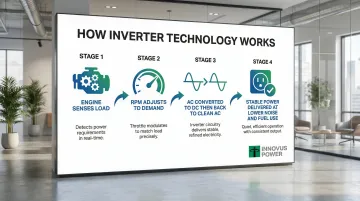
Traditional generators run at a fixed 3,600 RPM regardless of load, which is why they're noisy and inefficient. Inverter-based models throttle the engine to match actual demand — so when you're only running lights and a phone charger, the engine slows down, cutting both noise and fuel burn.
This guide covers the 5 best quiet fuel-efficient generators of 2025, what to look for when shopping, and how to match the right model to your needs.
TLDR
- Inverter generators combine quiet operation and fuel efficiency, making them ideal for home backup, camping, RVs, and sensitive electronics
- Top 5 picks: Honda EU2200i, Yamaha EF2000iSv2, Westinghouse iGen5000DFc, WEN 56200i, Champion 201050
- Noise levels below 60 dB and runtime of 8+ hours at 25% load are the benchmarks worth targeting
- Dual-fuel models (gas + propane) offer flexibility and longer fuel shelf life
- Match wattage to your actual load—undersizing or oversizing both hurt efficiency
What Makes a Generator Quiet and Fuel Efficient?
Inverter generators achieve quiet operation through variable throttle technology that adjusts engine speed to match actual load demand. Unlike traditional generators that run at a constant 3,600 RPM regardless of load, inverter models automatically slow down when powering lighter loads—cutting both noise and fuel consumption by up to 40%.
Understanding how this technology works helps narrow down which specs actually matter when comparing models.
Key Metrics to Compare
When evaluating generators, focus on two metrics:
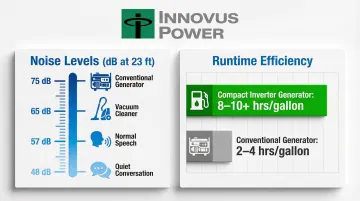
Noise Output (dB at 23 feet):
- 52 dB ≈ Quiet conversation
- 60 dB ≈ Normal speech
- 65 dB ≈ Vacuum cleaner
- Generators rated at or below 60 dB are considered "quiet" for residential and camping use
Fuel Consumption:
- Measured in runtime at 25% load (industry standard)
- Compact inverters: 8-10+ hours per gallon
- Conventional generators: 2-4 hours per gallon at similar loads
Clean Sine Wave Output
Inverter generators produce clean power with Total Harmonic Distortion (THD) below 3%, making them safe for sensitive electronics like laptops, medical equipment, and phones. This is achieved by converting AC power to DC, then inverting it back to stable AC, the same conversion process that makes variable-speed operation possible.
5 Best Quiet Fuel Efficient Generators for 2025
These five models were evaluated based on noise rating, fuel efficiency, wattage output, portability, and user reliability—covering a range of price points and use cases.
Honda EU2200i
The Honda EU2200i is one of the most widely cited inverter generators on the market, built on Honda's reputation for engine reliability and backed by an extensive dealer service network across North America.
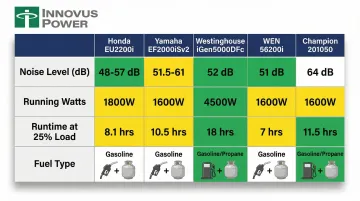
It runs at approximately 48–57 dB depending on load—comparable to normal conversation—while delivering up to 8.1 hours of runtime on a 0.95-gallon tank at 25% load. The Eco-Throttle system automatically adjusts fuel use to match demand.
| Spec | Detail |
|---|---|
| Running / Starting Watts | 1,800W / 2,200W |
| Noise Level | ~48–57 dB |
| Weight | 47.4 lbs |
| Fuel Type | Gasoline only |
| Runtime | Up to 8.1 hours at 25% load (0.95-gallon tank) |
| Key Features | Eco-Throttle, CO-Minder auto-shutoff, parallel capability, 3-year warranty |
Yamaha EF2000iSv2
Yamaha's EF2000iSv2 is a premium compact inverter generator known for exceptionally low noise and long-term reliability. It's especially popular among RV owners and campers who put a premium on quiet operation.
At approximately 51.5–61 dB, it ranks among the quietest in its class. The Smart Throttle system varies engine load to maximize fuel savings, delivering 10.5 hours of runtime at 25% load on 1.1 gallons—the best runtime-per-gallon in this roundup.
| Spec | Detail |
|---|---|
| Running / Starting Watts | 1,600W / 2,000W |
| Noise Level | ~51.5–61 dB |
| Weight | 44.1 lbs |
| Fuel Type | Gasoline |
| Runtime | 10.5 hours at 25% load (1.1-gallon tank) |
| Key Features | Smart Throttle, low oil shutoff, parallel capability, noise-block housing |
Westinghouse iGen5000DFc
Westinghouse's iGen5000DFc is a dual-fuel inverter generator offering more output power than compact models, designed for users who need to run multiple appliances or power a small home during an outage.
Dual-fuel capability (gasoline or propane) is the key differentiator here—propane runs slightly quieter and cleaner, and stores more reliably long-term. The unit operates as low as 52 dB and delivers 18 hours on gasoline or 22 hours on propane at 25% load.
| Spec | Detail |
|---|---|
| Running / Starting Watts | 3,900W / 5,000W (Gas); 3,500W / 4,500W (Propane) |
| Noise Level | As low as 52 dB |
| Weight | 105.8 lbs |
| Fuel Type | Gas or propane |
| Runtime | 18 hours (gas) / 22 hours (propane) at 25% load |
| Key Features | Dual-fuel, electric start, CO sensor with auto-shutoff, TT-30R RV outlet, remote start |
WEN 56200i
WEN's 56200i is a budget-friendly inverter generator that delivers reliable quiet operation for light-duty backup power, camping, and outdoor use—the most affordable inverter generator in this roundup.
It still hits noise levels around 51 dB despite the lower price point. Worth noting: it's gasoline-only and limited in output, so it's best suited to powering a few essentials rather than whole-home backup.
| Spec | Detail |
|---|---|
| Running / Starting Watts | 1,600W / 2,000W |
| Noise Level | ~51 dB |
| Weight | ~48 lbs |
| Fuel Type | Gasoline only |
| Runtime | ~6 hours at 50% load (1-gallon tank) |
| Key Features | Eco-mode throttle, parallel capability, lightweight design |
Champion 201050 4000W Dual Fuel Inverter
Champion's 201050 sits at 4,000W starting watts with dual-fuel capability and electric start—a practical combination for RV users, job sites, and extended home backup at a mid-range price.
At 64 dB, it's louder than the compact models above—but quieter than conventional open-frame generators at comparable wattage. On propane, it delivers 25 hours of runtime from a 20-lb tank at 25% load, making it one of the longer-running options in this class.
| Spec | Detail |
|---|---|
| Running / Starting Watts | 3,000W / 4,000W (Gas); 2,700W / 4,000W (Propane) |
| Noise Level | 64 dB at 23 feet |
| Weight | Under 55 lbs |
| Fuel Type | Gas or propane |
| Runtime | 10 hours (gas) / 25 hours (propane) at 25% load |
| Key Features | Dual-fuel, electric start, CO Shield auto-shutoff, RV-ready outlet, clean sine wave output |
How We Chose the Best Quiet Fuel Efficient Generators for 2025
We assessed models on four primary criteria:
- Noise output: dB rating at 23 feet under load
- Fuel efficiency: Runtime per gallon or per tank at 25% load
- Power output: Wattage relative to size and weight
- Reliability reputation: User feedback and brand track record
Common Buyer Mistakes
Two mistakes consistently cost buyers money and safety margin:
- Chasing peak wattage: Spec sheets highlight starting watts, but running wattage and real-world runtime determine actual operating costs. A generator with high peak watts but poor fuel economy will cost far more over time.
- Skipping CO safety features: Auto-shutoff for carbon monoxide is now standard on top-tier models. The CPSC has advanced rulemaking to mandate automatic CO shutoff systems — and for good reason.
Why Inverter Technology Matters
Safety features matter, but the technology driving the engine is what separates quiet, efficient generators from the rest. All five picks use inverter technology, which adjusts engine speed to match the actual power demand rather than running at a fixed RPM. That variable speed is what delivers quieter operation and better fuel economy at the same time. Conventional open-frame generators, regardless of brand, cannot match inverter models on either metric.
Conclusion
For most users in 2025, a quiet fuel-efficient generator means an inverter model. The Honda EU2200i and Yamaha EF2000iSv2 lead on noise and portability, while dual-fuel models like the Westinghouse iGen5000DFc and Champion 201050 offer better versatility for home backup and RV use.
Before purchasing, assess your actual wattage needs. Undersized generators strain under load, while oversized units waste fuel. Calculating running watts for essential appliances is a 10-minute exercise that prevents over- or under-buying.
For homeowners and campers, the five generators above handle most home backup, camping, and RV scenarios. That said, the same variable-speed efficiency principle behind inverter generators scales far beyond the consumer market. For remote communities, mining operations, commercial facilities, and similar applications, Innovus Power's GridGenius™ Microgrid Platform applies that logic at 250kW to 200+MW — delivering up to 80% reduction in fuel consumption where power costs and reliability carry much higher stakes.
Frequently Asked Questions
What is the most fuel-efficient generator on the market?
Inverter generators—particularly the Honda EU2200i and Yamaha EF2000iSv2—are the most fuel-efficient class due to variable-throttle technology that matches engine speed to load demand. They perform best at 25% load or lower, so running them near capacity burns fuel quickly and negates much of the efficiency advantage.
How long will a 20lb propane tank last running a generator?
A 20-lb propane tank holds approximately 4.7 gallons of liquid propane. Runtime depends on generator wattage and load. For example, the Champion 201050 runs 25 hours at 25% load on a 20-lb tank, while a 3,000–4,000W generator at 50% load typically runs 12–16 hours.
What will a 3000 watt generator run in a house?
A 3,000W generator can simultaneously power a refrigerator (~700W), several lights (~100W), phone chargers (~50W), and a window fan (~75W). It cannot support central AC, electric water heaters, or electric stoves—those appliances require 4,000W or more.
Are inverter generators quieter than conventional generators?
Inverter generators typically operate at 50–60 dB versus 65–75+ dB for conventional models—a meaningful difference in real-world use. Variable-speed engines run at lower RPMs under partial load, and enclosed housing further dampens sound.
How much fuel does a generator use per hour?
Fuel consumption varies widely by generator size and load. A compact inverter like the Honda EU2200i consumes approximately 0.12 gallons per hour at 25% load, while a larger conventional generator at full load can consume 0.5+ gallons per hour—a roughly 4x difference that adds up fast during extended outages.
What's the difference between running watts and starting watts on a generator?
Starting (or surge) watts are the brief extra power needed to start motors in appliances like refrigerators or AC units. Running watts are the sustained output. Size your generator based on the running watts of all devices you plan to use simultaneously, plus headroom for the highest starting surge.