Introduction
In 2026, industrial power generation has become mission-critical infrastructure. Data centers supporting AI workloads, remote mining operations, oil and gas facilities, and critical infrastructure all depend on reliable, high-capacity generator systems to maintain operations when grid power fails or where grid connection isn't possible.
According to the Uptime Institute, over 54% of significant data center outages now cost more than $100,000 — and one in five exceeds $1 million. For industrial operators, choosing the wrong generator manufacturer can translate directly into costly downtime and compliance failures.
Those failures don't stay isolated. Inflated operational costs from undersized, unreliable, or poorly supported equipment affect profitability for years.
This guide cuts through the options. It profiles the top five industrial generator manufacturers in 2026 — Caterpillar, Cummins, Kohler Power Systems, Wärtsilä, and MTU — evaluating each on power range, fuel flexibility, emissions compliance, and service network reach. We'll also cover the criteria that matter most for heavy-duty applications and how resilient operations are integrating these generators with intelligent microgrid controls.
Key Takeaways
- Industrial generators deliver continuous, high-load power (100 kW to 20+ MW) for mining, oil & gas, data centers, and remote infrastructure — well beyond consumer standby units
- Leading manufacturers include Caterpillar, Cummins, Kohler Power Systems, Wärtsilä, and MTU (Rolls-Royce Power Systems)
- Key selection criteria include fuel flexibility, emissions compliance (Tier 4 Final/Stage V), and microgrid integration capability
- The global industrial generator market is projected to reach USD 22.7 billion by 2030, driven by data center expansion and grid resilience needs
- Pairing generators with intelligent controls and renewables cuts fuel costs by up to 50%
Overview of Industrial Generators
Industrial generators are purpose-built for demanding, continuous-duty applications that consumer or portable units cannot handle. Unlike residential standby generators that run intermittently during outages, industrial units are engineered to deliver reliable power under sustained, high-load conditions.
Key Distinguishing Characteristics:
- Power Output Range: Typically 100 kW to 20+ MW for single units, with paralleling capability for even larger installations
- Duty Ratings: Prime-rated for unlimited runtime at variable loads, or continuous-rated for baseload power at 100% capacity
- Fuel Types: Diesel, natural gas, heavy fuel oil (HFO), LNG, dual-fuel, and emerging hydrogen blends
- Reliability Standards: Built to ISO 8528 specifications with redundancy, load acceptance, and transient response capabilities far exceeding commercial units
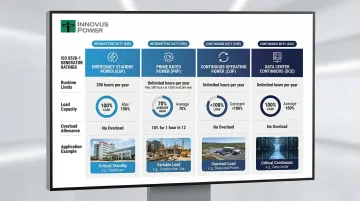
Rating Classifications (ISO 8528-1):
| Rating Type | Definition | Typical Application |
|---|---|---|
| Emergency Standby Power (ESP) | Max power for outage duration (max 200 hrs/year, avg 70% load, no overload) | Healthcare, life safety backup |
| Prime Rated Power (PRP) | Unlimited hours/year at variable load (avg 70% load, 10% overload for 1 hr/12) | Remote mining, industrial plants, rental fleets |
| Continuous Operating Power (COP) | Unlimited hours/year at constant 100% load, no overload permitted | Baseload power, cogeneration, pumping stations |
| Data Center Continuous (DCC) | Manufacturer-specific rating for unlimited hours at 100% load | Hyperscale data centers (Tier III/IV) |
Market Growth and Demand Drivers:
The global industrial generator market is projected to reach nearly USD 22.7 billion by 2030, growing at approximately 6% CAGR. The high-capacity segment (>2,000 kVA) is expanding even faster at 8.5% annually, driven primarily by hyperscale data center growth.
Several forces are reshaping industrial power demand in 2026:
- Data Center Expansion: Hyperscale facilities supporting AI and cloud computing require multi-megawatt backup systems with instant load acceptance
- Grid Instability: Extreme weather events have caused 1.2 billion outage hours in North America, making on-site generation essential for operational resilience
- Emissions Regulations: EPA Tier 4 Final, EU Stage V, and California's proposed Tier 5 standards are forcing replacement of older legacy assets with cleaner, compliant units
These pressures raise the stakes for choosing the right manufacturer — one with proven output ratings, certified compliance, broad service coverage, and documented deployments at scale. The five manufacturers profiled below meet those criteria across the full range of industrial applications.
Top Industrial Generator Manufacturers in 2026
The manufacturers below were evaluated on power output range, fuel flexibility, emissions certifications, industrial sector presence, global service infrastructure, and technological differentiation—not brand familiarity alone.
Caterpillar (CAT)
Caterpillar stands as one of the world's largest industrial power equipment manufacturers, with a generator portfolio spanning diesel, natural gas, and dual-fuel units serving mining, oil & gas, construction, and data center markets globally.
Why CAT Stands Out:
CAT's primary differentiator is its vertically integrated manufacturing approach—producing engines, alternators, and control systems in-house. This integration ensures seamless compatibility and consistent quality across the product line. The company maintains Tier 4 Final and EU Stage V compliance across its entire product range, with the Cat Clean Emissions Module (CEM) delivering regulatory compliance without sacrificing transient response.
The company's global dealer and service network spans over 1,800 dealer branch stores across 200 countries, providing parts availability and field support virtually anywhere. That reach is critical for multinational operators requiring standardized service protocols.
Technology Highlights:
- Cat Connect (VisionLink): Provides granular telematics tracking fuel burn, idle time, and health alerts to optimize fleet utilization
- Dual-Fuel Capability: Enables fuel cost optimization by switching between natural gas and diesel based on availability and pricing
- Advanced Energy Management: Integrates with microgrid controls for renewable energy coordination
| Spec | Details |
|---|---|
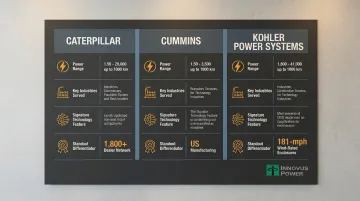
| Power Range | 6 kW to 5,720 kW (7,150 kVA) diesel; up to 16+ MW with paralleling |
| Key Industries | Mining, oil & gas, data centers, utilities, construction, emergency response |
| Notable Technology | Cat Connect remote monitoring, dual-fuel capability, Tier 4 Final compliance with CEM |
Cummins
Cummins competes on deep vertical integration and a comprehensive portfolio covering diesel, natural gas, and emerging battery-hybrid systems. With a broad presence in North America, Europe, and Asia-Pacific, Cummins serves industrial, healthcare, and telecom sectors with particular strength in the US market.
Cummins' Key Differentiators:
Cummins maintains significant US-based manufacturing operations, including key facilities in Fridley, Minnesota (power systems hub) and Jamestown, New York—answering the common question about US-manufactured generators. This domestic manufacturing footprint provides supply chain resilience and supports Buy America requirements for government and infrastructure projects.
The company's PowerCommand digital control system sets an industry benchmark for paralleling applications, offering integrated control for synchronizing, load sharing, and protection across multiple units.
In March 2025, Cummins celebrated completion of "Project Brunel," delivering a hydrogen internal combustion engine (H2-ICE) that achieves >99% reduction in tailpipe carbon emissions. For buyers weighing long-term fuel strategy, that signals a concrete path forward.
| Spec | Details |
|---|---|
| Power Range | 15 kVA to 3,750 kVA diesel; 55 kW to 2,000 kW natural gas; up to 3,500 kW with QSK95 series |
| Key Industries | Data centers, healthcare, telecom, commercial & industrial facilities, remote communities |
| Notable Technology | PowerCommand™ digital control, paralleling capability, hydrogen-blend fuel compatibility |
Kohler Power Systems
Kohler Power Systems offers a comprehensive industrial generator lineup covering diesel and natural gas units, widely deployed in critical facilities, commercial real estate, and utilities across North America and international markets.
The Case for Kohler:
Kohler's industrial manufacturing is centered in Mosel, Wisconsin, where a recent 155,000 sq. ft. expansion was completed specifically to support production of large generators exceeding 2,000 kW. This investment demonstrates Kohler's commitment to the high-capacity industrial segment.
The company's OnCue® Plus cloud-based platform enables facility managers to monitor multiple generator assets remotely, tracking performance parameters and routing data directly to service dealers for proactive maintenance.
Kohler is particularly noted for its factory-fitted, sound-attenuated enclosures (Level 1 and 2) that are UL 2200 listed and IBC certified, capable of withstanding 181-mph winds. For coastal and hurricane-prone facilities, that structural spec matters more than most catalog comparisons reveal.
| Spec | Details |
|---|---|
| Power Range | 15 kW to 4,000 kW across diesel and natural gas product families |
| Key Industries | Healthcare, data centers, utilities, commercial real estate, government/military facilities |
| Notable Technology | OnCue® generator management system, paralleling switchgear, weatherized industrial enclosures for harsh environments |
Wärtsilä
Wärtsilä operates at a different scale than traditional generator manufacturers, focusing on large-scale engine-based power plants, marine propulsion, and flexible generation solutions in the 1 MW to 100+ MW range. The Finnish power technology company specializes in high-capacity industrial installations and power utilities.
Where Wärtsilä Competes Differently:
Wärtsilä's emphasis on fuel flexibility distinguishes it from competitors. The company's engines support natural gas, LNG, heavy fuel oil (HFO), biofuels, and hydrogen blends, positioning them as a strong choice for energy transition projects. Their Wärtsilä 31SG gas engine delivers up to 11.8 MW of electrical power with market-leading efficiency, while the Wärtsilä 34DF dual-fuel engine provides 5.6 MW to 9.8 MW with instant fuel switching for maximum operational security.
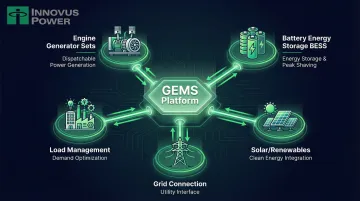
The company's GEMS (Grid and Energy Management System) platform optimizes entire microgrids, managing the interplay between engines, battery storage (BESS), and renewables to ensure grid stability while maximizing efficiency. This makes Wärtsilä particularly valuable for utility-scale projects integrating fossil generation with renewable energy sources.
| Spec | Details |
|---|---|
| Power Range | 1 MW to 100+ MW for engine-based power plants; individual units from 5.6 MW to 11.8 MW |
| Key Industries | Power utilities, oil & gas, marine auxiliary power, remote industrial sites, island/microgrid power systems |
| Notable Technology | GEMS energy management platform, multi-fuel engine capability, optimized part-load efficiency |
MTU (Rolls-Royce Power Systems)
MTU, the power systems brand of Rolls-Royce headquartered in Germany, is known for premium high-performance diesel and gas generator sets deployed in data centers, defense, marine, rail auxiliary, and critical industrial applications worldwide.
MTU's Advantage in Mission-Critical Applications:
MTU's Series 4000 engines cover 1,125 kWe to 3,250 kWe (60 Hz) and accept 100% block load in a single step, a concrete requirement for data centers and hospitals where instantaneous load acceptance prevents power quality issues. MTU engineers these engines to exceed ISO 8528-5 G3 performance classes, with EPA Tier 4 Final certification standard across the range.
MTU gensets also carry industry-leading load factors up to 85% for standby ratings, meaning more usable power than standard ratings typically show. The MTU OnSite Energy platform adds remote diagnostics and predictive maintenance, reducing unplanned downtime and extending service intervals. Purpose-built configurations cover military, arctic, and offshore deployments where standard commercial specs fall short.
| Spec | Details |
|---|---|
| Power Range | 680 kWe to 1,250 kWe (Series 2000); 1,125 kWe to 3,250 kWe (Series 4000) |
| Key Industries | Data centers, defense & military, oil & gas, marine auxiliary, rail, critical infrastructure |
| Notable Technology | MTU Series 4000 engine platform, OnSite Energy remote monitoring, high power density design for space-constrained installations |
How We Chose the Best Industrial Generator Manufacturers
The manufacturers profiled here were assessed on criteria that directly impact long-term operational success — not brand recognition or sticker price alone.
Evaluation Framework:
- Industrial Power Output Range: Capability to deliver from hundreds of kilowatts to multiple megawatts in single or paralleled configurations
- Fuel Type Flexibility: Support for diesel, natural gas, dual-fuel, and emerging alternatives like hydrogen blends
- Emissions Certification Status: Compliance with EPA Tier 4 Final, EU Stage V, and IMO standards where relevant
- Global Service Network Density: Parts availability and field service response times in remote locations
- Proven Mission-Critical Deployments: Track record in data centers, mining, oil & gas, and critical infrastructure
- Technology Roadmap: Investment in lower-emission and hybrid-ready systems aligned with 2026+ regulatory environment
Common Procurement Mistakes:
Industrial operators frequently select generators on unit price or brand familiarity, overlooking total cost of ownership factors with far greater financial impact:
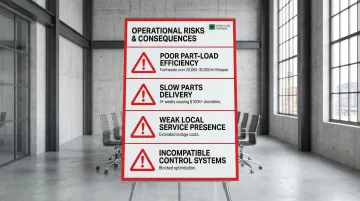
- Poor part-load fuel efficiency compounds into significant waste over a generator's 20,000–30,000+ hour service life — most units rarely run at full capacity.
- Slow parts delivery (three weeks or more) creates extended downtime that far outweighs any upfront savings, especially in mining, oil & gas, and remote infrastructure.
- Weak local service presence drives up downtime costs that can exceed $100,000 per incident when a critical unit fails.
- Poor control system compatibility isolates generators from building management systems, SCADA, and energy management platforms, blocking operational optimization.
The Microgrid Integration Factor:
With emissions regulations tightening and fuel costs climbing in 2026, a manufacturer's ability to support hybrid and microgrid-integrated deployments has become a defining selection criterion. The most resilient operations pair generator systems with solar, battery energy storage systems (BESS), and intelligent energy management platforms — achieving fuel consumption reductions up to 83%, as shown in documented Cummins microgrid case studies.
Companies like Innovus Power bring 30+ years of vendor-agnostic microgrid expertise, integrating generators from any of these manufacturers with renewables, storage, and intelligent control through their proprietary GridGenius platform. The result is the lowest levelized cost of energy and maximum uptime: outcomes that generator manufacturers, focused on hardware alone, are not positioned to deliver.
Conclusion
The five manufacturers profiled—Caterpillar, Cummins, Kohler Power Systems, Wärtsilä, and MTU—each lead in specific industrial contexts. The right choice depends on power scale, fuel infrastructure, sector requirements, and operational environment, not brand preference alone.
Each manufacturer has a clear strength profile:
- Caterpillar — global service network for multinational operations needing standardized support
- Cummins — US manufacturing footprint and hydrogen readiness for domestic sustainability goals
- Kohler — weatherized enclosures built for harsh coastal and arctic environments
- Wärtsilä — multi-megawatt output for utility-scale and large industrial installations
- MTU — high power density and rapid load acceptance for data centers and defense applications
Before finalizing any procurement decision, assess long-term total cost of ownership across four dimensions:
- Fuel efficiency at partial loads
- Service costs in your specific operating locations
- Scalability for future capacity needs
- Emissions compliance trajectory
The lowest purchase price rarely delivers the lowest lifecycle cost.
If your requirements extend beyond a single generator to a complete power system, Innovus Power has spent over 30 years designing vendor-agnostic microgrids for exactly these sectors. We integrate generators from any of these manufacturers with renewables, storage, and GridGenius control to deliver the lowest levelized cost of energy and maximum uptime for your critical operations.
Frequently Asked Questions
What are the top 5 generator brands?
The leading industrial generator brands in 2026 are Caterpillar, Cummins, Kohler Power Systems, Wärtsilä, and MTU (Rolls-Royce Power Systems). The best fit depends on your application, power scale, and regional service coverage—so treat this list as a starting point, not a final answer.
What generators are manufactured in the USA?
Cummins operates US facilities in Fridley, Minnesota and Jamestown, New York; Kohler's industrial production is centered in Mosel, Wisconsin; and Caterpillar produces generator sets at several US locations. Given global supply chains, verify "US-manufactured" status for the specific product line you're evaluating.
What is the difference between a standby and prime-rated industrial generator?
Standby-rated generators (Emergency Standby Power/ESP) are designed for limited hours of emergency use—typically maximum 200 hours per year with no sustained overload capability. Prime-rated generators (Prime Rated Power/PRP) are built for continuous operation as a primary power source with unlimited run hours at variable load, carrying a 10% overload capability for 1 hour every 12 hours.
What fuel types do industrial generators use?
Industrial generators support diesel, natural gas, LNG, heavy fuel oil (HFO), dual-fuel (gas/diesel), and emerging hydrogen-blend options. Diesel delivers the highest energy density and simplest storage; natural gas offers cleaner emissions and lower fuel costs where pipeline access exists. Fuel choice ultimately drives emissions compliance, operating cost, and site logistics.
What certifications should I look for in an industrial generator manufacturer?
Key certifications include EPA Tier 4 Final (USA) for emissions, EU Stage V (Europe), ISO 8528 (generator set performance standards), and CSA/UL certifications for electrical safety. Sector-specific requirements like IMO (marine), MIL-SPEC (defense), and UL 2200 (stationary emergency power) also apply in specialized deployments.
How long do industrial generators typically last?
Well-maintained industrial generators from leading manufacturers typically achieve 20,000–30,000+ operating hours of service life. In standby applications with limited annual runtime, this can translate to 20-25 years of service. Runtime hours, load profile, maintenance schedule adherence, and operating environment are the primary factors determining longevity.