Introduction
For mining sites, remote facilities, hospitals, and data centers, a generator failure doesn't just cause inconvenience — it halts production, risks lives, and triggers financial losses. Unplanned downtime costs U.S. manufacturers approximately $1.7 million per hour, while data center outages frequently exceed $1 million per incident, with 60% of failures resulting in at least $100,000 in total losses.
Choosing the right industrial generator goes well beyond selecting the highest kW output. Each of these factors shapes the final decision:
- Fuel type and emissions compliance for your site and regulatory environment
- Application type — standby, prime, or continuous power duty cycle
- Load profile — peak demand, average load, and load variability over time
- Total cost of ownership across 20-30 years of operation
A standby-rated unit deployed in a prime power role will shorten engine life and void warranties. An oversized unit running at 30% load burns fuel inefficiently for decades.
This guide walks through the leading industrial generator manufacturers and the evaluation criteria that matter most for your specific application. By the end, you'll have a clear framework for a purchase decision that affects your facility's power costs and reliability for decades.
Key Takeaways
- Industrial generators are heavy-duty power systems rated for standby, prime, or continuous use, typically starting at 100 kW and scaling to multiple megawatts
- Top manufacturers — Caterpillar, Cummins, Kohler, MTU, and Generac — each have distinct strengths in power range, fuel options, and target applications
- Size for peak demand (motors draw 5x rated current at startup), verify EPA Tier 4 Final compliance, and model total cost of ownership — not just purchase price
- Off-grid and remote deployments (mining, military, communities) gain measurable fuel savings and resilience from hybrid microgrid integration
- Evaluate beyond upfront price — fuel efficiency at partial load, service network depth, and scalability drive real long-term cost
What Makes a Generator Truly "Industrial"?
An industrial generator is a high-capacity power generation system designed for continuous or near-continuous operation in demanding commercial, manufacturing, utility, and infrastructure environments. These units start at 100 kW and can exceed 3 MW, distinguishing them from residential or light commercial models.
The Three Core Operational Classifications
Understanding the difference between Standby, Prime, and Continuous ratings is critical. Misclassifying the application is one of the most costly mistakes buyers make.
| Rating Type | Typical Use Case | Key Constraint |
|---|---|---|
| Standby | Emergency backup during outages | No overload capability; not for continuous use |
| Prime | Primary power in off-grid or unreliable grid environments | 10% overload allowed for 1 hr per 12 hrs of operation |
| Continuous | Non-stop base-load operations (24/7/365) | Unit is derated; designed for uninterrupted runtime |
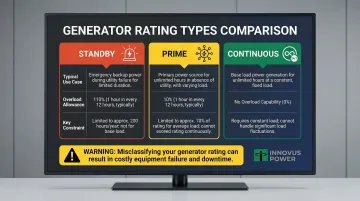
Critical distinction: A 500 kW Standby generator cannot sustain 500 kW continuously without risking engine failure or voiding warranties. Always match the rating to your actual application.
Market Size and Growth
These classifications matter at scale. The global generator market reflects surging demand across all three categories:
- Valued at approximately $25.31 billion in 2025
- Projected to reach $33.45 billion by 2030 (CAGR of 5.7%)
- Data center growth is fueling demand in the >3,500 kW segment
- Asia-Pacific commands a 40% market share (2024)
Best Industrial Generators: Top 5 Manufacturers
These five manufacturers represent the most widely deployed, technically proven, and broadly supported industrial generator platforms across North American and global markets — selected based on power range, engineering depth, industry adoption, and service infrastructure.
Caterpillar (CAT)
Caterpillar Inc. is one of the most recognized names in heavy industrial power. Their generator sets run across data centers, construction, oil and gas, healthcare, and military applications, with diesel and gas models ranging from 6 to 5,720 ekW.
CAT's industrial strength lies in its Cat Connect remote monitoring system, which provides real-time data on fuel levels, battery voltage, and run status. Their rugged enclosure options are built for extreme environments, and their global dealer network delivers parts and service in virtually every major market — making CAT a strong fit for mission-critical operations.
| Criteria | Details |
|---|---|
| Power Output Range | 6 – 5,720 ekW |
| Fuel Types Available | Diesel, Natural Gas, Biogas, Hydrogen Blend |
| Best For | Data centers, oil and gas, construction, healthcare, defense |
Cummins
Cummins is a global engine and power leader with a generator portfolio spanning diesel, natural gas, propane, and alternative fuel options — from compact commercial units to high-output systems exceeding 3,750 kVA (3 MW), widely used in manufacturing, utilities, and critical facilities.
Their PowerCommand digital control platform integrates voltage regulation, engine protection, and amp sensing into a single microprocessor. The QSK engine series delivers high horsepower with competitive fuel efficiency, backed by a global service network and modular scalability for large sites.
| Criteria | Details |
|---|---|
| Power Output Range | 15 – 3,750 kVA (QSK Series) |
| Fuel Types Available | Diesel, Natural Gas, Propane, Alternative Fuels |
| Best For | Manufacturing, utilities, data centers, hospitals, prime power in off-grid regions |
Kohler (Rehlko)
Formerly Kohler Power Systems, now operating as Rehlko, this manufacturer offers industrial generator sets from 10 kW to 4 MW — with a focus on power quality, low harmonic distortion, and performance in noise-sensitive or environmentally regulated environments.
Their industrial line features corrosion-resistant enclosures, advanced automatic transfer switch integration, and compliance with stringent emissions standards. Kohler is explicitly approved for Hydrotreated Vegetable Oil (HVO) and Renewable Diesel (RD), making them well-suited for healthcare, commercial real estate, and mid-size industrial operations that need clean, consistent power.
| Criteria | Details |
|---|---|
| Power Output Range | 10 kW – 4 MW |
| Fuel Types Available | Diesel, Natural Gas, HVO/Renewable Diesel |
| Best For | Healthcare facilities, commercial real estate, noise-sensitive industrial sites |
MTU (Rolls-Royce Solutions)
MTU, operating under Rolls-Royce Solutions, produces diesel and gas generator sets engineered for demanding, high-load continuous-duty applications — including its Series 2000 and Series 4000 platforms used in power plants, mining, maritime, and data center industries.
MTU stands apart through high power density, extended service intervals, and CHP (combined heat and power) capability in gas variants. The Series 4000 natural gas generators carry a Time Between Overhaul (TBO) of 84,000 hours. That longevity makes MTU the go-to option for large-scale industrial customers where maximum output and energy efficiency at full load are the top priorities.
| Criteria | Details |
|---|---|
| Power Output Range | 1,125 – 3,250 kWe (Series 4000) |
| Fuel Types Available | Diesel, Natural Gas, Hydrogen Blend |
| Best For | Power plants, mining, maritime, data centers, large-scale manufacturing |
Generac Industrial
While Generac is best known for residential and light commercial generators, its industrial division offers generator sets and modular power systems (MPS) ranging into the megawatt range — designed for scalable, redundant power across commercial and industrial facilities.
Generac's Modular Power System (MPS) allows facilities to combine multiple units (e.g., 100 kW – 500 kW) for redundancy and scalability without investing in a single large-capacity unit. This architecture delivers up to 99.999% reliability through redundancy — if one unit fails, the others continue to run. That said, Generac is less prevalent in heavy industrial or remote site applications compared to CAT or Cummins.
| Criteria | Details |
|---|---|
| Power Output Range | 35 kW – 3.5 MW (MPS configurations) |
| Fuel Types Available | Diesel, Natural Gas, Propane, Bi-Fuel |
| Best For | Commercial facilities, scalable backup power, light to medium industrial applications |
Key Buying Criteria for Industrial Generators
Power Output Sizing: The Most Dangerous Mistake
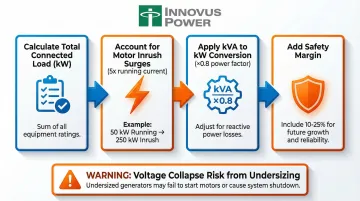
Undersizing is the most common and dangerous mistake in industrial generator selection. Facilities must calculate total connected load (kW), account for motor starting surges (which can be 5x running current), and apply a safety margin.
kW vs. kVA distinction: Industrial generators are typically rated in kVA at a 0.8 power factor. To find the real power (kW) available, multiply the kVA by 0.8. For example, a 100 kVA generator provides 80 kW of real power.
Motor inrush is critical. A 50 kW motor can draw 250 kW during startup. If your generator isn't sized for this transient surge, you'll experience voltage collapse, equipment damage, and nuisance shutdowns.
Fuel Type and Availability
Diesel: High energy density, easy storage, proven at extreme temperatures, higher emissions. Typical lifespan: 20,000 to 30,000 operating hours.
Natural Gas: Cleaner, lower operating cost, requires pipeline access. MTU's gas generators offer 84,000 hours before major overhaul.
Bi-Fuel and Propane: Flexibility for sites with intermittent gas supply or fuel storage constraints.
Tie the choice to site logistics: Can you store 10,000 gallons of diesel? Is there a natural gas pipeline within 500 feet? Are you subject to air quality regulations that penalize diesel?
Emissions Compliance and Certifications
EPA Tier 4 Final: Stationary compression-ignition (diesel) engines must meet Tier 4 Final emission standards, which strictly limit NOx and Particulate Matter (PM).
Emergency vs. Non-Emergency: Under NESHAP and NSPS rules, "emergency" engines have relaxed requirements but are strictly limited in non-emergency run time (typically 100 hours/year for maintenance/testing).
UL 2200: This standard covers stationary engine generator assemblies rated 600 volts or less. A UL 2200 listing verifies the safety of the entire assembly, including the engine, alternator, and controls, and is often required by electrical inspectors.
Choosing a non-compliant unit can result in regulatory fines and installation rejections.
Total Cost of Ownership (TCO) vs. Sticker Price
The purchase price typically represents a fraction of lifetime costs. Fuel consumption at varying load levels is critical — a generator rated at peak efficiency at full load may be significantly less efficient at 50–75% load, which is the typical real-world operating range.
Partial load efficiency example: A 230 kW gas generator consumes 3,000 scfh at 100% load but only 1,560 scfh at 50% load. If your facility operates at 50% load 80% of the time, your fuel costs will be dramatically different than the manufacturer's full-load spec sheet suggests.
TCO factors:
- Fuel consumption at actual operating load (not just nameplate rating)
- Maintenance intervals and parts availability
- Downtime costs (how much does an hour of outage cost your operation?)
- Service network depth (can a technician reach your site in 4 hours or 4 days?)
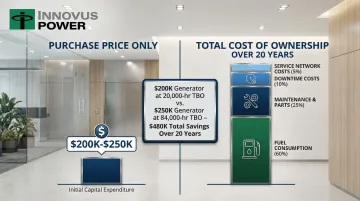
MTU's extended service intervals (84,000 hours TBO) can significantly reduce the maintenance portion of TCO compared to units requiring major overhauls every 20,000 hours.
Microgrid and Hybrid Integration Readiness
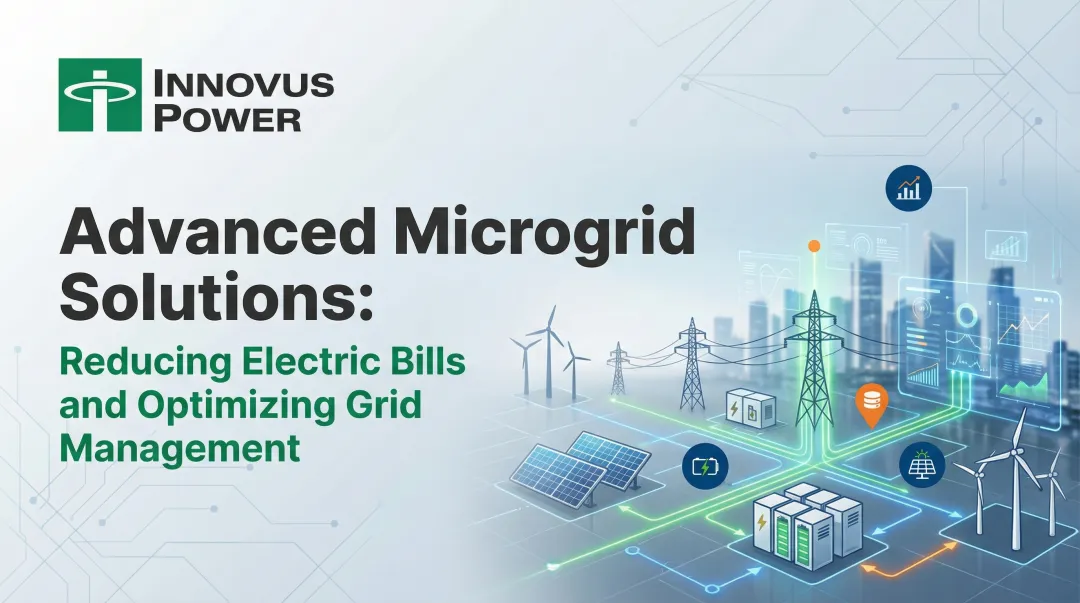
That TCO calculation changes substantially when generators operate within a hybrid microgrid. Mining, oil and gas, military, and remote community operations are increasingly pairing generators with solar, wind, and battery storage to cut fuel costs and emissions at the same time.
Advanced energy management systems can optimize generator dispatch automatically, enabling up to **80% fuel cost reduction** and 90–100% renewable penetration without curtailment. Innovus Power's GridGenius platform, for example, integrates with engine OEMs including Caterpillar, Cummins, MTU/Rolls Royce, and Volvo Penta, using power electronics and control software to decouple power generation from engine speed constraints.
Key capabilities this approach unlocks:
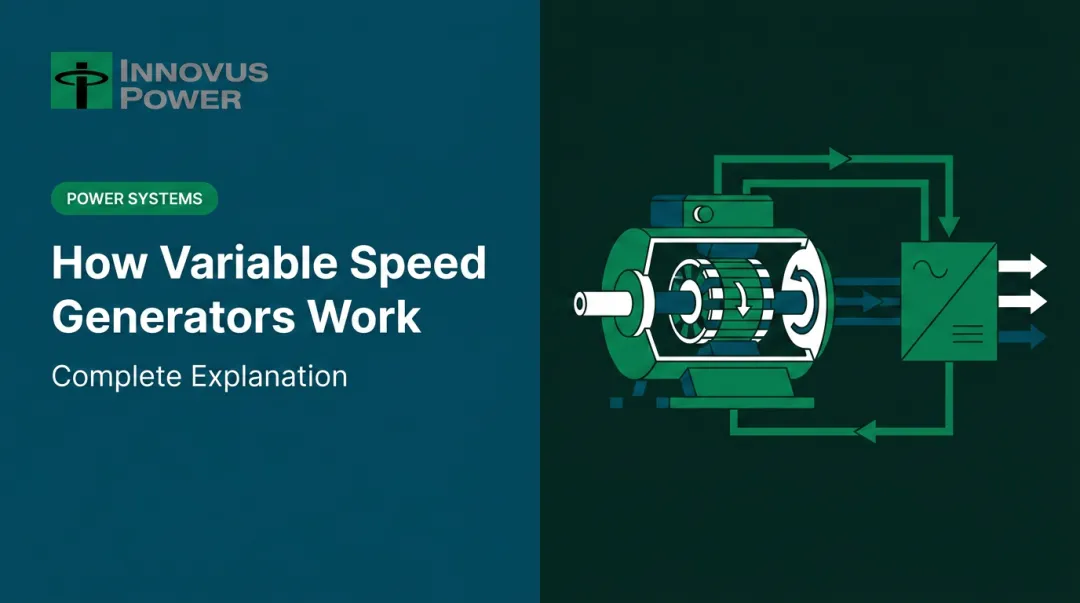
- Generators operate at variable speeds matched to real-time load demand, delivering up to 50% superior efficiency across all load levels
- Solar, wind, battery storage, and backup generators coordinate as a unified system
- Fossil fuel generation reduces automatically when renewable energy is available, without compromising power quality or grid stability
For operations where fuel logistics drive costs, this framing matters: the generator is no longer a standalone backup asset — it's one dispatchable resource within a system designed around the lowest levelized cost of energy (LCOE).
How We Chose the Best Industrial Generator Brands
Evaluation Approach
This list prioritizes manufacturers with demonstrated performance across heavy industrial applications — evaluated on power range breadth, fuel flexibility, emissions compliance, global service infrastructure, and real-world deployment track record in sectors like mining, oil and gas, healthcare, and utilities.
Common Buyer Mistakes to Avoid
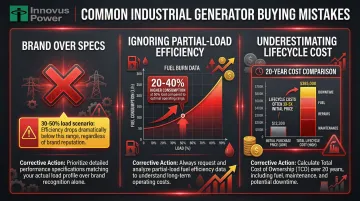
Choosing on brand reputation without matching specs to your load profile. A well-known nameplate doesn't guarantee efficiency at your actual operating conditions. If your facility runs at 30–50% load most of the time, partial-load fuel consumption matters far more than peak power ratings — and most spec sheets bury that data.
Ignoring partial-load fuel efficiency. Generators are typically most efficient near full load. At 50% load, real-world fuel burn per kWh can be 20–40% higher than the headline figure suggests. Always request the fuel consumption curve, not just the peak spec.
Underestimating total lifecycle cost. A $200,000 generator with a 20,000-hour service interval will cost more over 20 years than a $250,000 unit rated for 84,000 hours. Factor in parts, labor, and planned downtime — not just the purchase price.
What This List Does Not Cover
This guide focuses on leading North American market brands. There are additional reputable manufacturers — Perkins, Volvo Penta, Scania, John Deere, Doosan — that serve specific regional or application niches and may be worth evaluating depending on site location and fuel availability.
Conclusion
Choosing the best industrial generator is not a brand decision — it is an engineering and operational decision. The right unit depends on load profile, application type, fuel infrastructure, emissions requirements, and long-term TCO. Treat the selection process as a systems-level investment, not a commodity purchase.
For operations where a standalone generator is not enough — remote communities, mining sites, military installations, Arctic locations, or any facility seeking to eliminate or dramatically reduce fossil fuel dependency — an intelligent microgrid solution integrates generator assets with renewable energy sources under a unified control platform.
Innovus Power's GridGenius microgrid platform optimizes generator performance within a unified system designed for the lowest levelized cost of energy (LCOE), achieving up to 90%+ renewable penetration without curtailment while maintaining utility-grade power quality. Systems scale from 250 kW to 200+ MW, with documented deployments delivering 20–80% fuel savings across:
- Canadian Arctic remote communities
- Industrial manufacturing facilities
- Caribbean agricultural processing operations
Contact Innovus Power to model how GridGenius integration performs against your current fuel costs, load profile, and renewable targets.
Frequently Asked Questions
What is the difference between standby, prime, and continuous power ratings for industrial generators?
Standby is for emergency use only (highest kW rating, no overload allowed). Prime is for variable load, frequent operation as a primary source (10% overload for 1 hour per 12 hours). Continuous is for constant base-load operation at derated output. Using a standby-rated unit in a prime power role will shorten engine life and void warranties.
What size generator does an industrial facility typically need?
Sizing is determined by total facility load (kW), motor starting surge factors (typically 5x running current), and a recommended safety margin. A formal load analysis is essential — estimating leads to undersizing or expensive oversizing. Work with a qualified engineer before committing to a unit size.
Diesel or natural gas: which fuel is better for industrial generators?
Diesel offers energy density, cold-weather reliability, and no pipeline dependency. Natural gas provides lower emissions, reduced fuel cost, and continuous supply via pipeline. The right choice depends on fuel availability, storage feasibility, and environmental regulations at the site. Lifespan varies significantly between fuel types — a key factor when calculating total cost of ownership.
What EPA emissions standards apply to industrial generators in the United States?
EPA Tier 4 Final is the current standard for stationary compression-ignition (diesel) engines. NESHAP rules distinguish between "emergency" engines (limited to 100 hours/year non-emergency operation) and non-emergency engines with stricter emission requirements. UL 2200 listing is required for safety compliance and insurance approval.
How can industrial generators be integrated with renewable energy systems?
Hybrid microgrid configurations allow generators to operate alongside solar, wind, and battery storage, coordinated through an energy management system to reduce fuel consumption and runtime while maintaining power reliability. Platforms like Innovus Power's GridGenius enable up to 90+% renewable penetration without curtailment, using power electronics to decouple generation from engine speed constraints.
What is the typical lifespan of an industrial generator, and what affects it most?
Diesel generators typically last 20,000 to 30,000 operating hours; natural gas units can reach 84,000 hours (MTU Series 4000). Key factors affecting longevity include load profile management (avoiding chronic overloading or underloading), maintenance adherence, cooling system health, and whether the unit is operated within its rated capacity.