Introduction
The case for off-grid power has never been stronger. According to U.S. Energy Information Administration data, commercial electricity prices jumped 6.8% and industrial rates 7.5% between November 2024 and November 2025. Meanwhile, the average duration of U.S. power outages has more than doubled over the past decade. For remote communities, industrial operators, resorts, and military installations, waiting for the grid is no longer viable.
A complete off-grid power solution goes far beyond a solar panel on a roof. These are fully integrated systems that generate, store, manage, and deliver reliable electricity with no connection to the central grid — eliminating utility bills, forced outages, and dependence on aging infrastructure.
This guide covers the primary off-grid generation technologies, critical system components, how to match solutions to operational requirements across industries, and the role intelligent energy management plays in reducing fuel consumption and long-term costs.
Key Takeaways
- Off-grid systems generate, store, and manage all electricity on-site, cutting utility bills and ending dependence on the grid
- Primary power sources include solar PV, wind, micro-hydro, and dispatchable backup generators, each suited to different site conditions
- Systems reaching 90–100% renewable penetration pair multiple sources with battery storage and intelligent dispatch control
- Upfront investment is significant, but fuel and power cost reductions can reach 80%
- Intelligent microgrid control systems maximize renewable use, ensure reliability, and enable remote management
Core Off-Grid Power Technologies Explained
No single technology delivers a complete off-grid solution on its own. Understanding the strengths and limitations of each source is the first step to designing a resilient system.
Solar Photovoltaic (PV)
Solar PV converts sunlight to DC electricity through the photovoltaic effect. It's the most widely deployed off-grid source for good reason: costs have plummeted. Between 2010 and 2024, the global weighted-average LCOE for solar PV fell by 90% to $0.043/kWh, while crystalline silicon module costs dropped by 97%.
Solar scales from kilowatts to megawatts, making it adaptable to everything from remote telecom towers to multi-MW industrial mining operations. It generates nothing at night and significantly less during cloudy periods, making storage or backup essential.
Wind Power
Wind turbines convert kinetic energy to electricity and make sense in high-wind coastal, elevated, or open terrain. They provide critical diversity in energy mixes, particularly in high-latitude regions where solar irradiance is low during winter months.
Wind often operates at night and during stormy weather when solar output is low, reducing required battery capacity and backup generator runtime. Properly sized wind/solar hybrid systems can reduce diesel fuel consumption by 70-90%.
Wind is unpredictable, however, and cannot serve as a sole reliable source without storage or hybrid backup.
Micro-Hydro Power
Micro-hydro is the most consistent renewable option when a site has flowing water. These systems, typically generating up to 100 kilowatts, can operate continuously 24/7, independent of weather. They offer high capacity factors and availability rates, making them often the most cost-effective renewable technology in suitable locations.
The major constraint is site specificity — micro-hydro is only viable where adequate water flow exists year-round.
Battery Energy Storage
Battery storage — primarily lithium-ion chemistries today — is the essential bridge technology that turns intermittent renewables into a firm, dispatchable power source. Batteries store surplus daytime solar or wind energy for use during nights, cloudy days, or calm wind periods.
Utility-scale lithium-ion battery system costs could reduce by 21% to 67% by 2050 relative to 2022 costs, making 24/7 renewable power increasingly economical. Storage capacity must be carefully sized against load demand and required days of autonomy.
Advanced inverters allow batteries to act as the grid-forming asset, maintaining voltage and frequency stability without a diesel generator running.
Dispatchable Backup Generation
Dispatchable generators — diesel, propane, natural gas, and emerging hydrogen-fueled — serve as the "firm power" backstop when renewables and storage alone cannot meet demand. They're particularly critical for extended adverse weather or high-load events.
In remote Alaskan communities, fuel can cost $9.11/gallon for utilities and reach $16.14/gallon for residential heating. Modern variable-speed generators deliver up to 50% better fuel efficiency than traditional fixed-speed diesel units across all load levels.
In a well-integrated system, dispatchable generation runs only when renewables and storage cannot cover demand — shifting from primary power source to occasional backup.
Building a Complete Off-Grid System: Key Components
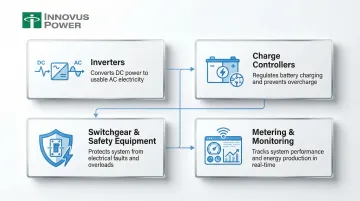
Generation sources produce the power — but "balance-of-system" (BOS) equipment is what makes that power usable. These components condition, convert, and safely deliver electricity throughout the system:
Critical BOS Components:
- Inverters — Convert DC output from solar panels and batteries into AC power for standard equipment and appliances
- Charge controllers — Regulate the rate of battery charging to prevent overcharge, overheating, and premature degradation
- Switchgear and safety equipment — Isolate faults, protect personnel, and keep the system compliant with electrical codes
- Metering and monitoring — Track generation, consumption, and storage in real time to enable ongoing optimization
System Sizing: The Foundation of Performance
Get the sizing wrong in either direction and you pay for it — either through chronic power shortfalls and generator overuse, or through unnecessary capital tied up in capacity you don't need. Proper load profiling — documenting peak demand, average daily consumption, and seasonal variation — is what anchors any accurate system design.
Tools like NREL's REopt determine the least-cost mix of technologies based on hourly load profiles and resource availability. Systems are often sized to meet critical loads during specific outage durations rather than just economic optimization.
Design for Resilience and Growth
A well-designed off-grid system anticipates change — in load growth, budget, and available technology. Building modularity into the architecture from the start means the system can grow without being scrapped and replaced.
Key design features that support long-term resilience include:
- Modular generation and storage — Add capacity incrementally as needs or budgets evolve
- Automatic paralleling — Bring additional units online without a complete system redesign
- Scalable control architecture — Energy management software that can handle expanding assets without reconfiguration
Choosing the Right Off-Grid Power Solution for Your Needs
The best power combination for a remote Arctic mining operation looks nothing like the right solution for a tropical resort island or a rural agricultural facility.
Key Variables in System Design
Geographic location determines available resources:
- Solar irradiance levels
- Wind resource quality and consistency
- Hydro availability and seasonal flow patterns
Load profile and power quality requirements shape technology priorities:
- Peak demand vs. average consumption
- Variability and transient loads
- Voltage and frequency stability needs
Reliability standards vary by application:
- Mission-critical facilities (military, medical, data centers) require firm, dispatchable backup
- Commercial operations balance uptime with cost optimization
- Remote communities prioritize long-term fuel cost reduction
Technology Priorities by Use Case
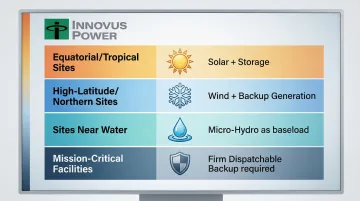
The right technology mix depends on where you are and what you're running:
- Equatorial/tropical sites lean on solar + storage — consistent year-round irradiance makes this the natural fit
- Northern or high-latitude sites benefit from wind and backup generation when winter solar output drops
- Sites near streams or rivers can use micro-hydro as baseload, reducing or eliminating the need for dispatchable generation
- Mission-critical facilities require firm, dispatchable backup regardless of renewable mix
The Reliability vs. Renewable Penetration Trade-Off
Some operators prioritize maximum uptime above all else and thus rely more heavily on dispatchable generation. Others prioritize minimum carbon emissions and fuel cost, sizing storage and renewables to cover the vast majority of load.
Advanced hybrid systems can economically displace approximately 80% of diesel fuel consumption. Beyond this threshold, the cost to displace the last 20% of fuel increases significantly due to the need for massive energy storage to cover long periods of low renewable resource.
The Value of Vendor-Agnostic Design
A designer or partner with no commercial bias toward any particular manufacturer will recommend the optimal combination based purely on performance and cost — not inventory or supplier relationships.
Innovus Power's vendor-agnostic design methodology applies expertise across solar, wind, hydro, stored energy, and dispatchable generation to deliver the lowest levelized cost of energy for each unique situation.
Validated Modeling Before Commitment
Insist on validated modeling and simulation before committing to a design. Accurate energy simulation tools predict annual performance, fuel consumption, and cost across a range of operating scenarios — catching expensive design errors before they reach the field.
Done right, upfront design work has saved customers up to 25% on total capital costs and 20% on long-term energy costs.
Intelligent Microgrid Control: The Brain Behind Reliable Off-Grid Power
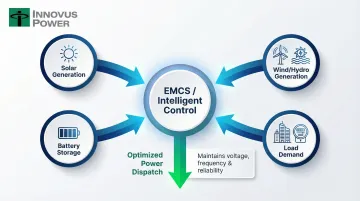
An Energy Management Control System (EMCS) continuously monitors all generation sources, storage state, and load demand in real time. It automatically dispatches the right combination of resources to meet demand at minimum cost and maximum reliability.
Without intelligent control, even a well-designed off-grid system with multiple generation sources will operate inefficiently — wasting fuel, over-stressing batteries, or curtailing valuable renewable energy.
Enabling High Renewable Penetration
Advanced microgrid control enables renewable energy penetration up to 90-100% without curtailment. The control system manages the frequency and voltage stability that traditionally required spinning diesel generation, allowing much greater renewable dispatch while maintaining utility-grade power quality.
The system operates through power electronics and control software rather than traditional engine-controlled systems. This approach decouples power control from fossil generation, making renewable energy sources the primary power providers.
Remote Monitoring and Management
For remote sites — Arctic installations, island resorts, offshore facilities — the ability to diagnose and optimize system performance without dispatching on-site technicians dramatically reduces operational costs and improves uptime.
Innovus Power's proprietary GridGenius EMCS is a purpose-built intelligent control platform designed for exactly this challenge. It delivers:
- 24/7 worldwide remote monitoring and management
- PowerView software for single-site installations
- FleetGenius software for customers managing multiple systems
- Continuous performance optimization without on-site visits
Future-Proofing Your Investment
Intelligent control also future-proofs the investment. As load profiles change or new generation technologies — such as hydrogen fuel cells — become available, a capable EMCS can integrate them without rebuilding the system from scratch.
Because GridGenius is vendor-agnostic, it integrates and optimizes any energy technology within a microgrid — including emerging options like hydrogen and solid oxide fuel cells — without bias toward any single supplier or solution.
Off-Grid Power Costs, ROI, and Long-Term Savings
Off-grid systems are capital-intensive, and costs vary significantly based on system size, technology mix, site remoteness, and local labor. The right metric to evaluate them is Levelized Cost of Energy (LCOE): total lifecycle cost divided by total energy produced over the system's life.
Cost Benchmarks and Comparisons
Unsubsidized LCOE for utility-scale solar ranges from $29 to $92/MWh, while solar + storage hybrid systems range from $60 to $210/MWh. These provide firm capacity value that standalone solar cannot.
In remote locations, the marginal cost of diesel generation often exceeds $300-$500/MWh, making renewable hybrids immediately cost-competitive.
Fuel Cost Displacement Opportunity
In diesel-dependent remote locations, fuel often drives the majority of operating costs. High renewable penetration changes that calculus significantly:
- Fuel typically represents 60-80% of total operating costs in diesel-reliant sites
- Renewable hybrid systems can cut fuel consumption by up to 80%
- An Arctic community case study recorded fuel savings of 20-50% depending on season
- A single variable-speed generator replaced 2-3 fixed-speed units, reducing maintenance load and simplifying powerhouse operations
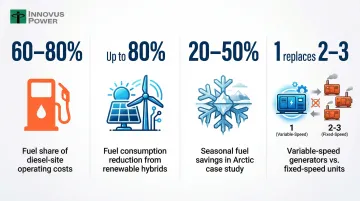
These savings compress payback periods, making the capital investment highly attractive at the LCOE level.
Available Financial Incentives
Stacking available incentives further strengthens the LCOE case — often reducing effective capital outlay by 30% or more before operations begin.
United States:
- Investment Tax Credit (ITC) of 30% for qualified solar and energy storage projects under the Inflation Reduction Act
- Bonus credits for domestic content or energy communities can increase this further
- Qualified clean energy facilities may be classified as 5-year property under MACRS for accelerated depreciation
Canada:
- Clean Technology ITC providing up to 30% refundable tax credit for capital invested in eligible clean technology property
- Clean Energy for Rural and Remote Communities (CERRC) program providing funding to reduce reliance on diesel
Capturing these incentives requires system designs that qualify under program-specific criteria — another area where vendor-agnostic engineering pays dividends. Innovus Power's unbiased design approach ensures system configurations are optimized for both LCOE performance and available financial programs, not limited by component preferences.
Frequently Asked Questions
What is the best way to generate electricity off-grid?
The best approach depends on location and load requirements. Solar + battery storage is the most widely applicable combination, but the most reliable systems combine multiple sources: solar, wind, hydro where available, and a backup generator, all managed by an intelligent control system that maximizes renewable use while ensuring continuous power.
What can a 3000 watt solar system run?
A 3 kW solar system generates roughly 15 kWh per day under good solar conditions, enough for basic lighting, refrigeration, and a few small appliances. Commercial, community, or industrial off-grid applications require much larger arrays (tens to hundreds of kW) paired with battery storage to cover full operational loads reliably.
What is the 33% rule in solar panels?
The 33% rule is a general guideline advising that panels not exceed roughly one-third of rated capacity in certain charge controller configurations to avoid overloading. Properly engineered off-grid systems use detailed energy modeling instead, precisely matching panel capacity to load, battery, and inverter specifications.
What is the difference between an off-grid and a grid-tied system?
A grid-tied system remains connected to the utility grid and can draw from or export to it. A fully off-grid (stand-alone) system operates entirely independently, requiring sufficient on-site generation and storage to meet 100% of demand at all times without utility backup.
How does a microgrid differ from a simple off-grid solar setup?
A simple off-grid solar setup uses one generation source plus batteries. A microgrid integrates multiple sources, storage, and intelligent control software that continuously optimizes dispatch across all resources, delivering higher reliability, greater renewable penetration, and lower long-term operating costs than any single-technology solution.