Introduction
Commercial and industrial energy users are making a decisive shift toward on-grid solar adoption. Rising utility costs—which climbed 6.8% year-over-year to reach 13.19 cents/kWh in November 2025—combined with grid reliability concerns and sustainability mandates are pushing facilities to reconsider how they source power. In Q3 2025 alone, the U.S. commercial solar segment installed 554 MWdc, marking a 9% year-over-year increase, with a projected 6% annual growth rate from 2027 through 2030.
But choosing the wrong on-grid solar system can significantly erode ROI and operational reliability. Undersized capacity means insufficient bill savings. Poor inverter quality leads to downtime and lost production. A setup incompatible with local net metering policies can leave thousands of dollars on the table.
For energy-intensive facilities where power is the second highest operational cost after personnel, these mistakes aren't just inconvenient — they're expensive.
This guide covers everything you need to select the right system for your facility:
- Core components and how they work together
- Sizing your system to match actual load demands
- Inverter types and what each is suited for
- Net metering compatibility and policy considerations
- Intelligent control systems that protect long-term returns
Key Takeaways
- An on-grid solar system generates power from sunlight and feeds it directly into your facility while staying connected to the utility grid
- Most cost-effective solar setup with no battery storage required and potential to earn credits through net metering
- Evaluate system capacity, inverter type, panel efficiency, net metering compatibility, energy management, and scalability before buying
- Best for facilities with consistent grid access seeking to reduce energy costs without disconnecting from utilities
- Upgradeable with battery storage later, making it a flexible entry point before adding backup power or microgrid capability
What Is an On-Grid Solar System?
An on-grid (grid-tied) solar system is a photovoltaic system electrically connected to the public utility grid, using solar generation to offset grid consumption while drawing from the grid as needed. Unlike off-grid systems, it requires no battery storage to function, though storage is increasingly added for economic optimization.
Core Components of an On-Grid Solar System
Solar Panels (PV Modules)
PV panels convert sunlight into direct current (DC) electricity. Modern commercial panels typically range from 20.5% to 23.2% efficiency. Panel wattage, efficiency rating, and temperature coefficient all affect output and should match your site's solar irradiance profile.
Higher-efficiency modules cost more upfront but reduce the roof or ground space needed to meet energy targets — a real constraint in commercial environments where roof real estate is limited.
Key specifications to evaluate:
- Efficiency: Monocrystalline PERC modules offer 20.5%–22%, while TOPCon modules push this to 21.5%–23.2%
- Temperature coefficient: TOPCon modules have a superior coefficient of approximately -0.30%/°C compared to -0.34%/°C for PERC modules, resulting in >1% greater annual energy yield in hot climates
- Bifacial gain: Bifacial modules harvest reflected light from the rear, achieving 70%–95% rear-side efficiency — now standard in ground-mount C&I projects
Grid-Tie Inverter
The inverter converts DC output from panels into AC electricity compatible with the grid. Your choice of inverter type shapes performance under partial shading, monitoring granularity, and long-term system reliability — so it warrants careful evaluation.
Three main inverter categories:
- String inverters: Dominant choice for C&I rooftop applications, offering multiple Maximum Power Point Trackers (MPPTs) for granular optimization of arrays with varying tilts or shading
- Central inverters: Reserved for very large industrial or ground-mount systems (>5 MW), offering lower cost per watt but presenting a single point of failure
- Microinverters: Panel-level optimization with superior fault isolation but higher cost and complexity
The median Inverter Loading Ratio (ILR) for U.S. systems has risen to approximately 1.34. While this causes some "clipping" (loss of peak power), it broadens the production curve, generating more energy in morning and evening hours. Current designs ensure clipping losses remain below 2% of annual yield.
Net Metering & Utility Interconnection
Excess solar generation fed back to the grid earns bill credits through net metering — effectively turning the utility into a virtual battery. Interconnection agreements and metering arrangements vary significantly by utility and jurisdiction, directly affecting financial returns.
Systems must comply with IEEE 1547-2018, which mandates grid-support functions including voltage ride-through capabilities and anti-islanding protection that detects grid outages and disconnects within 2.0 seconds to protect utility workers.
Energy Monitoring & Control System
Modern on-grid systems increasingly include monitoring platforms that track real-time generation, consumption, and grid import/export data. Intelligent energy management systems can further optimize how solar power is dispatched across loads, maximizing cost savings and power quality.
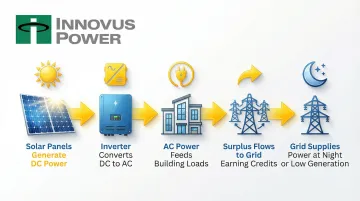
How an On-Grid Solar System Works (Energy Flow)
The operational cycle is straightforward and automatic:
- Solar panels generate DC power
- Inverter converts DC to AC
- AC power feeds loads in the building
- Surplus power flows to the grid (earning credits)
- At night or during low-generation periods, power draws from the grid
This switching happens automatically without user intervention, maintaining continuous power supply to your facility.
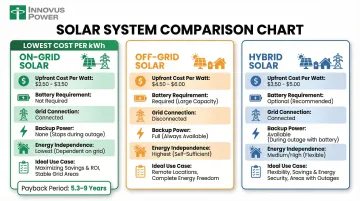
On-Grid vs. Off-Grid vs. Hybrid Solar: Which Is Right for You?
| Factor | On-Grid | Off-Grid | Hybrid |
|---|---|---|---|
| Upfront Cost | $1.47/Wdc | $3.00+/Wdc | $2.46/Wac |
| Battery Storage | None required | Essential | Included |
| Grid Connection | Maintained | None | Maintained |
| Backup Power | No (unless with storage) | Yes | Yes |
| Energy Independence | Low | Complete | Moderate |
| Ideal Use Case | Reliable grid access, cost reduction focus | Remote locations, no grid access | Cost reduction + backup power needs |
On-grid makes the most sense when:
- Grid access is reliable and stable
- Energy cost reduction is the primary goal
- Capital efficiency matters — on-grid delivers the lowest cost per kWh generated
- Payback speed is a priority (typically 9 years nationally, as low as 5.3 years in high-rate states like Virginia)
One limitation worth knowing upfront: standard on-grid systems do not provide backup power during grid outages. Anti-islanding protection requirements shut the system down when the grid goes down — a real constraint for medical facilities, mining operations, or industrial processes where continuity is non-negotiable.
What to Consider When Choosing the Best On-Grid Solar System
Selecting an on-grid solar system involves aligning technical specifications with operational requirements, financial constraints, and regulatory realities. The following factors help move from general interest to an informed purchasing decision.
System Capacity and Load Assessment
System capacity (measured in kWp) must be sized against actual energy consumption data, not rough estimates. Undersizing means insufficient bill savings; oversizing without favorable net metering can mean wasted generation.
A professional load audit is essential. Standard industry practice suggests sizing systems to offset 70–90% of annual daytime energy usage. Sizing to 100% or more often results in diminishing returns in markets with poor export compensation.
Capacity decisions influence critical financial metrics:
- Payback period
- Return on investment (ROI)
- Levelized Cost of Energy (LCOE)
For commercial systems, the median payback period is approximately 9 years, but this varies significantly by region and incentive availability.
Inverter Type and Power Quality
The inverter choice affects system performance under variable conditions, fault isolation, monitoring capabilities, and maintenance complexity.
String inverters offer multiple MPPTs for granular optimization and scalability. A single unit failure doesn't take the entire plant offline, simplifying operations and maintenance.
Central inverters suit very large industrial systems (>5 MW) with lower cost per watt and high efficiency but present a single point of failure.
DC-to-AC ratio optimization: A ratio of 1.20 to 1.30 is standard for commercial systems. Oversizing the DC array ensures the inverter operates at full capacity for more hours daily. Even with a ratio of 1.34, clipping losses typically remain below 2% of total annual energy, outweighed by gains during mornings, evenings, and cloudy days.
Power quality is a critical concern for commercial and industrial sites with sensitive equipment. Poor power quality reduces component lifespan and increases energy consumption. IEEE 519-2014 limits Total Harmonic Distortion (THD) to 5.0% for systems connected at voltages of 69 kV or less.
Solar Panel Efficiency and Durability
Panel efficiency determines how much roof or ground space is needed to meet energy targets. Higher-efficiency panels cost more upfront but reduce the land/roof footprint—critical in constrained commercial environments.
Durability indicators to evaluate:
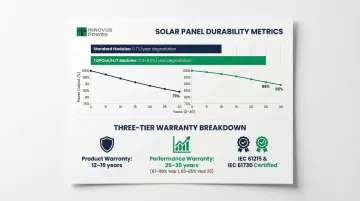
Degradation rates:
- Standard assumption: 0.7% per year for financial modeling
- High-performance modules (TOPCon, HJT): 0.4% to 0.6% per year
Warranty standards to demand:
- Product warranty: 12 to 15 years (covering defects in materials and workmanship)
- Performance warranty: 25 to 30 years, guaranteeing output won't drop below 97-98% in year one and will remain above 83-85% by year 25 or 30
- Certification: Modules certified to IEC 61215 (design qualification) and IEC 61730 (safety)
These durability indicators directly affect long-term output and the reliability of financial projections over a 25+ year asset lifespan.
Net Metering and Utility Tariff Compatibility
Net metering policies vary significantly by utility and jurisdiction. As of 2025, 34 states plus D.C. and Puerto Rico mandate some form of net metering, but the trend is shifting.
Policy landscape changes:
California has moved to a "Net Billing Tariff" (NEM 3.0), where export credits are roughly 75% lower than retail rates. States like Kentucky and West Virginia are following suit, transitioning from full retail net metering to net billing structures.
The financial return on an on-grid system is directly tied to your available net metering program. Key variables include:
- Full retail rate credits (most favorable)
- Wholesale or avoided-cost rate credits (common under net billing)
- System size caps or export limits set by the utility
Action required:
Confirm interconnection requirements, export limits, and applicable tariff structures with your utility before finalizing system design. Time-of-use (TOU) tariffs can significantly affect when self-consumption provides the most value, potentially shifting the economic case toward hybrid systems with storage.
Energy Management and Intelligent Control Systems
Navigating variable tariffs and shifting net metering rules requires more than good panel placement — it demands intelligent system control. An Energy Management Control System (EMCS) optimizes how solar generation, grid draw, and loads interact in real time to maximize cost savings and power quality.
Innovus Power's GridGenius EMCS is purpose-built for grid-connected and microgrid-capable systems. Rather than relying on traditional engine-controlled power systems, GridGenius uses advanced power electronics and control software to manage power volume, response speed to load demand changes, and power quality across all energy sources.
Key capabilities include:
- Real-time energy dispatch optimization balancing solar generation, stored energy, and grid draw
- Automatic paralleling between multiple systems for scalable power management
- Up to 90+% renewable energy penetration without curtailment
- Utility-grade power quality specifications regardless of energy source mix
- 24/7 remote monitoring through PowerView software
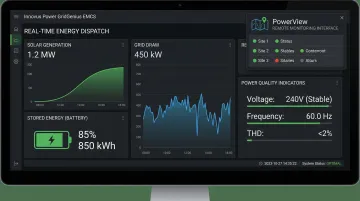
Remote monitoring is critical for commercial deployments. It enables fast fault detection, performance optimization, and reduces operational risk — especially for multi-site installations.
Scalability and Long-Term Cost (LCOE)
The best on-grid solar systems are designed to grow with operational needs. Capacity expansion, battery storage integration, or EV charging additions should be architecturally possible without a full system redesign.
Vendor-agnostic design — not locked into a single brand of panels, inverters, or storage — is a significant long-term advantage. It ensures you can upgrade components based on performance and cost rather than vendor contracts.
Levelized Cost of Energy (LCOE) is the most accurate metric for comparing on-grid solar economics over a 20–25 year system lifespan, factoring in capital cost, maintenance, degradation, and financing.
LCOE benchmarks for 2024-2025:
- Commercial solar LCOE (unsubsidized): $75/MWh (7.5 cents/kWh)
- Average commercial grid price: $131.9/MWh (13.19 cents/kWh)
- Cost advantage: Commercial solar LCOE is roughly 43% lower than grid electricity
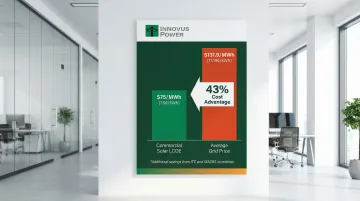
This substantial spread drives the strong economic case for C&I solar, even before incentives like the Investment Tax Credit (ITC) and accelerated depreciation (MACRS) are applied.
How Innovus Power Can Help
Innovus Power is a microgrid systems integrator with over 30 years of experience designing intelligent, vendor-agnostic power systems for commercial, industrial, and remote energy applications. Where most solar installers stop at panels and inverters, Innovus designs complete hardware-software platforms spanning solar, wind, stored energy, and grid-tied systems.
GridGenius Microgrid Platform and GridGenius EMCS are purpose-built to optimize on-grid solar performance:
- Up to 80% reductions in power costs through maximized solar and wind energy integration with right-sized stored energy systems
- Utility-grade power quality that reduces customer energy consumption and extends equipment life
- Scalability from 250kW to 200+MW, suitable for mid-sized commercial facilities to utility-scale installations
- Ability to scale from on-grid solar toward full microgrid resilience as needs evolve
Key differentiators:
- No vendor or component bias — technology selection is driven by your objectives and performance requirements, not commercial relationships
- Proprietary modeling and simulation tools design optimal configurations for any scenario, saving customers up to 25% of total capital costs and 20% on long-term cost of energy
- 24/7 remote monitoring through PowerView software provides continuous oversight and proactive troubleshooting before issues affect power generation or quality
- Sector experience spanning commercial and industrial facilities, mining, agriculture, resorts, remote communities, and medical facilities — including a recent agreement with a U.S. medical care provider to upgrade 100+ facilities from solar to full microgrid configurations
If your current on-grid solar system is underperforming — or you want to build toward full energy resilience — Innovus Power can model the upgrade path, design the solution, and manage it remotely once it's running.
Conclusion
The right on-grid solar system aligns capacity, technology choices, utility policy, and monitoring capabilities with the specific operational and financial goals of your facility.
With commercial electricity prices climbing 6.8% year-over-year and the commercial solar market projected to grow at 6% annually through 2030, the initial system design decision carries lasting financial consequences. Systems built for scalability, intelligent control, and vendor flexibility will deliver the lowest levelized cost of energy over their operating life.
Specifically, the systems that consistently deliver on LCOE, renewable penetration, and operational flexibility share three design characteristics:
- Built on advanced power electronics platforms, not commodity inverter stacks
- Controlled by a sophisticated energy management system capable of real-time dispatch decisions
- Designed without vendor lock-in, so components can be upgraded as technology evolves
For facilities that need to meet these benchmarks at scale — from commercial rooftops to remote industrial sites — Innovus Power's GridGenius platform provides the vendor-agnostic control layer that ties hardware performance to measurable energy outcomes.
Frequently Asked Questions
What is the difference between an on-grid and off-grid solar system?
On-grid systems stay connected to the utility grid and draw from it when solar generation is insufficient, while off-grid systems rely entirely on solar plus battery storage with no grid connection. On-grid systems have much lower upfront costs (approximately $1.47/Wdc vs. $3.00+/Wdc) but do not provide power during grid outages unless paired with battery storage.
Does an on-grid solar system work during a power outage?
Standard on-grid systems automatically shut down during outages due to anti-islanding protection requirements mandated by IEEE 1547-2018, which prevents the system from electrocuting utility workers. Adding battery storage to an on-grid system is required to maintain power supply during grid failures.
How do I determine what size on-grid solar system I need?
System sizing draws on historical energy consumption (kWh per month), available roof or ground space, local solar irradiance, and net metering policy. Best practice targets 70-90% of annual daytime usage, with a professional assessment using NREL's PVWatts or System Advisor Model (SAM) providing the most accurate baseline.
How long does an on-grid solar system take to pay for itself?
Payback periods for commercial on-grid solar typically range from 5 to 12 years (national median: ~9 years), depending on system size, local utility rates, available incentives, and net metering terms. In high-rate states with strong incentives like Virginia, payback can be as short as 5.3 years.
Can an on-grid solar system be upgraded to include battery storage later?
Most modern on-grid systems can be retrofitted with battery storage, converting them into hybrid systems. The process is easiest when the original design accounts for future storage, avoiding additional permitting costs, inverter replacement, and labor expenses.
What maintenance does an on-grid solar system require?
On-grid systems have relatively low maintenance requirements—primarily periodic panel cleaning, inverter performance checks, and monitoring system reviews. Operations and maintenance costs typically range from $19 to $22 per kW-DC per year. Remote monitoring platforms reduce the need for on-site inspections by enabling proactive fault detection and performance tuning.