Introduction
Energy storage has moved from optional to essential. Industrial facilities face demand charges accounting for 30-50% of monthly electricity bills. Remote communities pay fuel delivery costs exceeding $400 per gallon. Grid outages cost commercial operations an average of $10,000 per hour in lost productivity.
Energy storage systems (ESS) now underpin operational continuity across sectors far beyond residential solar. The demand spans industries with little in common except one shared problem: unreliable or unaffordable power.
Common deployment scenarios include:
- Mining operations running variable-load conveyors where grid connection is impossible
- Military forward operating bases where fuel logistics dominate mission planning
- Remote Arctic communities replacing diesel gensets running 24/7
- Commercial facilities absorbing production losses from brownouts and blackouts
Each of these contexts demands a different storage solution. This guide examines the five leading energy storage technologies deployed at commercial and industrial scale today — what differentiates each, and how to evaluate them against your specific load profile, duration requirements, and total cost of ownership.
Key Takeaways
- Energy storage systems capture electricity when generation exceeds demand and release it when demand outpaces supply, decoupling production from consumption
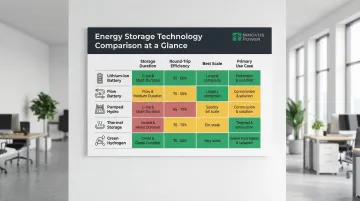
- Five technologies dominate deployments: lithium-ion (short-duration), flow batteries (long-duration), pumped hydro (utility-scale), thermal storage (industrial heat), and hydrogen (seasonal)
- Selection requires evaluating storage duration, round-trip efficiency, scalability, maintenance burden, and integration complexity—not just upfront capital cost
- For remote or critical-load applications, system-level intelligence matters as much as hardware: an Energy Management Control System optimizes dispatch across multiple technologies
- The right choice depends on your load profile, site constraints, budget, and operational requirements—there is no single universal answer
What Are Energy Storage Systems?
Energy storage systems (ESS) are technologies that capture energy at one point in time and release it at another, decoupling electricity generation from consumption. This time-shifting capability transforms how facilities manage power—enabling peak shaving, backup power, renewable integration, and grid stabilization.
ESS deployments span multiple scales and applications:
- Residential: 10–15 kWh battery systems paired with rooftop solar for backup power
- Commercial & Industrial (C&I): 500 kWh to 5 MWh systems for demand charge management and resilience
- Utility-scale: 50 MWh to multi-gigawatt-hour installations that stabilize regional grids and firm intermittent renewable generation
The global energy storage market reached $58.41 billion in 2024 and is projected to grow at a compound annual growth rate (CAGR) of 14.31% through 2030, potentially reaching $114.01 billion. Grid-related storage deployments alone are forecast to increase 15-fold from 2019 levels to nearly 160 GWh annually by 2030.
Best Energy Storage Systems: Top Technologies and Solutions
These five technologies represent the most widely deployed and commercially viable energy storage solutions available today, selected based on performance, scalability, cost trajectory, and applicability across commercial, industrial, and utility applications.
Lithium-Ion Battery Energy Storage Systems (BESS)
Lithium-ion BESS dominates electrochemical storage globally, accounting for approximately 90% of annual demand in the energy sector. Over 85 GW of battery storage was in operation globally as of 2023, deployed across applications ranging from grid-scale frequency regulation to EV charging buffers and commercial backup power.
Millisecond response times, high round-trip efficiency of 85-95%, modular scalability from kilowatts to gigawatts, and a mature supply chain make it the default choice for most new deployments. Two chemistries dominate the market:
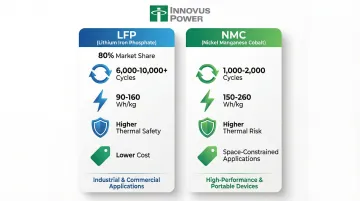
LFP (Lithium Iron Phosphate) captured 80% of new battery storage market share in 2023. Preferred for stationary storage due to superior safety (higher thermal runaway temperature), longer cycle life (6,000-10,000+ cycles), and lower costs driven by abundant raw materials. Energy density: 90-160 Wh/kg.
NMC (Nickel Manganese Cobalt) offers higher energy density (150-260 Wh/kg), making it suitable for space-constrained applications. Trade-offs include shorter cycle life (1,000-2,000 cycles) and higher thermal runaway risk. Calendar life for lithium-ion systems typically ranges 10-15 years.
| Attribute | Specification |
|---|---|
| Storage Duration | Typically 2-6 hours; extending to 8 hours for longer-duration applications |
| Best Use Case | Peak shaving, backup power, EV integration, commercial demand management, frequency regulation |
| Notable Providers | Tesla Megapack 3: ~5 MWh per unit; Megablock: 20 MWh system. Fluence Gridstack: Configurable 2-4+ hour systems; 160 MW / 640 MWh Winchester project. CATL TENER: 6.25 MWh per 20ft container; zero degradation first 5 years. |
Flow Batteries (Vanadium Redox)
Vanadium Redox Flow Batteries (VRFBs) store energy in liquid electrolytes held in external tanks, allowing energy capacity (kWh) and power output (kW) to be scaled independently. This architecture enables 6-12+ hours of discharge without the capacity degradation that affects solid-state batteries over thousands of cycles.
VRFBs excel in applications requiring daily deep cycling over decades. The electrolyte does not degrade with cycling, enabling potentially unlimited cycle life for the active material. Operational lifespans exceed 20+ years, with maintenance focused on mechanical components (pumps, stacks) rather than chemical replacement. For industrial operations, renewable time-shifting, and remote sites needing long-duration backup, this architecture is difficult to match.
| Attribute | Specification |
|---|---|
| Storage Duration | 4-12+ hours; designed for long-duration discharge applications |
| Best Use Case | Industrial operations, renewable energy time-shifting, utility grid balancing, remote site long-duration backup |
| Notable Providers | Invinity ENDURIUM: Next-gen modular VRFB scaling 10 MWh - 1 GWh. Sumitomo Electric: 2 MW / 8 MWh California system (operational since 2017); 17 MW / 51 MWh Hokkaido system. Rongke Power: 100 MW / 400 MWh Dalian system—world's largest VRFB. |
Pumped Hydro Storage
Pumped Hydro Storage (PHS) remains the backbone of global energy storage, accounting for over 90% of total installed electricity storage capacity worldwide. During low-demand periods, water is pumped to an upper reservoir; when demand peaks, it flows back down through turbines to generate electricity.
PHS offers massive capacity (hundreds of MW to multi-GW scale) and operational lifespans exceeding 50 years, often reaching 80-100 years with maintenance. Deployment has real constraints, though:
- Geography-dependent: requires suitable topography with significant elevation differential
- High capital investment and long permitting timelines
- Environmental impact assessments add complexity to new projects
| Attribute | Specification |
|---|---|
| Storage Duration | Hours to seasonal storage; suited for grid-scale balancing |
| Best Use Case | National grid stabilization, large-scale renewable integration, long-duration energy shifting |
| Notable Providers | Snowy Hydro 2.0 (Australia): 2,200 MW / 350,000 MWh under construction; ~160 hours storage. Bath County (USA): 3,003 MW—world's most powerful pumped storage station. Nant de Drance (Switzerland): 900 MW / 20 GWh operational since 2022. |
Thermal Energy Storage (TES)
Thermal Energy Storage captures and holds energy in the form of heat or cold using materials like molten salt, water, or specialized ceramic bricks. Most commonly deployed in Concentrated Solar Power (CSP) plants and industrial heating/cooling applications, TES is particularly cost-effective for facilities with high thermal loads.
For applications requiring industrial process heat, large commercial HVAC, or CSP electricity generation, TES avoids the round-trip conversion losses inherent in electrochemical storage. Storing energy as heat and using it directly for thermal processes is more economical at large scale than converting electricity to chemical energy and back.
Molten salt systems enable storage durations of 8 to 17.5 hours, allowing CSP plants to dispatch electricity 24 hours a day despite solar intermittency. Emerging solid-state solutions like Rondo Energy's brick heat battery store heat at temperatures exceeding 1,000°C for industrial applications.
| Attribute | Specification |
|---|---|
| Storage Duration | Hours to days depending on system design and insulation quality |
| Best Use Case | Industrial heat processes, CSP power generation, commercial building HVAC load shifting |
| Notable Providers | Cerro Dominador (Chile): 110 MW / 17.5 hours molten salt CSP operational since 2021. Rondo Energy: 100 MWh brick heat battery commercial operation started Oct 2025 in California. SaltX Technology: 1 MW / 15 MWh nanocoated salt pilot in Sweden. |
Green Hydrogen Storage
Hydrogen storage converts surplus electricity into hydrogen gas via electrolysis, which can then be stored in tanks and reconverted to electricity through fuel cells or combustion turbines. It is the leading candidate for long-duration and seasonal storage at scale, capable of shifting energy across weeks or months.
Hydrogen offers virtually unlimited storage duration and versatility across power generation, transportation, and industrial feedstock applications. The primary limitation is efficiency: the power-to-hydrogen-to-power pathway delivers only 30-40% round-trip efficiency due to conversion losses at both ends.
Cost is the other barrier. Green hydrogen currently runs $4-6/kg to produce, though projections put that figure at $1-2/kg by 2030 in optimal locations, driven by cheaper renewables and falling electrolyzer costs.
| Attribute | Specification |
|---|---|
| Storage Duration | Days to seasonal (weeks/months); the only technology suited for true seasonal storage at scale |
| Best Use Case | Seasonal renewable energy balancing, remote industrial sites, long-duration backup, decarbonizing industrial processes |
| Notable Providers | Nel Hydrogen: A-Series (Alkaline) and M-Series (PEM) electrolyzers scaling to 100 MW+ plants; 3,500+ installed globally. Plug Power: GenEco electrolyzers (1 MW, 5 MW modules). ITM Power: TRIDENT (2 MW), POSEIDON (20 MW module); 10 MW REFHYNE at Shell Rhineland refinery. |
How We Chose the Best Energy Storage Systems
Each technology was evaluated on six criteria — focused on commercial and industrial use cases, not residential or theoretical applications:
- Storage duration capability
- Round-trip efficiency
- Scalability across deployment sizes
- Total cost of ownership (TCO)
- Technology maturity and supply chain readiness
- Applicability to real-world C&I deployments
Common buyer mistakes to avoid:
Many organizations focus exclusively on upfront capital cost while underestimating cycle degradation, O&M costs, and integration complexity. A battery with a lower purchase price but 2,000-cycle life requires replacement twice as often as a system rated for 6,000+ cycles — dramatically increasing TCO.
Technology fit matters just as much. A system optimized for short-duration peak shaving (2-4 hours) is the wrong tool for applications requiring continuous backup or long-duration discharge. That mismatch leads to oversizing, inefficiency, and wasted capital.
A third mistake is evaluating storage hardware in isolation rather than as part of a complete system. In complex, multi-source deployments — remote microgrids integrating solar, wind, storage, and dispatchable generation — the control system determines how well the hardware actually performs.
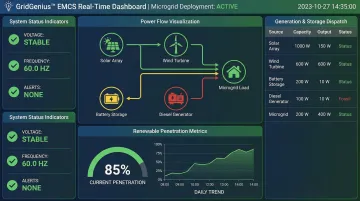
An Energy Management Control System (EMCS) like Innovus Power's GridGenius EMCS optimizes dispatch across multiple storage types and generation sources in real time, maximizing renewable penetration while minimizing fuel consumption and maintaining utility-grade power quality. Systems without intelligent control often curtail renewables at 30-40% penetration; properly managed microgrids can reach 90+% renewable penetration without curtailment.
Frequently Asked Questions
What is the best energy storage technology?
No single technology is universally best. Lithium-ion dominates short-to-medium duration applications (2-6 hours) due to high efficiency and fast response. Flow batteries and hydrogen suit long-duration needs (6+ hours to seasonal). Pumped hydro leads at utility scale where geography permits. Match your choice to duration requirements, scale, and total cost of ownership — not just upfront price.
Can a 10kW battery run a whole house?
A 10 kWh battery can cover basic home loads (refrigerator, lights, internet, some outlets) for several hours during an outage, but may not sustain a whole house for a full day depending on consumption patterns. Pair it with solar for ongoing recharge during daylight hours. Proper sizing requires actual load analysis—not assumptions.
What is the difference between a battery energy storage system (BESS) and a flow battery?
BESS stores energy in solid electrodes within a sealed unit, with power and energy capacity coupled together. Flow batteries store energy in liquid electrolytes in external tanks, allowing capacity (kWh) and power (kW) to be scaled independently. Flow batteries are preferred for long-duration, high-cycle applications where daily deep cycling over 20+ years is required.
How long do energy storage systems last?
Lithium-ion BESS typically last 10-15 years (LFP: 6,000-10,000+ cycles; NMC: 1,000-3,000 cycles before reaching 80% capacity). Flow batteries exceed 20+ years with minimal degradation, and pumped hydro infrastructure routinely operates 50-100 years with periodic refurbishment.
What is the most cost-effective energy storage for remote or off-grid applications?
Lithium-ion BESS paired with solar PV is the most cost-effective entry point for remote sites needing 2-6 hours of storage. For longer duration or higher energy demands, a hybrid microgrid — batteries plus dispatchable generation managed by an intelligent EMCS — typically delivers the lowest levelized cost of energy over time.
What is round-trip efficiency and why does it matter for energy storage?
Round-trip efficiency (RTE) is the ratio of energy retrieved from storage to energy put in — lithium-ion reaches 85-95%, pumped hydro 70-85%, and hydrogen 30-40%. For daily cycling, a 10-percentage-point RTE gap compounds to thousands of dollars in wasted energy each year. Seasonal storage applications may tolerate lower RTE when long-duration value outweighs efficiency losses.
Conclusion
The "best" energy storage system is not a universal answer—it depends on load requirements, operational environment, storage duration, and total lifecycle cost. Each technology fills a distinct role:
- Lithium-ion: Short-duration, high-cycle applications
- Flow batteries: Long-duration industrial and grid needs
- Pumped hydro: Utility-scale where geography permits
- Thermal storage: Industrial heat process optimization
- Hydrogen: Seasonal and long-duration balancing
Evaluate scalability, vendor support, and integration capabilities—not just headline specs. Consider how storage will interact with existing or planned generation assets before committing to a solution. For applications requiring 6+ hours of storage, hybrid configurations combining multiple technologies typically deliver better economics and resilience than single-technology approaches.
For organizations operating remote sites, industrial facilities, or critical infrastructure, Innovus Power brings over 30 years of experience designing vendor-agnostic microgrid systems that integrate the right mix of storage and generation technologies.
Their GridGenius EMCS has demonstrated up to 90+% renewable penetration without curtailment, delivering utility-grade power quality and a competitive levelized cost of energy across deployments in remote Arctic communities, mining operations, military installations, and commercial facilities worldwide.