Introduction
Industrial and commercial operations face converging energy challenges that are reshaping operating budgets. In November 2025, industrial electricity prices surged 7.5% year-over-year, while commercial rates climbed 6.8% according to the U.S. Energy Information Administration. Meanwhile, grid reliability has deteriorated—the average annual outage duration per customer reached 11 hours in 2025, nearly double the previous decade's average.
Monthly utility bill reviews and reactive maintenance are no longer viable strategies. Organizations now face ESG mandates, volatile energy costs, and grid instability that threaten operational continuity. Energy Management Systems (EMS) address all three by shifting operations from reactive monitoring to active control—providing real-time visibility, automated load decisions, and measurable cost reduction across facilities of any scale.
This guide breaks down the leading EMS software platforms, key monitoring capabilities, and the criteria that matter most when selecting a system for industrial, remote, or critical power environments.
Key Takeaways
- An EMS monitors, analyzes, and optimizes energy consumption across facilities, industrial operations, or distributed power networks in real time
- The best platforms deliver automated load control, renewable integration, predictive analytics, and real-time fault response
- Selection depends on your environment — building, manufacturing, utility-scale, and off-grid/microgrid deployments each have distinct requirements
- Top platforms: GridGenius EMCS (Innovus Power), Siemens SIMATIC Energy Manager, Schneider Electric EcoStruxure, EnergyCAP, and Aveva Energy Performance
- Mismatched tools deliver negligible ROI — choosing based on your operational context (not feature count) is what separates effective deployments from expensive ones
What Is an Energy Management System (EMS)?
An Energy Management System combines hardware, software, and control logic that continuously monitors energy flows, identifies inefficiencies, and enables automated or operator-directed interventions to optimize consumption and cost. Unlike simple metering or bill-tracking tools, a true EMS provides direct operational control—not just data collection.
Four Primary EMS Categories
Selecting the wrong category is the most common and costly mistake buyers make. Each serves a distinct operational context:
| Category | Primary Focus | Typical User | Key Standards |
|---|---|---|---|
| Building EMS (BEMS) | HVAC, lighting, occupant comfort | Commercial Real Estate, Campuses | BACnet, ASHRAE |
| Industrial EMS (IEMS) | Production processes, energy per unit, SCADA integration | Manufacturing, Mining, Oil & Gas | ISO 50001, OPC UA |
| Utility EMS (UEMS) | Grid stability, transmission, market operations | TSOs, DSOs, Utilities | IEC 61970 (CIM) |
| Microgrid EMCS | Generation dispatch, islanding, frequency/voltage control | Remote Sites, Critical Facilities | IEEE 2030.7, IEC 61850 |
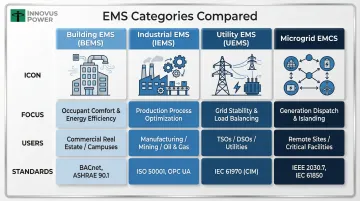
These categories aren't interchangeable — deploying a BEMS where an Industrial EMS is needed, for example, leaves critical production-level inefficiencies unaddressed.
The global market for energy management software within real estate and built environments reached $9.3 billion in 2024 and is projected to grow at 8% CAGR through 2030, according to Verdantix. This growth reflects the broader shift from reactive energy management to proactive control systems.
The platforms reviewed in this guide were evaluated across six criteria:
- Real-time monitoring depth
- Renewable integration capability
- Automation functionality
- Scalability
- Remote management support
- Demonstrated industry relevance
Best Energy Management Systems: Top Platforms Compared
Selection Criteria Summary
These platforms were evaluated on real-time monitoring depth, renewable energy integration, scalability, automation capability, remote management support, and suitability across diverse industries and deployment environments—from grid-connected facilities to fully off-grid remote sites.
GridGenius EMCS by Innovus Power
Innovus Power brings over 30 years of microgrid and distributed power expertise to remote communities, mining, oil & gas, military, resorts, and industrial operations across North America, the Caribbean, and beyond. The GridGenius EMCS is the control intelligence at the heart of their vendor-agnostic microgrid platform, designed to manage multi-source power systems including solar, wind, hydro, stored energy, and dispatchable generation.
Its vendor-agnostic architecture integrates with any combination of technology and hardware—Caterpillar, Cummins, MTU/Rolls Royce, Volvo Penta, Siemens engines, and various fuel cell OEMs—without locking clients into a single supplier.
What sets GridGenius apart: GridGenius is purpose-built for microgrid environments—the only platform on this list designed ground-up for off-grid and hybrid power control. The system achieves up to 90–100% renewable energy penetration without curtailment, reduces fuel consumption by up to 80%, and delivers utility-grade power quality even at remote off-grid sites. The platform is backed by 24/7 remote monitoring and management support worldwide through PowerView and FleetGenius software.
The system's variable-speed generator control decouples engine speed from electrical frequency, allowing diesel generators to run at optimal efficiency even at low loads—a critical feature for high-penetration renewable microgrids. In a documented Canadian Arctic community deployment, one GridGenius VSG replaced 2-3 fixed-speed gensets, achieving 20–50% fuel savings depending on season while maintaining superior power quality despite solar volatility.
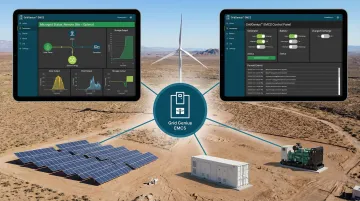
| Best For | Off-grid, remote, and hybrid microgrid operations; mining, military, remote communities, resorts, oil & gas | | Key Features | Multi-source renewable integration (solar, wind, hydro, storage), variable-speed generator control, up to 80% fuel reduction, proprietary modeling and simulation tools, 24/7 remote monitoring | | Ideal Use Case | Organizations seeking energy independence, dramatic cost reductions, and reliable power in locations where grid connectivity is absent or unreliable |
Siemens SIMATIC Energy Manager
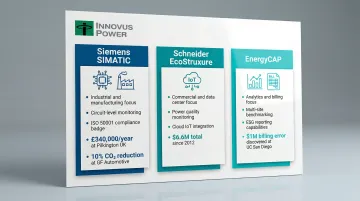
Siemens SIMATIC Energy Manager is a scalable industrial EMS designed for high-demand manufacturing and plant environments. It provides granular energy visibility from individual machine circuits up to full-site energy balances, and supports ISO 50001 compliance reporting.
Where it stands out: Built-in integration with Siemens automation hardware (PLCs, drives, switchgear) enables precise circuit-level monitoring. The platform supports OPC UA, Modbus TCP, and OPC DA for data acquisition from S7 controllers and SCADA systems. However, integration with non-Siemens third-party equipment adds complexity and cost, and the platform is primarily optimized for grid-connected industrial facilities rather than off-grid or renewable-heavy deployments.
Documented results: GF Automotive in Austria saved 4,500 m³ of compressed air per weekend and reduced CO2 emissions by 10% through die-casting optimization. Pilkington UK is on target to save approximately £340,000 annually with a typical payback period of 3 years.
| Best For | Large manufacturing facilities and industrial plants operating in Siemens automation ecosystems | | Key Features | Circuit-level energy monitoring, ISO 50001 compliance support, scalable multi-site deployment, integration with Siemens PLCs and drives | | Ideal Use Case | Manufacturers seeking to reduce per-unit energy intensity and meet industrial energy reporting standards within a Siemens infrastructure environment |
Schneider Electric EcoStruxure
Schneider Electric's EcoStruxure is a cloud-enabled IoT platform covering energy monitoring, power quality management, and predictive maintenance for commercial campuses, data centers, and industrial facilities. It delivers strong electrical infrastructure visibility across distributed sites.
Key distinction: Power quality monitoring—covering harmonics, voltage sags, and transient detection—protects sensitive equipment from electrical faults. The platform plots events against standard ITIC (CBEMA) and SEMI F47 curves, allowing facility managers to instantly assess if a voltage event threatened equipment. Scalable cloud architecture suits organizations of any size, though pricing is non-transparent and advanced features require higher-tier subscriptions, making total cost evaluation difficult for smaller operations.
Documented results: Schneider's own Lexington, KY smart factory achieved 3.4% year-over-year energy savings, contributing to $6.6 million in total savings since 2012, with payback periods as short as 2 to 6 months.
| Best For | Commercial campuses, data centers, and multi-site industrial operations with complex electrical infrastructure | | Key Features | Real-time energy and power quality monitoring, predictive maintenance alerts, IoT integration, scalable cloud deployment | | Ideal Use Case | Organizations managing multiple grid-connected facilities that need to protect equipment from power quality issues while tracking energy consumption centrally |
EnergyCAP
EnergyCAP is a utility bill management and energy analytics platform widely used by government agencies, higher education institutions, commercial real estate portfolios, and multi-site retailers. It specializes in aggregating utility data, identifying billing errors, and producing ESG and sustainability compliance reports.
What it does best: Benchmarking across large building portfolios and rigorous audit trails for regulatory compliance. The platform flags actionable issues in an average of 4.7% of utility bills monthly, and comprehensive utility audits can reduce costs by up to 10% in the first 18 months. However, it functions primarily as an analytical and accounting tool—it does not provide real-time operational control, load management, or renewable energy integration, making it unsuitable as a standalone EMS for operational environments.
Documented results: University of California San Diego identified a single billing error worth $1 million and reduced labor associated with billing by over 95%. University of Kansas manages over $2.3 million in annual internal chargebacks through the platform.
| Best For | Multi-site organizations focused on utility spend management, billing verification, and sustainability reporting | | Key Features | Utility bill aggregation, anomaly detection, multi-site benchmarking, ESG and carbon reporting, audit-ready data exports | | Ideal Use Case | Facility and sustainability managers responsible for tracking energy spend across large building portfolios and meeting regulatory reporting requirements |
Aveva Energy Performance
Aveva (formerly Schneider Electric Software) delivers industrial energy performance management through deep SCADA integration, making it the go-to platform for process industries such as oil & gas, chemicals, power generation, and water treatment. It visualizes energy flows across complex plant diagrams in real time.
Built on: The PI System (formerly OSIsoft), the industry standard for high-speed operational data management. The platform handles steam balance modeling, heat exchanger networks, and complex process energy flows with engineering-grade precision. Configuration requires dedicated engineering resources—typically weeks of setup—and the platform is less focused on work-order-driven maintenance workflows or off-grid/renewable control scenarios.
Documented results: Dominion Energy deployed a centralized, cloud-enabled model to monitor 28,000 assets, identifying and preventing 42 potential equipment failures in a single year and increasing speed-to-market for environmental data by 50%.
| Best For | Process industries with complex energy flows: oil & gas, chemical, power generation, water utilities | | Key Features | SCADA-integrated energy flow visualization, steam balance modeling, process-level energy benchmarking, real-time KPI dashboards | | Ideal Use Case | Process plant engineers and energy managers in grid-connected facilities requiring detailed thermodynamic and electrical energy flow analysis |
How We Chose the Best EMS Platforms
Platforms were assessed across six criteria:
- Real-time monitoring depth and data granularity
- Renewable energy and multi-source integration capability
- Automation and control functionality beyond passive reporting
- Scalability across single-site and multi-site deployments
- Remote monitoring and management support
- Demonstrated suitability for target industries and environments
The most common buyer mistake: Selecting an EMS built for facility bill tracking when operational power control is needed (or vice versa). Mismatched tools deliver negligible ROI. The right tool depends entirely on whether your primary need is billing analytics or physical power control.
The most overlooked factor: Deployment environment fit. A platform that excels on a grid-connected commercial campus may be entirely unsuitable for a remote mining site or military forward operating base, where power reliability, renewable penetration, and off-grid autonomy are the primary performance metrics.
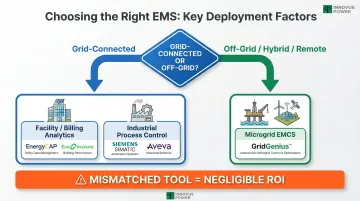
Research from NREL demonstrates that microgrid systems can provide 1.8 days of added resiliency for critical infrastructure — a value proposition that standard building EMS platforms simply cannot deliver.
Vendor lock-in deserves more scrutiny than most buyers give it. Platforms tied exclusively to proprietary hardware ecosystems — meters, PLCs, switchgear — limit future flexibility and inflate lifecycle costs. The United Nations Economic Commission for Europe recommends mandating open standards for sensors and market interfaces to reduce this risk. Prioritize vendor-agnostic solutions where feasible, especially for long-duration deployments in remote or evolving energy environments.
Conclusion
The right EMS platform is the one that matches your operational environment, power infrastructure type, and long-term energy goals. A building-focused bill-tracking tool won't address a remote community's reliability challenges. A full microgrid EMCS is unnecessary for a single-campus utility reporting need.
Evaluate these factors before committing:
- Ongoing performance support and remote monitoring availability
- Scalability to integrate new energy sources as your infrastructure evolves
- True total cost of energy (not just software licensing costs)
- Vendor lock-in risks and interoperability with open standards
For remote, industrial, or mission-critical operations that need off-grid or hybrid power control, the software layer is only part of the equation. Innovus Power's GridGenius EMCS is built specifically for these environments, with deployments demonstrating up to 80% reductions in fuel and power costs alongside utility-grade reliability. Reach out to the Innovus Power team to discuss your specific power environment and whether a GridGenius-based microgrid is the right fit.
Frequently Asked Questions
What is the difference between an EMS and a SCADA system?
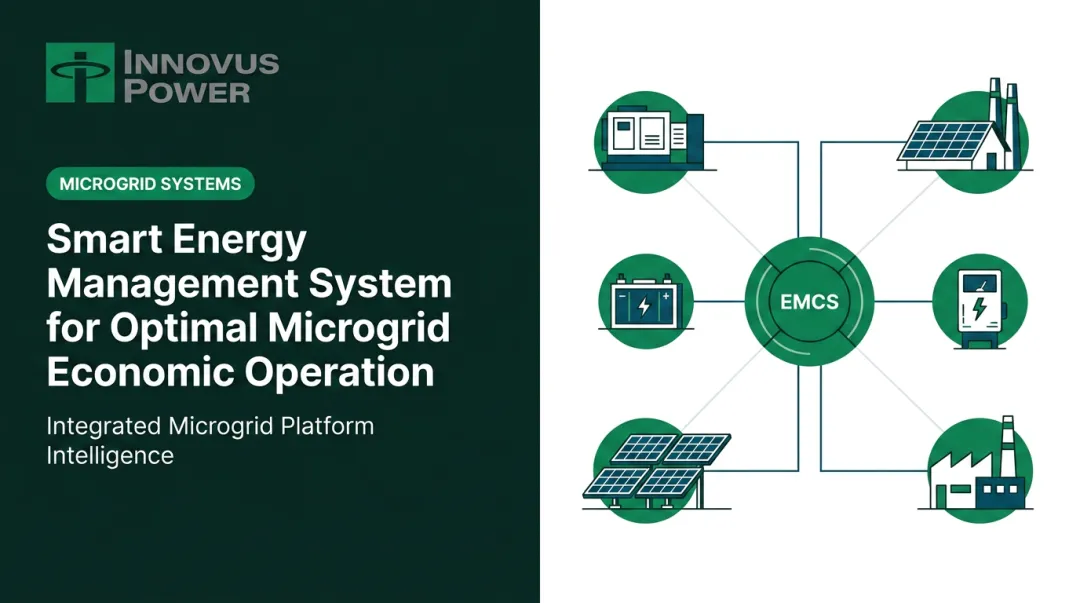
EMS focuses specifically on energy consumption analytics, cost optimization, and load control, while SCADA is a broader industrial control system for monitoring and controlling all operational processes. In advanced microgrid environments, EMS and SCADA functions are often integrated within a single Energy Management Control System (EMCS) that combines real-time control with economic optimization.
What features should I look for in energy management software?
Prioritize real-time consumption monitoring, automated alerts and load control, renewable energy source integration, multi-site scalability, and reporting tools aligned to ESG or compliance requirements. Operational environments (off-grid vs. grid-connected) significantly influence which features matter most—remote sites need 24/7 monitoring support, while grid-tied facilities may prioritize demand charge management.
Can an EMS integrate with solar, wind, and battery storage systems?
Advanced EMS platforms—particularly microgrid EMCS solutions—manage multi-source power inputs including solar PV, wind, hydro, and battery storage, dispatching each source dynamically to minimize fuel use. Modern controllers have achieved 90%+ renewable penetration in operational deployments without requiring curtailment.
What is a microgrid Energy Management Control System (EMCS)?
A microgrid EMCS is specialized control software that manages power generation, storage, and distribution within a localized grid. It optimizes dispatch across multiple energy sources in real time, maintains power quality, and can operate fully independently from the utility grid, providing resilience for critical operations.
How much can an EMS reduce energy costs?
Savings depend on deployment type and baseline inefficiency. Off-grid and diesel-heavy operations have demonstrated fuel cost reductions of up to 80% through renewable integration, while grid-connected facilities typically see 10–30% reductions in utility spend through load shifting and demand charge management.
Is energy management software suitable for remote or off-grid locations?
Purpose-built microgrid EMCS platforms operate without continuous grid connectivity and support 24/7 remote monitoring via satellite or cellular links. They're built for locations—arctic communities, remote mines, island resorts—where power failure is not an acceptable outcome.