Introduction
Organizations across North America face mounting pressure from rising utility costs, aging grid infrastructure, and increasingly frequent power outages. Commercial and industrial electricity prices climbed approximately 19% from 2019 to 2024, with recent monthly data showing year-over-year increases as high as 7.8% for the commercial sector. Meanwhile, power outages cost US businesses an estimated $79 billion annually, with data centers facing average costs of roughly $8,851 per minute of unplanned downtime.
Advanced microgrids directly address both problems. These localized power systems give operators control over their own generation, storage, and energy costs—cutting dependence on utility pricing and reducing exposure to grid failures. This article examines two core outcomes: measurable reduction in electric bills and smarter, more resilient grid management that protects critical operations.
Key Takeaways
- Advanced microgrids integrate multiple distributed energy resources (DERs) with intelligent control software for reliable, lower-cost power
- Cost savings come from demand charge reduction, peak shaving, time-of-use optimization, and fuel displacement
- Intelligent Energy Management Control Systems automate dispatch, maximize renewable penetration, and maintain power quality 24/7
- Remote communities, mining operations, military sites, hospitality businesses and all others with high energy costs or critical uptime needs benefit most
- Vendor-agnostic design and proprietary control software differentiate advanced microgrid providers
What Sets Advanced Microgrids Apart from Basic Systems
Advanced microgrids are a fundamental step beyond basic backup power systems. The core distinction is architectural: basic microgrids rely on a single energy source—usually a diesel or natural gas generator. Advanced systems integrate multiple distributed energy resources (DERs), including solar, wind, battery storage, and dispatchable generation, all coordinated through an intelligent control layer.
According to the U.S. Department of Energy and IEEE Std 2030.7-2017, a microgrid is a group of interconnected loads and distributed energy resources within clearly defined electrical boundaries that acts as a "single controllable entity" with respect to the grid. This ability to connect and disconnect—operating in both grid-connected and islanded modes—is what separates advanced microgrids from simple backup generators.
Operational Capabilities That Define "Advanced"
Advanced microgrids deliver operational flexibility that basic systems cannot match. They seamlessly switch between grid-connected and islanded (off-grid) modes without disruption to critical loads, maintaining power quality throughout transitions. This capability is essential for facilities where even brief interruptions are unacceptable.
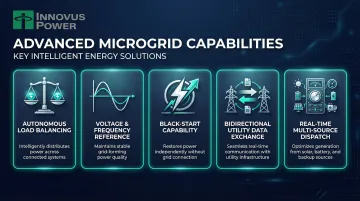
Key capabilities include:
- Balances generation and load autonomously, even during grid outages
- Establishes voltage and frequency reference for islanded operation, allowing other assets to synchronize
- Restarts generation and restores power without relying on the external utility grid (black-start capability)
- Exchanges data bidirectionally with the utility for market participation and grid services
- Continuously adjusts power output across multiple sources to match demand in real time
Innovus Power's GridGenius platform is built on this architecture—using power electronics and intelligent control software instead of traditional engine-based control. The result is a vendor-agnostic system that integrates any energy source while delivering utility-grade power quality across diverse applications, from remote mining sites to commercial facilities.
How Advanced Microgrids Reduce Electric Bills
Advanced microgrids cut electricity costs through several compounding mechanisms — from eliminating peak demand charges to locking in predictable energy prices for decades.
Demand Charge Management
For commercial and industrial users, demand charges—billed on peak consumption within a billing period—often represent 30-70% of total electricity costs. Intelligent battery energy storage systems within a microgrid target these costs through peak shaving, discharging stored energy during periods of peak demand to lower the metered peak.
The GridGenius Energy Management Control System continuously monitors load patterns and automatically dispatches stored energy or on-site generation to flatten demand spikes. This automated approach eliminates the need for manual intervention and captures savings that manual systems miss.
Time-of-Use Optimization
Energy Management Control Systems optimize for time-of-use (TOU) rates by scheduling energy draw from the grid during low-rate periods and switching to stored or locally generated energy during peak pricing windows. This directly reduces the per-kWh cost paid to the utility.
For facilities with predictable load patterns, this optimization can reduce grid purchases by 40-60% during expensive peak periods, shifting consumption to off-peak hours or eliminating it entirely through on-site generation.
Fuel Displacement Through Renewable Integration
Integrating high percentages of renewables into microgrids sharply reduces reliance on expensive fossil fuels. This impact is particularly significant for remote operations dependent on diesel fuel.
Economic comparison of microgrid configurations in remote contexts:
| Scenario | Renewable Fraction | LCOE ($/kWh) | Net Present Value |
|---|---|---|---|
| Diesel-Only Base Case | 28% | $0.25 | $93.9 Million |
| Near-Term (Grant Funded) | ~58% | $0.19 | $71.2 Million |
| Long-Term Battery | ~90% | $0.36 | $137 Million |
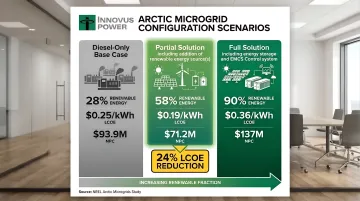
Source: NREL Arctic Microgrids Study
That 24% LCOE reduction in the near-term hybrid scenario is driven by displacing expensive diesel with locally generated renewable power. For remote communities where diesel costs range from $250 to $580 per MWh, even modest fuel displacement produces substantial annual savings.
Innovus Power systems with high renewable penetration have demonstrated fuel consumption reductions of up to 80%, with one Canadian Arctic community achieving 20-50% fuel savings depending on season, excluding additional solar impact.
Defining LCOE: The levelized cost of electricity (LCOE) is the average net cost of generating power over an asset's lifetime, expressed per unit of energy produced. It accounts for capital, fuel, operations, and maintenance costs, providing a standardized way to compare the true economics of different energy sources.
Levelized Cost of Energy Advantage
Advanced microgrids achieving 80-100% renewable penetration can produce power at costs that compete with or undercut utility-scale rates over the system's lifetime. This levelized cost of energy (LCOE) advantage stems from:
- Zero fuel costs for renewable generation
- Predictable maintenance expenses over decades
- Declining capital costs for solar and storage technologies
- Avoided utility infrastructure charges and transmission losses
Innovus Power's proprietary modeling has enabled customers to achieve up to 25% reductions in total capital costs and 20% reductions in long-term cost of energy through optimal system sizing and technology selection.
Long-Term Cost Stability
Unlike utility tariffs that fluctuate with fuel prices and infrastructure levies, on-site microgrid generation locks in predictable energy costs for decades. With commercial electricity prices rising nearly 19% over five years, this hedge against future rate hikes delivers compounding value.
For sectors like healthcare, agriculture, and remote operations — where unplanned cost spikes directly affect operations — that price stability translates into more reliable budgeting and stronger long-term margins.
Optimizing Grid Management with Intelligent Control
Intelligent Energy Management Control Systems and storage orchestration in advanced microgrids improve grid stability, reduce renewable waste, and ensure critical load continuity.
The Role of Energy Management Control Systems
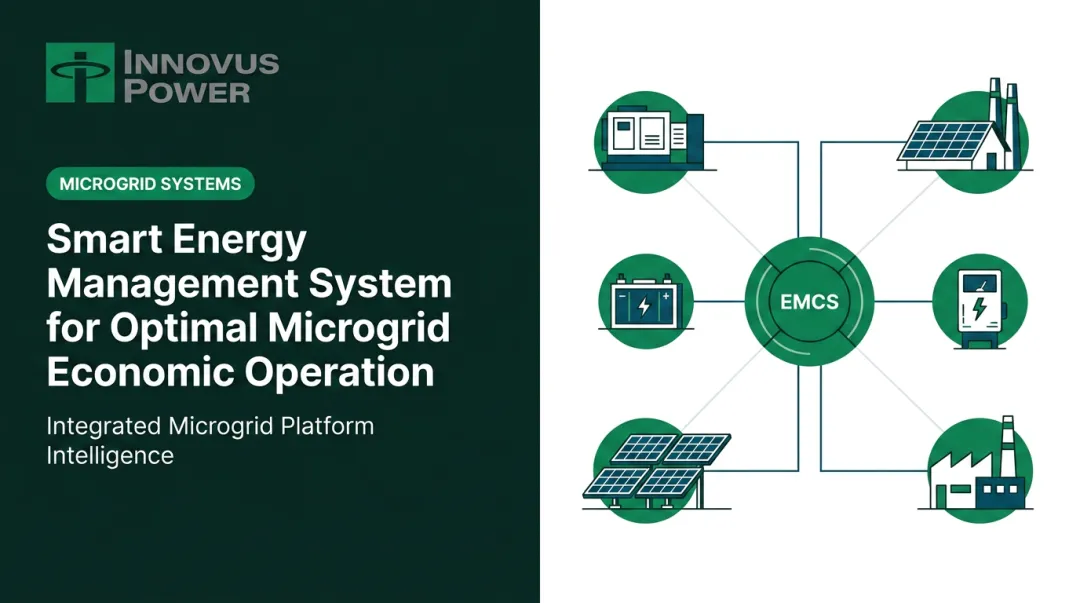
The EMCS continuously monitors generation sources, load demand, storage state, and grid signals, then automatically dispatches resources to maintain balance, frequency stability, and voltage quality without manual intervention. This real-time optimization operates on millisecond-to-second timescales for immediate response and minute-to-hour timescales for economic optimization.
The GridGenius EMCS manages where and when energy is dispatched and stored across all connected resources. The system controls power volume, response speed to load changes, and power quality through advanced power electronics rather than mechanical engine control.
Renewable Penetration Without Curtailment
Without advanced control, high renewable penetration leads to significant energy waste (curtailment) when generation exceeds load. Advanced microgrids use storage and flexible dispatch to capture this energy instead of losing it.
In a case study of islanded grids, proposed microgrids with battery energy storage and solar PV were projected to provide up to 56% reduction in annual energy consumption from the main grid and 42% reduction in diesel consumption during outages.
Innovus Power systems achieve up to 90-100% renewable penetration without curtailment through:
- Predictive algorithms that forecast renewable output and load demand
- Storage orchestration that absorbs surplus generation and deploys it during shortfalls
- Intelligent dispatch that coordinates multiple generation sources without interruption
- Grid-forming inverters that maintain stability even with variable renewable input
Islanding and Grid-Reconnection Management
Advanced microgrids detect grid disturbances and transition automatically to islanded operation, protecting critical loads and reducing outage impact. During "black sky" events (major, extended outages), these systems maintain power for critical loads indefinitely, avoiding the high costs of downtime.
The GridGenius platform supports both operating modes:
- Grid-forming mode: Establishes voltage and frequency reference when islanded
- Grid-following mode: Synchronizes safely for reconnection when grid conditions stabilize
For hospitals, data centers, and industrial facilities, even a brief outage can trigger six- or seven-figure losses — making seamless islanding a hard operational requirement.
Power Quality Optimization
Superior power conditioning in advanced microgrids maintains consistent voltage and frequency, which reduces energy waste, extends the life of electrical equipment, and lowers total energy consumption for end users.
Economic impact of power quality issues:
- Industrial sectors such as semiconductor manufacturing can face losses of millions of dollars per event due to voltage sags
- Harmonics cause excessive heating in transformers and motors, leading to premature failure and reduced operating life
- Poor power quality increases energy consumption and shortens equipment lifespan across all connected loads
One Canadian industrial manufacturing facility documented higher energy consumption and decreased life expectancy of major electrical components due to power quality issues. After installing a GridGenius system with ultracapacitor energy storage, the facility achieved power quality suitable for critical applications with dramatically improved frequency stability.
Remote Monitoring and Management
24/7 real-time telemetry and remote management allow operators to optimize performance, respond to anomalies, and update dispatch logic from anywhere — a critical capability for remote or distributed sites where on-site technical expertise is limited.
Innovus Power's remote management tools include:
- PowerView: Remote monitoring, performance optimization, and software upgrades worldwide
- FleetGenius: Extends monitoring and management across entire deployed fleets for customers operating multiple systems
Key Components of an Advanced Microgrid System
Distributed Energy Resources (DERs)
Advanced microgrids integrate multiple DER categories, selecting technologies based on site-specific conditions rather than vendor preferences.
Primary DER categories include:
- Solar PV – Declining costs and proven reliability make solar the foundation for most advanced microgrids
- Wind turbines – Particularly valuable in locations with consistent wind resources or seasonal complementarity with solar
- Battery energy storage systems (BESS) – Lithium-ion, flow batteries, or ultracapacitors providing millisecond-to-hour response
- Variable-speed generators – Diesel Generators that match load, delivering up to 50% superior efficiency
- Fuel cells – Hydrogen or solid oxide fuel cells providing clean, dispatchable generation
- Micro-hydro – Run-of-river or small-scale hydro in suitable locations
Innovus Power's vendor-agnostic approach evaluates all available DER technologies without equipment bias, ensuring each system is optimized for the lowest cost of energy at that specific site.
Energy Storage as the Balancing Backbone
Energy storage serves as the critical balancing resource that enables high renewable penetration. Batteries and other storage technologies absorb surplus renewable generation, provide instantaneous response to load changes, and underpin islanded operation reliability.
The North American microgrid market is projected to reach $13.05 billion by 2033, driven heavily by storage integration for resilience and renewable firming. That trajectory reflects what operators already know: without storage, high renewable penetration remains unreliable.
Microgrid Control Architecture
Advanced microgrids employ a three-tier control hierarchy that ensures seamless operation across all conditions.
Three control levels:
Local (Primary) Controls – Operate in milliseconds to seconds at the device level for immediate response, handling voltage/frequency regulation and device protection (for example, inverter droop control)
EMCS (Secondary Control) – Operates in seconds to days for site-wide energy management, managing dispatch, synchronization, islanding transitions, and economic optimization
Utility-Interface (Tertiary) Controls – Operates in minutes to days for coordinated grid interaction, managing the utility interface, market participation, and longer-term scheduling
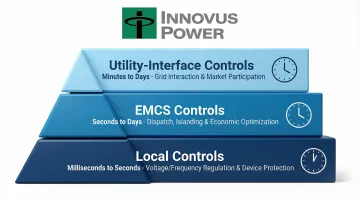
This hierarchical structure, defined by IEEE 2030.7 standards, allows the system to transition cleanly between grid-tied and islanded modes without interrupting local load — a critical capability for high-reliability sites.
The GridGenius EMCS serves as the central intelligence coordinating all three control levels — managing dispatch, storage, and automatic paralleling across multiple systems. This enables up to 90–100% renewable penetration without curtailment.
Who Benefits Most from Advanced Microgrid Solutions
Remote and Off-Grid Communities
Remote communities face extreme energy costs due to reliance on imported diesel. Fuel costs for power generation in remote Alaska can range from $250 to $580 per MWh, with some Canadian Arctic costs reaching similar or higher levels. Hybrid microgrids can cut these costs while improving energy security.
Innovus Power deployed a system in a Canadian Arctic community of 550 residents that achieved 20-50% fuel savings depending on season, simplified powerhouse operations from 2-3 fixed-speed gensets to one GridGenius unit, and delivered high reliability with improved power quality.
Industrial Operations
Mining, oil and gas, and other industrial operations with high energy costs and uptime requirements benefit substantially from advanced microgrids. These facilities often face:
- High demand charges from variable loads (conveyors, crushers, drilling equipment)
- Unreliable grid connections in remote locations
- Expensive fuel logistics for backup generators
- Production losses from power quality issues or outages
For industrial facilities, fuel savings can exceed 20% in fossil-only operations and climb above 50% when full-penetration solar or wind power is optimized through intelligent control systems.
Critical Facilities
For hospitals, data centers, and military installations where power failure is not an option, the value of resilience is quantifiable and high.
Outage costs for critical facilities:
| Facility Type | Estimated Cost Impact |
|---|---|
| Data Centers | ~$8,851 per minute |
| Hospitals | ~$690,000 per event |
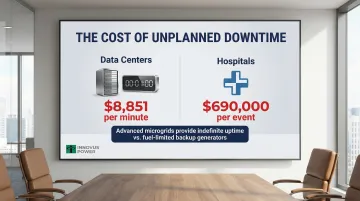
Advanced microgrids provide essential redundancy beyond standard UPS systems, sustaining operations indefinitely compared to fuel-limited backup generators. That scale of resilience is what drove a US medical care provider to engage Innovus Power for microgrid systems across more than 100 facilities — targeting a greener footprint, lower energy costs, and stronger power resilience across critical healthcare operations.
Commercial and Hospitality Sectors
Resorts, hotels, and commercial campuses benefit from cost reduction, sustainability credentials, and power quality improvements that protect expensive equipment and improve guest or tenant experience. These facilities value:
- Predictable energy costs for budget planning
- Uninterrupted operations during grid outages
- Sustainability messaging for brand differentiation
- Power quality that protects HVAC, refrigeration, and IT systems
Agriculture and Greenhouse Operations
Agricultural enterprises rely on power certainty for climate control, irrigation systems, and processing operations. Advanced microgrids support consistent, low-cost power in rural areas with unreliable grid access or high demand charges.
One Caribbean agricultural processing facility implemented Innovus Power's solar plus battery storage design, sourcing approximately 90% of required energy on-site. The result: lower utility costs, reduced carbon emissions, and reliable power for time-sensitive processing operations.
What to Look for in an Advanced Microgrid Partner
Vendor-Agnostic Expertise
A provider locked into specific equipment brands will optimize for their products, not for the customer's lowest cost of energy. Look for partners who evaluate all available DER technologies without bias.
Vendor-agnostic design ensures the system is optimized based on site-specific conditions, load profiles, and economic objectives rather than equipment preferences. This approach typically delivers 15-25% lower capital costs and 10-20% lower long-term energy costs compared to vendor-locked solutions.

Key Provider Capabilities
Evaluate potential partners on these capabilities:
- Proprietary modeling and simulation tools that validate performance before deployment and optimize for lowest LCOE
- Proven installations across diverse applications and environments, not just reference projects in ideal conditions
- 24/7 remote monitoring and optimization to keep systems performing as designed throughout their service life
- Standards compliance with IEEE 2030.7 (Specification) and IEEE 2030.8 (Testing) for interoperability
- Advanced testing methods including Controller Hardware-in-the-Loop (CHIL) and Power Hardware-in-the-Loop (PHIL) simulations for site-specific validation
Experience and Long-Term Partnership
Complex microgrid projects demand deep expertise across all power technologies—solar, wind, hydro, storage, dispatchable generation, and grid integration. With over 30 years in the field and systems operating across North America, the Caribbean, remote Arctic locations, and other demanding environments, Innovus Power has the track record and cross-environment experience that complex microgrid projects demand. Its proprietary modeling tools have helped customers cut total capital costs by up to 25% and long-term cost of energy by up to 20% before a single component is deployed.
A strong long-term partner should provide more than equipment. Look for:
- Comprehensive design services covering risk, operational performance, and technology mix
- Ongoing optimization support after deployment to maximize value over decades
- Remote management capabilities for distributed and off-grid installations
- Software upgrades and performance improvements throughout the system lifecycle
The North American microgrid market is projected to grow at 10.43% CAGR through 2033, which means more vendors will be competing for projects. In a crowded field, separating a genuine track record from marketing claims becomes one of the most important procurement decisions you'll make.
Frequently Asked Questions
How much can an advanced microgrid reduce my electric bill?
Reductions depend on site conditions, current rates, and system design, but advanced microgrids with high renewable penetration can achieve substantial savings. Systems optimized for demand charge reduction, time-of-use arbitrage, and fuel displacement have demonstrated up to 80% reductions as a benchmark for well-optimized configurations.
What is the difference between a basic microgrid and an advanced microgrid?
Basic microgrids typically use a single fossil fuel source for backup power, while advanced microgrids integrate multiple distributed energy resources (solar, wind, storage, dispatchable generation) with intelligent control software for autonomous, optimized, multi-mode operation that maximizes renewable use and minimizes costs.
Can an advanced microgrid operate independently from the utility grid?
Yes, advanced microgrids can island from the utility grid and operate autonomously using on-site generation and storage. This capability makes them suitable for remote locations without grid access or as resilience infrastructure for critical loads that cannot tolerate utility outages.
What types of organizations benefit most from advanced microgrids?
Organizations with high energy costs, critical uptime requirements, sustainability goals, or limited grid access benefit most. This includes:
- Industrial facilities and mining operations
- Remote and rural communities
- Healthcare institutions and military installations
- Hospitality venues and agricultural operations
How does an energy management control system reduce costs?
An EMCS continuously optimizes dispatch decisions in real time, shifting loads, managing storage charge cycles, and maximizing renewable use to minimize grid draw during expensive periods and eliminate unnecessary fuel consumption. The result is consistent, automated cost reduction that manual systems simply can't replicate.
How long does implementing an advanced microgrid system typically take?
Smaller systems can be deployed in 3–6 months, while larger or more complex installations typically take 12–24 months from design through commissioning. Site complexity, permitting, and system scale are the main variables. Upfront modeling and simulation significantly reduces design risk and helps avoid costly mid-build redesigns.