Introduction
The global benchmark cost for a 4-hour battery project plummeted 27% year-on-year to $78/MWh in 2025 — a record low since tracking began in 2009. Procuring without current pricing data can leave tens or hundreds of thousands of dollars on the table.
There is no single price point for smart grid storage. Costs shift based on technology type, system scale, application context (utility grid vs. remote microgrid), and integration requirements.
A small behind-the-meter battery for a commercial building costs a few thousand dollars. A utility-scale deployment runs into tens of millions. The gap between those extremes contains dozens of technology options, each with distinct cost profiles.
This article breaks down pricing ranges across major storage technologies, explains the key cost drivers, provides a full cost component breakdown, and offers a framework for budgeting the right system for your application.
Key Takeaways
- Storage costs range from thousands for small distributed systems to tens of millions for utility-scale deployments, driven by scale and technology choice
- Lithium-ion BESS costs have dropped 93% since 2010; flow batteries and pumped hydro lead in long-duration storage
- Total cost of ownership includes CapEx, OpEx, and lifecycle expenses — upfront price alone gives an incomplete picture
- Remote and industrial sites carry higher costs than grid-connected projects because of added site complexity
- Matching technology to your specific use case, not defaulting to the cheapest option, determines long-term value
How Much Do Smart Grid Storage Systems Cost?
Smart grid storage does not have a fixed price. Costs span multiple orders of magnitude depending on technology, capacity, application, and integration complexity. Misreading these ranges leads to underbudgeting, wrong technology selection, or unexpected lifecycle expenses that surface years into operation.
Understanding Cost Metrics
The industry uses two standard measurements:
- Cost per kWh of energy capacity — how much total energy the system stores; critical for bulk energy shifting and long-duration applications
- Cost per kW of power capacity — how fast it can discharge; critical for frequency regulation and short-burst applications
Both metrics matter because different applications prioritize different ratios. Frequency regulation needs high power for short bursts (high kW, low kWh), while bulk energy shifting needs sustained discharge (high kWh, moderate kW).
The most complete comparison metric is Levelized Cost of Storage (LCOS) — total lifetime cost divided by total energy delivered over the system's life, expressed in $/kWh. LCOS accounts for upfront capital, operating expenses, efficiency losses, and replacement costs, making it the most accurate basis for comparing storage options.
Small-Scale / Distributed Storage (Residential to Small Commercial)
This tier covers behind-the-meter battery systems and small islanded microgrid storage in the 5–50 kWh range. Typical installed costs include hardware and basic integration but exclude advanced SCADA, remote monitoring platforms, or complex grid interconnection equipment.
Typical installed cost range: $400–$800/kWh
Best for:
- Small commercial facilities
- Backup power applications
- Residential solar self-consumption
- Small remote sites with limited power needs
Mid-Scale / Commercial and Industrial Storage
This tier includes C&I peak shaving, demand charge management, and microgrid applications from 100 kWh to several MWh. Costs include power electronics, battery management systems (BMS), and site integration but may exclude full SCADA and advanced energy management platforms.
Typical installed cost range: $250–$500/kWh
Best for:
- Industrial facilities managing demand charges
- Remote community microgrids
- Resorts and hotels
- Mining operations
- Agriculture and greenhouse facilities
- Medium-scale renewable integration projects
At this scale, the energy management layer matters as much as the hardware. Innovus Power's GridGenius EMCS actively dispatches storage to shave peaks, coordinate solar and wind inputs, and reduce diesel runtime — which directly lowers effective $/kWh costs over the system's life. Effective cost management becomes especially important as projects scale up to utility level.
Utility-Scale / Grid-Level Storage
Large BESS projects (10 MWh and above), pumped hydro installations, and grid-tied flow battery systems fall into this tier. Grid interconnection, civil works, and control system integration are major cost contributors beyond battery hardware itself.
Typical installed cost range: $107–$334/kWh
The 2024 NREL benchmark for a 4-hour utility-scale system was $334/kWh, while Lazard reported ranges of $107–$232/kWh for 100 MW/400 MWh systems. This wide range reflects differences in site conditions, interconnection complexity, and procurement strategies.
Best for:
- Power utilities managing grid stability
- Large-scale renewable integration
- Grid frequency regulation
- Bulk energy shifting and arbitrage
Types of Grid Energy Storage and Their Cost Ranges
The type of storage technology chosen is the single biggest determinant of upfront cost. Each technology has different strengths, weaknesses, and cost profiles across the CapEx-OpEx-lifecycle spectrum.
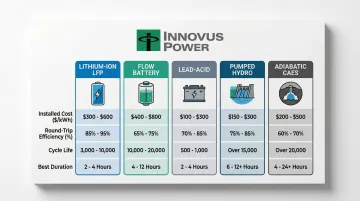
The table below summarizes how these five technology types compare across the metrics that matter most to system designers and project financiers.
| Technology | Installed Cost ($/kWh) | Round-Trip Efficiency | Cycle Life | Best Duration |
|---|---|---|---|---|
| Lithium-Ion (LFP) | $107–$334 | 85–92% | 4,000–10,000 | 2–4 hours |
| Flow Battery | $300–$658 | 70–85% | 20,000+ | 6–12 hours |
| Lead-Acid | ~$236 | 75–84% | 1,000–2,000 | Backup/short |
| Pumped Hydro | ~$140/MWh levelized | 70–85% | 50+ year asset | 8–12+ hours |
| Adiabatic CAES | ~$120 | 60–70% | 30+ year asset | 8–24 hours |
Lithium-Ion Battery Energy Storage Systems (BESS)
Lithium-ion BESS dominates the market today due to high round-trip efficiency (85-92%), declining pack prices, modularity, and fast response times. Utility-scale battery storage costs have dropped 93% since 2010, falling from $2,571/kWh to $192/kWh in 2024.
Current benchmark cost: $107–$334/kWh installed for utility-scale systems
The technology comes with clear operational tradeoffs to weigh against those cost advantages:
- Round-trip efficiency of 85–92%, with modular scalability and millisecond response times
- Cycle life degrades over time, requiring augmentation at year 5–10 to maintain rated capacity
- Thermal management adds ongoing cost
- Best suited for 2–4 hour discharge durations; economics weaken beyond that window
Lithium Iron Phosphate (LFP) chemistry has displaced Nickel Manganese Cobalt (NMC) as the dominant choice, accounting for 74% of the stationary storage market. LFP offers superior cycle life (4,000–10,000 cycles) compared to NMC (~2,000 cycles), which meaningfully reduces long-term replacement costs.
Flow Batteries
Flow batteries carry a higher upfront cost per kWh than lithium-ion but offer longer cycle life, deeper discharge capability, and lower degradation over time. They decouple power (kW) from energy (kWh), making them cost-effective for long-duration applications.
Current benchmark cost: $300–$658/kWh installed
The case for flow batteries sharpens as discharge duration increases:
- Cycle life exceeding 20,000 cycles with minimal degradation — the electrolyte doesn't wear out like solid electrodes
- Can discharge to 100% depth without damage
- Lower round-trip efficiency (70–85%) and larger physical footprint than lithium-ion
- Less mature supply chain, which can affect procurement timelines
Flow batteries become cost-competitive with lithium-ion when discharge duration extends beyond 6 hours, as their high fixed power costs are spread across more kWh of energy storage.
Lead-Acid Batteries
Lead-acid offers the lowest upfront cost but comes with significantly higher maintenance, shorter cycle life, and lower efficiency. Its role has narrowed to backup power, telecom applications, and budget-constrained small microgrids.
Current benchmark cost: ~$236/kWh (DC block cost, 2020 data)
The upfront savings rarely hold up under daily cycling conditions:
- Cycle life of 1,000–2,000 cycles; requires replacement every 3–7 years depending on usage
- Round-trip efficiency of 75–84%
- Depth of discharge limitations reduce usable capacity
Its low cycle life results in annualized costs nearly three times higher than lithium-ion for grid applications with daily cycling. For projects where storage cycles daily, lead-acid is rarely the economical choice over a 10-year horizon.
Pumped Hydro and Other Bulk Storage Technologies
Pumped hydro offers the lowest levelized cost of storage over its lifespan (often 50+ years) but requires very high upfront capital and specific geographic conditions. It accounts for over 90% of total global electricity storage capacity.
Levelized cost: ~$140/MWh ($0.14/kWh) for 10-hour systems
Its economic case is compelling at scale, but constrained by geography:
- Asset life of 50–60 years at massive scale (typically 100 MW+)
- Requires an elevation difference and reliable water resources — not available in most project locations
- Highest upfront capital costs of any storage technology
Compressed Air Energy Storage (CAES) provides a geographically flexible alternative for bulk storage. Large-scale Adiabatic CAES costs declined to approximately $120/kWh in 2024, making it competitive for long-duration applications where suitable geology exists.
Emerging and Hybrid Options
Sodium-ion, solid-state batteries, and gravity-based storage are all on declining cost trajectories, though none have reached commercial scale comparable to lithium-ion or flow batteries. Sodium-ion in particular is drawing attention for stationary applications, with projected costs below $100/kWh as manufacturing scales.
Hybrid systems — pairing lithium-ion for short-duration frequency response with a flow battery for longer discharge — are gaining traction in remote and industrial microgrids. The combination targets total cost rather than per-technology cost, with each component handling the duty cycle it handles most efficiently. As storage economics continue shifting, the right technology mix increasingly depends on discharge duration, cycle frequency, and site-specific constraints.
Key Factors That Affect Smart Grid Storage Costs
Beyond technology type itself, four operational and contextual factors drive significant cost variation between otherwise similar projects.
Scale and Energy Capacity Requirements
Larger projects typically achieve lower $/kWh costs through bulk procurement and shared balance-of-system costs. However, this relationship is non-linear — doubling project size doesn't cut costs in half.
Scale economies in practice:
- Utility-scale systems (100 MW+): $107-$232/kWh
- Commercial systems (1-10 MW): $250-$500/kWh
- Small distributed systems: $400-$800/kWh
Capacity sizing errors in either direction are expensive. Over-sizing wastes capital on unused capacity, while under-sizing forces costly augmentation projects or subjects facilities to peak demand penalties that erode savings.
Application and Discharge Duration
The intended use case determines the required power-to-energy ratio, which directly affects technology selection and cost.
Duration-driven technology selection:
- 1-2 hours (frequency regulation, peak shaving): Lithium-ion excels
- 4-6 hours (daily arbitrage, renewable firming): Lithium-ion remains competitive
- 6-12 hours (bulk shifting, multi-day backup): Flow batteries or pumped hydro become cost-effective despite higher upfront costs
- 12+ hours (seasonal storage): Pumped hydro or emerging technologies
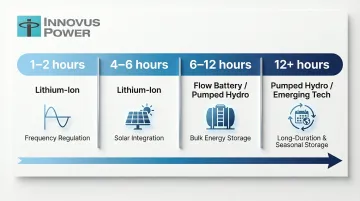
Short-duration applications favor lithium-ion's lower capital cost and high efficiency. Long-duration needs may justify flow batteries' higher upfront investment due to their minimal degradation and unlimited cycle life.
Installation Environment and Site Complexity
Remote or off-grid installations face significantly higher balance-of-system costs due to transportation, civil works, temperature management systems, and the absence of local grid infrastructure.
Cost premiums for challenging sites include:
- Transportation to Arctic or island locations
- Extreme temperature management (heating in cold climates, cooling in hot climates)
- Civil works on unprepared sites
- Extended commissioning timelines
- Limited local technical support
These site factors can add 30-50% premiums to hardware-only cost estimates. For example, a remote Arctic community microgrid deployed by Innovus Power achieved 20-50% fuel savings but required specialized packaging and thermal management that wouldn't be necessary for a grid-connected southern installation.
Integration with Renewable Generation and Grid Controls
Storage deployed as a standalone asset costs less to integrate than storage paired with solar, wind, or variable generation. The latter requires advanced inverters, bidirectional power electronics, and sophisticated energy management systems, all of which add to total installed cost.
Integration cost drivers:
- Bidirectional inverters for charging and discharging
- Advanced battery management systems
- Energy management control systems (EMCS)
- Renewable curtailment prevention logic
- Grid synchronization equipment
These integration costs can add 20-40% to the base storage hardware cost. However, they also unlock greater value through renewable firming, curtailment avoidance, and fuel displacement. Innovus Power's GridGenius EMCS addresses this directly — by optimizing storage dispatch and coordinating renewable inputs, it reduces diesel dependence and maximizes the economic return on integration spending. A Caribbean agricultural facility using a solar-plus-storage system designed by Innovus Power sourced approximately 90% of its energy from renewables, achieving a superior return on investment compared to storage-only alternatives.
Full Cost Breakdown: CapEx, OpEx, and Lifecycle Costs
The total cost of a smart grid storage system goes well beyond the battery or storage hardware itself. Five cost components determine true system economics.
Initial Hardware Purchase (One-Time)
Battery modules, power conversion system (inverter/converter), battery management system (BMS), and thermal management hardware make up the initial purchase.
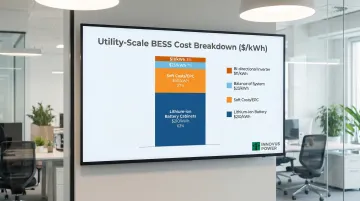
Hardware cost breakdown for a 4-hour utility-scale lithium-ion system ($334/kWh total):
- Lithium-ion battery cabinets: $210/kWh (~63%)
- Bi-directional inverter: $44/kW (~$11/kWh for 4-hour system)
- Balance of system (electrical + structural): $23/kWh
Hardware typically represents 50-70% of total installed cost, though this share varies by technology and project size. Flow batteries have a higher power system cost share, while pumped hydro has massive civil works costs that dwarf equipment expenses.
Installation and Integration (One-Time)
Soft costs catch many buyers off guard — particularly for remote sites requiring significant site preparation. These include:
- Engineering, Procurement, and Construction (EPC): 15-25% of total project cost
- Permitting and interconnection studies
- Site preparation and foundations
- Electrical infrastructure and transformers
- System commissioning and testing
- Tax and developer profit margins
For the utility-scale system example above, soft costs total approximately $90/kWh, representing about 27% of the installed cost.
Operations and Monitoring (Recurring)
Energy management software licensing, remote monitoring fees, cybersecurity, and utility interconnection charges create ongoing operational expenses.
Cloud-based monitoring reduces on-site staffing costs but adds recurring service fees. Innovus Power's PowerView software, for example, provides 24/7 remote monitoring and management worldwide without requiring local technical staff on-site.
Typical annual OpEx: 1-3% of initial capital cost
Maintenance and Degradation Management (Recurring/Periodic)
Preventive maintenance, battery augmentation (adding new cells as existing ones degrade), and component replacement represent significant periodic costs.
Lithium-ion systems typically require capacity augmentation at year 5-10 to maintain rated output — a substantial cost that vendors routinely exclude from headline CapEx figures. Fixed O&M budgets often include an augmentation reserve estimated at 4% of capacity cost annually.
Maintenance cost drivers:
- Scheduled inspections and testing
- Component replacement (inverters, cooling systems)
- Battery augmentation to offset degradation
- Software updates and cybersecurity patches
Flow batteries require pump and stack maintenance but avoid battery replacement, as the electrolyte doesn't degrade. This maintenance advantage helps offset their higher upfront cost in long-duration applications.
End-of-Life and Replacement (Periodic)
Battery recycling, decommissioning, and full system replacement at end of useful life must be factored into lifecycle cost analysis.
Technology lifespans:
- Lithium-ion BESS: 10-15 years with augmentation
- Flow batteries: 20+ years
- Lead-acid: 3-7 years
- Pumped hydro: 50-60 years
Levelized cost of storage (LCOS) ties all five components together into a single comparable figure. A flow battery priced at $800/kWh installed may outperform a $334/kWh lithium-ion system on LCOS once lifespan, augmentation costs, and maintenance cycles are fully modeled.
Low-Cost vs. High-Cost Storage: What's the Real Difference?
The cheapest storage option at purchase rarely delivers the lowest total cost. Understanding where costs diverge — efficiency, cycle life, and scalability — reveals which investment actually pays off.
Performance and Reliability
Lower-cost options (lead-acid, entry-level lithium-ion) typically have lower round-trip efficiency, losing more energy in charge/discharge cycles. A system with 75% efficiency wastes 25% of input energy, while a 90% efficient system wastes only 10% — that difference compounds over thousands of cycles.
Efficiency comparison:
- Premium lithium-ion (LFP): 90-92% round-trip efficiency
- Standard lithium-ion: 85-88% round-trip efficiency
- Flow batteries: 70-85% round-trip efficiency
- Lead-acid: 75-84% round-trip efficiency
Higher-cost systems maintain performance specifications closer to their rated values over their operating life, delivering more predictable output. Budget systems often experience faster degradation, requiring earlier capacity expansion or replacement.
Durability and Cycle Life
Efficiency losses and cycle life are linked: a battery rated for 2,000-3,000 cycles will require replacement far sooner than a premium system rated for 6,000-10,000+ cycles, compounding the cost gap over time.
Cost-per-cycle comparison:
- Lead-acid at $236/kWh with 1,500 cycles = $0.16/kWh/cycle
- Standard lithium-ion at $300/kWh with 3,000 cycles = $0.10/kWh/cycle
- Premium LFP at $350/kWh with 7,000 cycles = $0.05/kWh/cycle
- Flow battery at $500/kWh with 20,000 cycles = $0.025/kWh/cycle
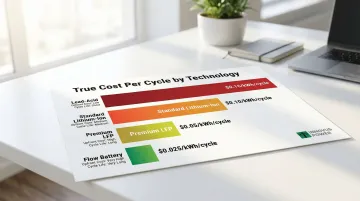
A more expensive upfront investment can cost less per unit of energy delivered over time. For applications with daily cycling, this difference is substantial — a system cycling daily for 10 years completes 3,650 cycles, favoring technologies with high cycle life ratings.
Long-Term Value and Scalability
Premium systems bring advantages that go beyond raw performance numbers:
- Modular scalability — capacity can be added without replacing the core system
- Deeper integration with advanced grid controls and energy management software
- Longer manufacturer support windows, reducing obsolescence risk
These factors matter most for critical infrastructure — remote communities, military installations, and industrial microgrids where downtime carries real operational costs. Innovus Power deployed a Canadian Arctic community microgrid that consolidated operations from 2-3 fixed-speed gensets down to a single GridGenius VSG running 24/7. The result: reduced maintenance complexity, longer service intervals, and operational savings that never show up in a purchase-price comparison.
How to Plan Your Storage Budget (and What Most Buyers Miss)
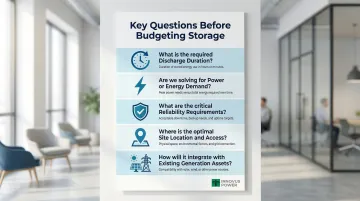
Effective storage budgeting starts with use-case clarity, not a technology shortlist. Answer key questions before requesting quotes.
Define These Factors Before Budgeting
- Discharge duration: How many hours of backup or peak shaving do you need? A 2-hour system costs roughly half what a 4-hour system costs for the same power capacity.
- Power demand vs. energy throughput: Do you need high power for short periods (kW-focused) or sustained energy delivery (kWh-focused)? This ratio determines technology selection.
- Reliability requirements: Can you tolerate occasional outages, or is 99.9%+ uptime mandatory? Higher reliability requires redundancy and backup systems that increase costs.
- Site location and access: Remote sites with difficult access face transportation and installation premiums. Arctic locations require thermal management; island locations face shipping constraints.
- Existing generation assets: Are you grid-connected, running solar and diesel, or completely off-grid? Integration complexity varies widely based on existing infrastructure.
Vendor-agnostic system design — selecting storage technology based on application requirements rather than a manufacturer's catalog — consistently produces better lifecycle economics. Innovus Power's proprietary modeling and simulation tools evaluate total cost of ownership across technology options before any system configuration is recommended, so the numbers driving the decision are grounded in your specific load profile, not a product line.
Frequently Asked Questions
How much does a BESS system cost?
Battery energy storage system (BESS) costs vary by scale and chemistry. Small commercial systems (50–500 kWh) typically cost $400–800/kWh installed, while utility-scale projects (10+ MWh) range from $107–334/kWh installed. Lithium-ion costs have declined 93% since 2010, making BESS increasingly competitive with traditional generation.
What are the different types of grid energy storage?
The main categories are electrochemical (lithium-ion, flow batteries, lead-acid), mechanical (pumped hydro, compressed air), and thermal storage. Each type suits different discharge durations, scale requirements, and cost profiles: lithium-ion excels at 2–4 hours, flow batteries at 6–12 hours, and pumped hydro at bulk long-duration storage.
What is the levelized cost of storage (LCOS) and why does it matter?
LCOS represents the total lifecycle cost of a storage system divided by total energy delivered over its lifetime, expressed in $/kWh. It accounts for capital costs, O&M, efficiency losses, and replacement expenses — making it a truer economic comparison across technologies with different lifespans and degradation rates than upfront price alone.
Which storage technology is most cost-effective for remote or off-grid microgrids?
Lithium-ion BESS is most commonly deployed in remote microgrids due to modularity, declining costs, and proven reliability. However, the best choice depends on load profile, renewable integration level, and whether diesel displacement savings can offset higher upfront investment. Flow batteries may prove more economical for heavy-cycling applications despite higher capital costs.
How long do smart grid storage systems typically last?
Lifespan varies by technology: lithium-ion BESS lasts 10–15 years (up to 20 with proper management), flow batteries 20+ years, lead-acid 3–7 years, and pumped hydro 50–60 years. Longer-lived systems amortize capital costs over more cycles, which directly improves lifecycle economics.
What is the difference between CapEx and OpEx in energy storage systems?
CapEx covers upfront hardware, installation, and commissioning costs, typically 70–85% of total lifecycle cost. OpEx covers ongoing monitoring, maintenance, and augmentation, typically 1–3% of capital cost annually. Evaluating both together matters because low-CapEx systems often carry higher OpEx burdens that erode apparent savings.