Introduction
Getting a straight answer on microgrid costs is harder than it should be. Utility rates keep climbing, outages are more frequent, and organizations across commercial, industrial, and remote sectors are moving toward microgrids — yet most pricing information is either vague or wildly inconsistent.
The core problem is that costs vary enormously based on scale, configuration, location, existing infrastructure, and intended use. A backup system for a single commercial facility might cost a few hundred thousand dollars, while a fully off-grid community microgrid can exceed $100 million. That range leads to real consequences: underbudgeting, stalled projects, or abandoning systems that could deliver decades of savings.
This guide breaks down real pricing ranges, the components driving cost, what separates budget systems from premium ones, and how to estimate the right investment for your situation.
Key Takeaways
- Microgrid costs range from a few hundred thousand dollars to over $100 million, with NREL benchmarking $2M–$5M per megawatt as a common reference
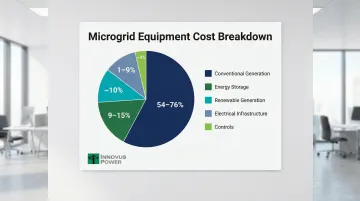
- Generation capacity is the biggest cost driver, historically accounting for 54–76% of equipment costs
- Grid-connected backup microgrids cost far less than fully off-grid systems designed for 24/7 operation
- Well-designed systems can cut power costs by up to 80% through fuel savings and renewable integration
- Hybrid renewable systems deliver 19–35% lower lifecycle costs than diesel-only designs — total cost of ownership is the metric that matters
How Much Does a Microgrid Cost? (Pricing Overview)
Microgrid pricing works nothing like buying off-the-shelf energy equipment: every system is engineered to a specific load, site, and use case. Organizations frequently underbudget based on incomplete quotes, choose undersized configurations, or get blindsided by integration and commissioning costs that never appeared in the initial proposal.
Typical Cost Ranges
The U.S. Department of Energy and National Renewable Energy Laboratory (NREL) set a baseline capital cost range of $2 million to $5 million per megawatt for microgrid development in the continental United States. This benchmark covers equipment, installation, and soft costs — though actual project costs vary by complexity. That range breaks down differently depending on system scale and application.
Entry-Level / Grid-Connected Backup Systems
Commercial facilities needing outage protection — and campuses with existing generation wanting basic islanding capability — fall into this tier. These systems include:
- Basic control system and grid interconnection equipment
- Battery storage or small generator
- Minimal distribution upgrades
- Costs generally range from $500,000 to $2 million for smaller installations
Mid-Range / Commercial or Community-Scale Systems
Industrial operations, hospitals, resorts, agricultural facilities, and small communities with moderate reliability and cost-reduction goals fall here. These systems typically include:
- Solar PV and battery energy storage
- Backup generation
- Intelligent microgrid controller
- Distribution automation
- Average costs of $2.1M to $4.1M per MW depending on market segment
Large-Scale / Off-Grid or High-Complexity Systems
Remote communities, Arctic and island locations, mining and oil & gas sites without grid access, and military installations demanding full energy independence all require this tier. Systems at this scale include:
- Multi-source generation (solar, wind, diesel/gas, or hydro)
- Large-scale battery storage
- Advanced energy management control system
- Full distribution infrastructure and remote monitoring
- Costs often exceed $5M per MW and can reach $100M+ for complete installations
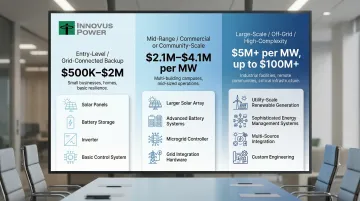
These ranges exclude major site preparation, permitting, utility interconnection studies, and financing costs — which can add 10–25% to a project's total investment.
Key Factors That Affect Microgrid Cost
Microgrid pricing is shaped by technical, operational, and site-specific variables working together. Two systems with identical generation capacities can differ dramatically in cost based on these factors.
Grid-Connected vs. Off-Grid Configuration
A grid-connected microgrid designed for backup and peak shaving requires far less generation capacity and storage redundancy than a fully off-grid system that must meet 100% of load 24/7. Off-grid systems — common for remote communities, mining, or Arctic locations — carry higher capital costs because they must be engineered for full self-sufficiency with no safety net.
Generation Capacity and Energy Mix
Scale is a primary cost lever. NREL data shows that commercial microgrid projects under 3 MW typically have higher normalized costs per MW ($4.1M per MW) compared to larger community or utility systems ($2.1M to $2.6M per MW), demonstrating clear economies of scale.
The choice of generation mix significantly affects both upfront and long-term costs:
- Conventional generation (diesel/gas): Accounts for 54–76% of total equipment costs
- Renewable generation: Typically represents ~10% of equipment costs
- Energy storage: Represents 9–15% of equipment costs
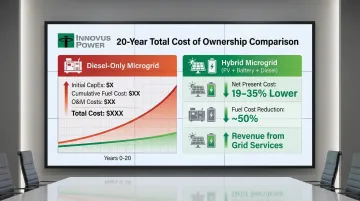
Fossil-fuel-heavy systems are cheaper to build but far more expensive to operate over time. Hybrid systems with high renewable penetration cost more upfront but deliver 19–35% lower net present cost over a 20-year lifecycle through fuel savings.
Existing Infrastructure: Greenfield vs. Retrofit
A site with existing generation — CHP plant, solar array, backup generators — can add microgrid controls and automation at a fraction of the cost of a greenfield build. The first question any microgrid designer should ask: what electrical infrastructure already exists on site, and how can it be leveraged to reduce scope?
Thorough infrastructure assessment at the design stage — evaluating what can be integrated versus replaced — is one of the highest-leverage cost reduction opportunities in any microgrid project.
Control System Sophistication
The microgrid controller typically accounts for approximately 3% of total equipment cost (ranging from $6,200/MW to $470,000/MW), but its sophistication directly determines long-term savings potential.
A basic controller handles islanding and synchronization. An advanced Energy Management Control System (EMCS) optimizes dispatch across all energy sources in real time, enabling high renewable penetration and eliminating unnecessary generator runtime.
Innovus Power's GridGenius EMCS operates at this advanced tier, enabling up to 90–100% renewable penetration without curtailment. As a relatively small line item in the overall budget, the controller's impact on lifetime fuel savings is disproportionate to its upfront cost.
That efficiency advantage becomes especially relevant once site location enters the equation.
Location and Site Complexity
Remote or difficult-to-access locations add significant cost through logistics, specialized equipment, and construction complexity:
- Arctic, island, or offshore sites: Require specialized cold-weather equipment, expensive fuel delivery, and complex logistics
- Dense urban environments: Add cost through distribution reconfiguration and permitting
- Site-specific factors: Soil conditions, distance between loads, and existing utility infrastructure all affect civil and electrical installation costs
Additional electrical infrastructure costs typically range from 1% to 38% of total microgrid costs, with the higher end representing complex or remote installations.
Full Cost Breakdown: What You're Actually Paying For
The total cost of a microgrid goes well beyond equipment. The DOE/NREL cost structure breaks down as follows:
The total cost of a microgrid goes well beyond equipment. The DOE/NREL cost structure breaks spending into three categories:
- Equipment and installation: ~75% of total project cost
- Construction management: ~15%
- Design and engineering: ~10%
Equipment and Installation (One-Time)
The largest budget category includes:
- Generation assets: Diesel/gas generators, solar PV, wind turbines
- Battery storage: Lithium-ion systems with 10–15 year lifespan
- Power electronics: Inverters, converters, switchgear
- Distribution infrastructure: Wiring, transformers, protection equipment
- Microgrid controller: EMCS or basic control system
Within equipment costs, conventional generation dominates at 54–76%, followed by energy storage (9–15%), renewable generation (~10%), controls (~3%), and electrical infrastructure (1–9%).
Design, Engineering, and Permitting (One-Time)
This 10% category covers:
- Feasibility studies and load analysis
- System modeling and electrical design
- Environmental compliance
- Permit applications and utility interconnection studies
Decisions made at this stage lock in long-term cost outcomes — accurate system sizing here prevents expensive corrections later. Innovus Power's proprietary modeling and simulation tools forecast performance before capital is committed, helping avoid the two most common specification errors: building too small for peak load or oversizing for a load that never materializes.
Operations and Maintenance (Recurring)
Annual O&M includes:
- Service equipment on scheduled maintenance intervals
- Replace degrading components — batteries, generator wear parts — before failures occur
- Apply software updates and monitor for cybersecurity vulnerabilities
- Optimize dispatch logic and track performance against baseline targets
Battery storage O&M costs approximately $10–$12.50 per kW-year, while diesel generators require around $9.30 per kW-year plus significant variable fuel costs. Complete microgrid systems typically incur fixed O&M costs of 3–3.5% of capital expenditure annually.
Fossil-fuel-heavy systems carry higher ongoing fuel and maintenance costs than renewable-dominant systems — a gap that widens as fuel prices rise. Those recurring costs make periodic capital reinvestment in battery replacement a more favorable trade-off over the full lifecycle.
Upgrades and Component Replacements (Periodic)
Battery storage systems require replacement at approximately year 10, with costs estimated at roughly 50% of initial battery capital (reflecting anticipated cost declines and reuse of balance-of-system infrastructure).
Generator technology evolves, but modular system architecture means upgrades can target individual components rather than triggering full replacements. A microgrid designed for scalability from the start avoids the rip-and-replace cycles that inflate 20-year lifecycle costs.
Low-Cost vs. High-Cost Microgrids: What's the Difference?
A $500K microgrid and a $20M microgrid differ in far more than size. They reflect fundamentally different performance levels, fuel dependencies, and long-term economic outcomes.
Performance and Reliability
Lower-cost systems typically:
- Depend on grid for primary power
- Provide backup only during outages
- Cover limited load segments
- Offer basic power quality
Higher-cost systems deliver:
- Full energy independence or near-independence
- Utility-grade power quality
- 24/7 operation without grid reliance
- Critical for operations where power interruption carries major financial or safety consequences
Renewable Integration and Fuel Costs
Fuel dependency is where the cost gap becomes most consequential over time. Lower-cost systems typically:
- Rely heavily on diesel or gas generation
- Achieve low renewable penetration (under 30%)
- Incur high ongoing fuel costs that erode ROI over time
- Face direct exposure to fuel price volatility
Higher-cost, renewables-heavy systems flip this equation:
- Renewable penetration reaching 90–100% in advanced designs
- Dramatically lower fuel consumption across the system's lifespan
- Operating costs that are largely fixed, independent of fuel prices
- Savings that compound as utility and fuel prices continue to rise
Long-Term Value and Total Cost of Ownership
Those fuel savings translate directly into total cost of ownership. A lower upfront investment in a fossil-fuel-heavy system can cost far more over a 20-year lifespan than a higher-capital renewable-integrated system with lower fuel and maintenance expenses.
NREL analysis comparing diesel-only microgrids against optimized hybrid (PV + Battery + Diesel) systems found:
- Hybrid systems deliver 19–35% lower net present cost over 20 years
- Fuel costs are reduced by approximately 50%
- Revenue streams from demand charge reduction and grid services contribute measurable additional value
In high-cost electricity markets, hybrid microgrids can achieve negative net present cost relative to grid power — meaning the system pays for itself and generates net savings.
How to Estimate the Right Budget for Your Microgrid
The right budget isn't the lowest number that buys a functional system — it's the investment that delivers the lowest total cost of energy over the system's life. Accurate budgeting starts with defining the problem the microgrid needs to solve.
Key Questions to Answer Before Estimating Budget
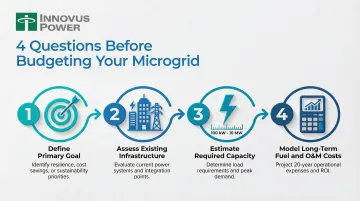
Before requesting any quotes, work through these four questions — each one shapes the configuration and drives a different cost profile:
Primary goal: Are you solving for outage resilience, energy cost reduction, carbon targets, or full energy independence? The answer determines which generation mix and control architecture you need.
Existing infrastructure: Generation assets, solar arrays, or electrical distribution already on-site can substantially reduce from-scratch build scope and cost.
Required capacity: The DOE provides rule-of-thumb generation capacity estimates:
- 1 home: 5 kW
- 10 homes: 25 kW
- 100 homes / 3 retail buildings: 250 kW
- 1 supermarket / 1 health clinic: 500 kW
- 1 hospital / 600 homes: 1.5 MW
Long-term fuel and O&M costs: Your financial model needs to quantify savings or avoided costs against upfront investment. Systems in high-electricity-cost regions can achieve payback periods of 2.7 to 4.5 years.
Once you've answered those questions, the next step is avoiding the planning errors that routinely inflate costs or undermine returns.
Common Budgeting Mistakes to Avoid
- Equipment quotes alone don't tell the full story. Installation, commissioning, permitting, and utility interconnection can add 25–40% above equipment prices — budget for the full scope from the start.
- The cheapest control system often kills the ROI case. If the controller can't achieve your renewable penetration and efficiency targets, the savings projections won't hold.
- Over-specifying adds cost without value; under-specifying triggers expensive retrofits. Right-sizing to actual load requirements is where experienced integrators earn their fee.
- Ignoring total cost of ownership is the most expensive mistake. A diesel-heavy system with low upfront cost can carry twice the 20-year lifecycle cost of a renewable-integrated design.
Frequently Asked Questions
How much does a microgrid cost?
Microgrid costs range from a few hundred thousand dollars to over $100 million depending on size and configuration. The NREL benchmark of $2M–$5M per MW provides useful context for mid-to-large systems. Grid-connected backup systems cost far less than fully off-grid installations.
Do microgrids save money?
Yes. Well-designed systems reduce utility bills, avoid outage costs, cut peak demand charges, and can generate revenue from grid services. Systems with high renewable penetration can cut power costs by up to 80% compared to traditional utility power or diesel generation.
What are the three types of microgrids?
Grid-connected microgrids tie to the utility grid and can island during outages. Off-grid/remote microgrids operate fully independently with no utility connection. Hybrid microgrids combine grid connection with significant on-site generation for both resilience and economics.
What is the payback period for a microgrid investment?
Payback typically runs 3–5 years for well-optimized systems in high-electricity-cost locations, with remote sites replacing diesel often hitting that mark in as little as 3.5 years. Savings compound over time as utility rates rise, making earlier investment more valuable.
Can a microgrid be built in phases to reduce upfront costs?
Yes — a phased approach starts with core reliability or generation infrastructure and layers in controls, renewables, and storage over time. However, the initial system must be designed with future expansion in mind, as not all architectures are modular or scalable.
What is the biggest cost driver in a microgrid project?
Generation capacity is the largest cost component, historically accounting for 54–76% of total capital costs. Whether generation is being built from scratch or integrated with existing assets is the single biggest factor separating low- and high-cost projects.