Introduction
Running a power system with no utility grid as a fallback changes everything. When a cloud passes over a solar array, or a large motor starts unexpectedly, there is no wider grid to absorb the imbalance — the isolated microgrid must resolve it internally, in seconds or less. Frequency deviates. Voltage swings. Without fast, coordinated action, equipment trips or the system goes dark.
Isolated microgrids need more than basic controls. They need an operational intelligence layer that monitors every asset continuously, anticipates imbalances before they become failures, and dispatches generation and storage in real time to maintain stability.
That intelligence layer is the energy management control system (EMCS). It coordinates solar arrays, battery storage, backup generators, and variable loads as a unified whole — not as separate devices doing their own thing. For operators running remote communities, mines, medical facilities, or military installations, the EMCS is the difference between controlled, reliable power and an unplanned outage with no external help coming.
Key Takeaways
- A EMCS serves as the single decision-making brain of an isolated microgrid, dispatching all energy assets from one control point
- Isolated microgrids face harder stability demands than grid-connected systems — every imbalance must be resolved internally
- Core EMCS functions include real-time dispatch, battery optimization, renewable maximization, and frequency/voltage regulation
- Advanced EMCS platforms can support up to 90–100% renewable energy penetration without curtailment
- Remote communities, military, mining, oil & gas, and agriculture benefit most from centralized EMS-driven control
What Is a Centralized Energy Management System for Isolated Microgrids?
Defining the Isolated Microgrid
The U.S. Department of Energy defines a microgrid as a group of interconnected loads and distributed energy resources within clearly defined electrical boundaries that can operate grid-connected, in island mode, or entirely off-grid. An isolated — or islanded — microgrid operates exclusively in that last mode. There is no utility connection. All generation, storage, and distribution happen within the system boundary.
That self-contained structure is what defines the challenge. Every kilowatt consumed must be produced or discharged locally. Every surplus must be absorbed or curtailed locally. The microgrid is its own grid, and it must behave like one at all times.
What a EMCS Actually Does
A centralized EMS is a supervisory control system — not just monitoring software — that collects real-time data from every component in the microgrid and uses it to make coordinated operational decisions. Per the architecture modeled by Olivares et al. (2014) at the University of Waterloo, a centralized EMS for isolated microgrids integrates:
- Dispatch optimization (unit commitment and economic dispatch)
- Storage management (state-of-charge constraints and cycling limits)
- Voltage and power flow control (including unbalanced conditions)
- Forecast ingestion (load and renewable generation predictions)
The control loop is continuous: sensors and smart meters feed live data to the central controller, which runs optimization logic and sends updated setpoints back to each asset.
Why Centralized Architecture Fits Isolated Microgrids
The alternative is distributed control, where decision-making is spread across multiple local controllers. Each asset responds to local measurements without full visibility into the rest of the system. In grid-connected systems, the utility provides a stabilizing buffer that masks those gaps. In an isolated microgrid, no such buffer exists.
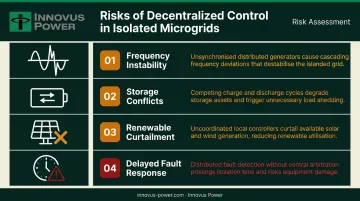
Decentralized control creates specific coordination risks in islanded operation:
- Frequency instability when local controllers respond to the same event independently
- Storage conflicts when assets charge or discharge without system-wide state-of-charge visibility
- Renewable curtailment from mismatched generation and load signals across controllers
- Delayed fault response when no single controller has full dispatch authority
A centralized EMS eliminates these gaps by giving one controller complete system visibility. When generation drops or a fault occurs, the response is immediate and coordinated across every asset simultaneously.
The Unique Energy Management Challenges of Isolated Microgrids
No Grid Buffer
On a utility-connected site, the combined inertia of thousands of generators across the grid absorbs local disturbances. Frequency barely moves. In an isolated microgrid, that buffer doesn't exist. Peer-reviewed control literature describes primary frequency response in islanded systems as operating over milliseconds to seconds — a time scale that demands pre-emptive coordination, not reactive recovery.
Any generation-demand mismatch that goes unresolved leads directly to frequency deviation, voltage instability, or a blackout. The system has no external help available.
Renewable Variability Without a Safety Net
Solar and wind are intermittent by design. On a large grid, their variability is a small fraction of total capacity and barely registers. In an isolated microgrid, a passing cloud can represent a significant fraction of total generation dropping out in seconds.
A 2021 study of an islanded microgrid with high PV penetration found peak curtailment could reach 58% in cases where the system lacked sufficient storage or load flexibility to absorb renewable surplus. That figure represents wasted generation and a fundamental failure to use what the system produces.
Coordination Complexity
A typical isolated microgrid combines solar PV, battery storage, diesel or gas generators, and variable loads — all operating simultaneously, each with its own operating constraints. Without centralized coordination:
- Generators run at inefficient part-loads or cycle unnecessarily
- Batteries charge and discharge without regard to upcoming generation forecasts
- Renewable energy gets curtailed because storage is full and generators can't back down fast enough
- Load spikes go unmanaged until they cause voltage sags
The result is higher fuel consumption, accelerated battery degradation, and a less reliable system than any individual asset would suggest.
Core Functions of a Centralized EMS in an Isolated Microgrid
Real-Time Monitoring and Intelligent Dispatch
The EMCS starts with data. Commercial microgrid deployments typically acquire data at rates up to 60 measurements per second, covering generation output, battery state-of-charge, load demand, frequency, and voltage across every node in the system.
That data feeds the dispatch engine, which determines in real time:
- Which generators should run and at what output level
- How much to draw from or push into battery storage
- Whether any non-critical loads should be shed or curtailed
- What reserves to hold in case of a generation trip
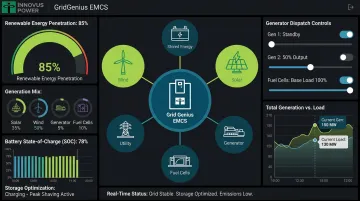
Innovus Power's GridGenius EMCS serves as the centralized control layer across its microgrid platforms, coordinating all of these functions while supporting remote monitoring and management through PowerView software for single systems and FleetGenius for multi-site deployments.
Renewable Maximization and Storage Optimization
In an isolated microgrid, renewable maximization and storage optimization work as a single coordinated function. The EMCS must absorb as much renewable generation as possible while keeping the system stable — and the battery is the primary tool for doing that.
Specific storage management responsibilities include:
- Enforcing state-of-charge limits to prevent deep discharges
- Scheduling charge cycles during periods of renewable surplus
- Smoothing generation fluctuations before they propagate to frequency
- Reserving capacity for anticipated demand peaks or low-generation windows
Innovus Power's GridGenius platform is built to achieve up to 90–100% renewable energy penetration without curtailment — a performance level that requires the EMCS to optimize storage dispatch and generator operating points simultaneously. A Caribbean agricultural facility case study achieved approximately 90% renewable energy penetration using the GridGenius Renewables Plus Standby configuration, with diesel generation required only for nighttime and extended cloudy periods.
Frequency and Voltage Regulation
Power quality in an isolated microgrid is not a secondary concern. Because there is no utility grid to absorb disturbances, the EMCS must actively maintain frequency and voltage within safe operating bounds at all times.
This involves coordinating across multiple time scales:
- Milliseconds to seconds: Fast device-level responses from inverters and storage
- Seconds to minutes: Supervisory adjustments to generator output and storage dispatch
- Minutes to hours: Load forecasting and scheduled asset transitions
The EMCS operates at the supervisory level, coordinating these layers rather than replacing the protective relays and inverter controls that handle sub-second responses. Industry standards define exactly how this coordination must work: IEEE 2030.7-2017 specifies the controller requirements, and IEEE 2030.8-2018 defines the testing procedures — including islanding, resynchronization, and black-start acceptance.
Key Benefits of a Centralized EMS for Off-Grid Operations
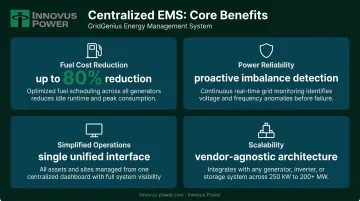
Fuel and Operating Cost Reduction
Fuel logistics are expensive in remote settings. DOE/NREL data shows diesel-generated power in many remote Alaska communities costs $0.50 to over $1.00/kWh — several times higher than utility rates in most regions. Every hour a generator runs unnecessarily is money spent on fuel that could have been covered by stored solar or wind energy.
Innovus Power documents fuel consumption reductions of up to 80% in systems where full renewable penetration is available and optimized. Even in fossil-only configurations, GridGenius variable speed generator technology delivers 25–35% lower annual operating costs compared to conventional fixed-speed systems by matching engine speed to actual load demand rather than running at a constant fixed speed.
Power Reliability and Quality
The EMCS's continuous monitoring allows it to detect impending imbalances and respond before they become failures — not after. For sites where a power interruption carries serious consequences, catching an imbalance early is what separates a brief correction from a full system failure.
Beyond availability, power quality matters. Research on industrial power quality shows voltage sags account for approximately 50% of power quality interruptions in industrial distribution networks. Stable, tightly regulated frequency and voltage protect sensitive equipment from damage and reduce wear — extending service life and cutting maintenance costs over time.
Simplified Operations and Remote Management
Centralized control consolidates the operational view. Instead of monitoring each asset through separate interfaces, operators manage the entire microgrid through one system.
For remote sites — where on-site technical expertise is limited or expensive to maintain — this matters enormously. Innovus Power's 24/7 remote monitoring and management service provides continuous expert oversight worldwide through PowerView and FleetGenius software.
Operators can monitor performance, adjust configurations, and deploy updates without dispatching field teams. That capability alone can eliminate costly site visits for routine changes.
Scalability and Future-Proofing
A vendor-agnostic EMCS architecture accommodates new assets without redesigning the control framework. Innovus Power's Grid Design Services are built on this principle — evaluating and integrating solar, battery storage, gas generation, and emerging technologies within the same control architecture, without bias toward any particular vendor or technology.
In practice, this means a site that begins with diesel generation and battery storage can add solar or wind capacity later — using the same GridGenius control layer — without replacing the underlying system architecture.
The four benefits above reinforce each other: lower fuel costs free up budget for reliability upgrades, cleaner power extends equipment life, simplified operations reduce staffing overhead, and a scalable architecture protects the capital investment long-term.
Industry Applications: Where a Centralized EMS Delivers the Most Value
Remote Communities and Military Installations
The scale of the need is significant. Canada's Energy Regulator reports 178 remote Indigenous and Northern communities not connected to North American electricity or natural gas infrastructure. The U.S. Army reported in 2023 that it had 28 operational microgrids, 9 under construction, and 18 in design — with a stated objective of deploying a microgrid on every installation by 2035.
In both contexts, power isolation is permanent or by design, and outages carry consequences ranging from severe community hardship to national security implications. A centralized EMS is not optional in these environments.
Mining, Oil & Gas, and Remote Industrial Sites
Energy costs at off-grid industrial operations are a direct hit to project economics. Off-grid mining research suggests electricity costs can reach $300/MWh and consume up to 15% of mining revenues at some sites — a cost structure that makes intelligent dispatch and renewable integration a direct lever on project economics.
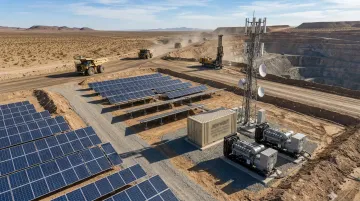
A EMCS that minimizes generator runtime, maximizes renewable utilization, and reduces fuel logistics can move a marginal project into the black — or keep a profitable one there.
Medical Facilities, Resorts, and Agricultural Operations
These applications share a common requirement: consistent power quality, not just power availability.
- Medical facilities depend on stable voltage and frequency to protect life-critical equipment and comply with NFPA emergency power standards
- Resorts require uninterrupted, high-quality power for guest experience and HVAC systems
- Agricultural operations and greenhouses need reliable power for climate control, irrigation, and refrigeration — disruptions translate directly to crop losses
A centralized EMS delivers the regulated, stable power these environments require by actively managing frequency and voltage rather than simply balancing supply and demand.
Frequently Asked Questions
What is a centralized energy management system in an isolated microgrid?
A EMCS is the single intelligent control layer that monitors all microgrid assets in real time and coordinates their operation to maintain stability, maximize renewable use, and minimize costs. In an isolated microgrid, it functions as the decision-making brain: with no utility grid to fall back on, every dispatch decision must come from within.
How does a centralized EMS differ from a distributed EMS in an isolated microgrid?
A centralized EMS gives one controller full system visibility and dispatch authority, enabling faster and globally optimized responses. A distributed EMS spreads decision-making across multiple local agents, each acting on local data. In islanded operation — where stability depends on rapid, coordinated action — that distinction has direct operational consequences.
What happens to an isolated microgrid without a proper energy management system?
Without a EMCS, renewable energy gets curtailed unnecessarily, backup generators run longer than needed, and the risk of frequency instability or blackouts rises substantially. The system burns more fuel and delivers less reliability than it should.
Can a centralized EMS support high renewable energy penetration in off-grid systems?
Yes. Platforms like Innovus Power's GridGenius EMCS use real-time optimization and storage management to absorb renewable generation without destabilizing the system. This enables up to 90–100% renewable penetration in islanded operation.
How does a centralized EMS reduce fuel consumption in remote microgrids?
The EMCS maximizes renewable utilization and deploys stored energy strategically, dispatching diesel or gas generation only when necessary. In high-renewable configurations, this approach can reduce fuel consumption by up to 80%.
Which industries benefit most from a centralized EMS for isolated microgrids?
Remote communities, military installations, mining and oil & gas sites, medical facilities, resorts, and agricultural operations stand to gain the most — anywhere reliable, high-quality power is mission-critical and utility grid connection is unavailable or impractical.