Introduction
Utility costs are climbing fast. U.S. commercial electricity hit 13.92 cents/kWh in March 2026, up 5.8% year over year, while industrial customers saw rates reach 14.18 cents/kWh — a 3.9% increase in the same period. At the same time, grid outages are growing more frequent and more costly, with power interruptions estimated to cost U.S. customers tens of billions annually.
Those numbers land differently when your facility is paying them directly — or when an outage shuts down production for hours. For industrial facilities, remote communities, and commercial operators, this combination of rising costs and unreliable supply has made the case for microgrids compelling. But a microgrid without intelligent control is just expensive infrastructure. The difference between a cost-effective microgrid and an inefficient one comes down to a single layer: the Smart Energy Management System.
This article explains what a SEMS does, how it drives optimal economic operation, and why intelligent control is the core differentiator for anyone deploying or evaluating microgrid technology. If you're building a business case, selecting a platform, or optimizing an existing system, understanding the SEMS layer is where that work starts.
Key Takeaways
- A SEMS actively forecasts, schedules, and dispatches energy assets across the full microgrid stack
- Economic dispatch and time-of-use arbitrage together cut both energy and demand charges
- Accurate forecasting alone can reduce dispatch costs by 2–7% compared to non-predictive approaches
- Remote diesel sites paying $0.35–$0.70/kWh can cut energy costs by up to 80% with SEMS-optimized renewables
- Flexibility options in renewable microgrids can reduce curtailment and overall costs by 30–50%
What Is a Smart Energy Management System for Microgrids?
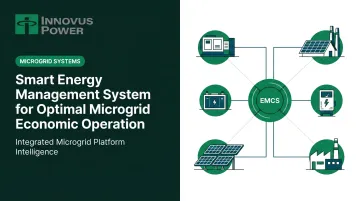
A Smart Energy Management System is the software and control layer that coordinates all energy resources within a microgrid — distributed generators, energy storage, renewable sources, and loads — to minimize cost, maximize reliability, and integrate renewables efficiently.
Unlike basic grid monitoring — which only observes — a SEMS actively manages. It continuously forecasts generation and demand, then acts on those forecasts without waiting for human input:
- Schedules generator and storage dispatch to minimize fuel and grid costs
- Responds to real-time pricing signals to shift or curtail loads
- Balances renewable output against demand as conditions change
- Executes connect/disconnect decisions autonomously during grid events
The microgrid itself is physical infrastructure — generators, storage, loads, protection equipment, and interconnection hardware. The SEMS is the intelligence layer above it, making thousands of small decisions every hour to keep costs down and power flowing.
As IEEE 2030.7 frames it, the microgrid energy management system is a key element of microgrid operation — enabling the system to manage itself, operate autonomously, or function grid-connected. The DOE's 2024 Microgrid Overview similarly describes microgrid control systems as central controllers that coordinate distributed energy resources, balance loads, and execute connect/disconnect decisions.
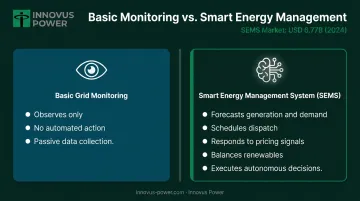
The microgrid controller market reflects how central this intelligence has become: the global market reached USD 6.77 billion in 2024 and is projected to grow at a 22.6% CAGR through 2029.
Key Components of a Smart Energy Management System
Power Forecasting Module
Forecasting is the foundation of economic scheduling. A SEMS uses historical load data, weather inputs, and — in more advanced implementations — machine learning to generate day-ahead and hour-ahead forecasts for both load demand and renewable generation output.
Why it matters economically: a peer-reviewed study of off-grid rural microgrids found that forecast-based dispatch strategies saved 2–7% compared to non-predictive dispatch. That gap widens substantially when fuel costs are high or renewable penetration is deep, because forecasting errors force the system to either curtail usable solar/wind or fire up expensive backup generation unnecessarily.
Energy Storage System (ESS) Management Module
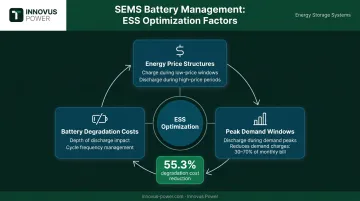
Battery management inside a SEMS is far more complex than simple charge/discharge logic. The ESS module determines optimal cycling across multiple time steps, balancing:
- Energy price structures — charging when power is cheap, discharging when it's expensive
- Battery degradation costs — depth of discharge and cycling frequency directly affect long-term battery life and replacement economics
- Peak-demand windows — strategic discharge during demand peaks reduces demand charges, which can represent 30–70% of a commercial customer's monthly bill
A 2025 study on agricultural microgrids found that degradation-aware ESS management reduced battery degradation costs by 55.3% versus a conventional baseline — a material improvement to total system economics.
Optimization Module and Real-Time Control
The optimization module consolidates load management, economic dispatch of distributed generators, and ESS operation into a unified problem. Algorithms such as model predictive control, genetic algorithms, or proprietary approaches produce least-cost dispatch schedules across the planning horizon.
Scheduled optimization alone can't account for every variable. Real-time control handles deviations — cloud cover, sudden load spikes, generator trips — and adjusts dispatch instructions automatically to maintain power balance and quality.
GridGenius EMCS: An Example Platform
Innovus Power's GridGenius Energy Management Control System is designed to achieve up to 90–100% renewable penetration without curtailment, coordinating fossil generation, renewables, and stored energy across the microgrid. Its vendor-agnostic design means GridGenius optimizes across any combination of energy sources and storage technologies — an advantage that matters when system composition evolves over time. PowerView and FleetGenius software extend the platform with remote monitoring and multi-site management capabilities.
How a SEMS Enables Optimal Microgrid Economic Operation
Economic Load Dispatch
Economic dispatch sits at the center of SEMS cost management: continuously determining the least-cost combination of generation sources to meet load demand at each time interval. Rather than running generators on fixed schedules or manual rules, the SEMS makes dynamic decisions based on real-time fuel costs, generator efficiencies, and marginal generation costs.
Generators don't run at flat efficiency across their load range — and that gap is where economic dispatch pays off. A SEMS holds diesel generators at their most efficient operating points, reduces unnecessary idling, and defers startup of expensive units when cheaper alternatives — storage discharge or renewable output — can cover demand.
Time-of-Use Price Arbitrage and Demand Charge Reduction
For grid-connected microgrids, the SEMS manages a two-sided economic equation:
- Buy low, sell high — charging storage during off-peak, low-price periods and discharging during peak-price windows
- Export optimization — selling excess renewable generation back to the grid when prices favor it
- Demand charge management — discharging storage during demand peaks to flatten the load profile
With roughly 5 million U.S. commercial customers on demand charge tariffs of $15/kW or more, peak demand management alone makes a compelling case for storage investment. A Fort Carson military facility BESS saved $500,000/year in utility costs through peak shaving and optimized dispatch.
Maximizing Renewable Utilization and LCOE
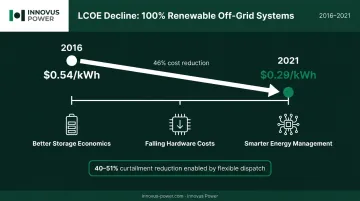
Curtailed renewable energy is economic waste — the system paid for the panels or turbines, but threw away the output. Flexible dispatch options in renewable-heavy microgrids can reduce curtailment by 40–51%, directly increasing the share of zero-marginal-cost generation in the dispatch mix.
The LCOE effect compounds over time. Average LCOEs for 100% renewable decentralized off-grid systems dropped from $0.54/kWh in 2016 to $0.29/kWh in 2021, driven by better storage economics, falling hardware costs, and smarter energy management. A SEMS accelerates this trajectory by ensuring the cheapest available generation is always dispatched first.
Demand-Side Management
Beyond controlling generation and storage, a SEMS can shift non-critical loads to off-peak periods — deferring processes like pumping, HVAC pre-cooling, or batch manufacturing runs to times when power is cheapest. This reduces both peak demand charges and average energy costs, cutting costs across the entire system without adding hardware.
Microgrid Operating Modes and Their Economic Implications
Grid-Connected Mode
In grid-connected operation, the SEMS treats the utility grid as one of several generation resources — one with a time-varying price. It coordinates grid purchases, on-site generation, storage, and renewable output to minimize net energy cost at each interval.
When renewable output exceeds on-site demand, exporting that surplus during high-price periods converts the microgrid from a pure cost center into a partial revenue source. Grid-connected mode supports several economic levers:
- Shift load to off-peak hours to reduce demand charges
- Export surplus renewables during peak-price windows
- Use storage to arbitrage time-of-use rate differentials
- Minimize grid draw when real-time prices spike
Islanded (Autonomous) Mode
Islanded operation removes the grid backstop entirely. The SEMS must maintain power balance using only local resources. Generation forecasting becomes critical, storage management tightens, and load shedding may be required during extended low-generation periods.
This mode is essential for:
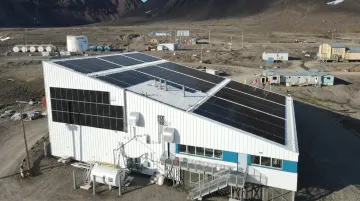
- Remote Arctic and island communities
- Mining and resource extraction sites
- Military installations requiring energy independence
- Any facility requiring continuity during extended grid outages
Innovus Power's GridGenius platform supports islanded operation with integrated storage and dispatchable generation, designed to maintain power quality and supply continuity without grid support.
Seamless Mode Transition
The ability to switch between grid-connected and islanded operation without service disruption is both an economic and reliability feature. The SEMS must detect grid faults rapidly, isolate the microgrid, and rebalance internal generation — all without interrupting loads.
IEEE 2030.7 defines this seamless connect/disconnect capability as a core function of the microgrid controller. For facilities where even brief power interruptions carry significant operational or financial cost, transition speed and reliability directly determine the system's value.
Overcoming Key Challenges in Smart Microgrid Energy Management
Intermittency and Forecast Uncertainty
Solar and wind don't always match load profiles. A SEMS addresses this through:
- Storage buffering — absorbing generation surpluses and covering demand gaps
- Rolling forecast updates — continuously refreshing predictions as conditions change
- Source complementarity — combining solar and wind reduces overall variability because they often peak at different times, a finding supported by peer-reviewed hybrid renewable system research
Protection Coordination
Distributed generation reverses traditional assumptions about power flow direction. With multiple generation sources on the same network, conventional protection relays can experience false tripping or loss of coordination, a risk documented in peer-reviewed research on DG integration and confirmed by NREL's 2024 microgrid protection analysis.
A SEMS works alongside dedicated protection schemes rather than replacing them. The control and protection layers must be co-designed from the outset.
Scalability and Future-Proofing
A SEMS that requires complete redesign when a new storage unit or generator is added isn't economically viable long-term. Well-designed platforms, such as Innovus Power's vendor-agnostic GridGenius, are built to accommodate new generation assets, storage expansions, or shifting load profiles without rebuilding the existing control infrastructure. That modularity has a direct financial payoff: it protects the original capital investment as the system grows rather than forcing costly overhauls at each stage.
Real-World Applications and the Economic Case for Smart Energy Management
Remote and Off-Grid Communities
IRENA reports small diesel generators produce electricity at USD 0.35–0.70/kWh. In Nunavut, Canada, unsubsidized diesel electricity has reached 112.3 cents/kWh. Every unit of solar or wind output that displaces diesel directly cuts that cost.
NREL modeling of remote Alaskan villages identified cost-optimal pathways to 75% fuel reduction through renewable integration and smart dispatch. Kodiak Island, Alaska, now generates 99.7% of its electricity from renewables — a direct result of intelligent microgrid management combining wind, hydro, batteries, and flywheels.
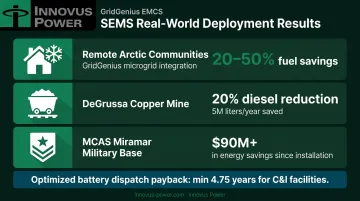
Innovus Power's GridGenius platform has been deployed in Arctic Canadian communities with documented fuel savings of 20–50% depending on seasonal renewable availability — replacing expensive diesel supply chains with predictable, locally managed power.
Industrial and Commercial Facilities
For mining, oil and gas, military, and resort operators, the SEMS value case has two dimensions:
- Cost reduction — lower fuel consumption, reduced demand charges, optimized generator loading
- Operational continuity — power quality improvements that extend equipment life and prevent production losses
The U.S. Marine Corps Air Station Miramar microgrid has produced over $90 million in energy savings since installation. The DeGrussa copper mine in Western Australia integrated solar and storage at a remote site to cut diesel consumption by approximately 20%, saving roughly 5 million liters of diesel annually.
These project-level results are consistent with broader data. A 2025 analysis of 606 commercial and industrial facilities on demand-charge tariffs found optimized battery dispatch achieved a minimum discounted payback period of 4.75 years, with 99% of facilities above 80 kW average peak demand achieving payback within 20 years.
The Long-Term Value Proposition
The financial case for SEMS-driven microgrids extends well beyond year-one savings. Facilities that own and control their generation can project energy costs decades forward — insulating operations from utility rate increases and fuel price volatility.
Innovus Power's GridGenius platform is designed to deliver up to 80% reductions in power costs and fuel consumption in qualifying deployments, with flat, predictable future costs replacing the uncertainty of utility pricing. For energy-intensive industries where power cost is a primary competitive variable, that cost certainty directly strengthens long-term project economics.
Frequently Asked Questions
What is an energy management system for a microgrid?
A microgrid energy management system is the control software layer that coordinates generation, storage, and loads to balance supply and demand in real time. It optimizes for cost, reliability, and renewable integration within the microgrid's electrical boundary, actively dispatching resources rather than passively monitoring them.
What is a smart microgrid system?
A smart microgrid is a locally controllable energy system that uses intelligent sensors, communication networks, and automated control to dynamically manage distributed energy resources. It can operate both connected to and independently from the main utility grid, responding automatically as generation and load conditions shift.
What is the difference between a microgrid and a smart grid?
A smart grid is a large-scale, utility-managed modernization of regional or national power infrastructure using digital communication. A microgrid is a smaller, localized energy system that can operate independently. Smart microgrids apply similar intelligence at a site or community scale, operating without utility coordination when needed.
How does a smart energy management system reduce operating costs?
Cost reductions come from several coordinated strategies: dispatching the least-cost generation sources first, scheduling storage for energy price arbitrage, maximizing zero-marginal-cost renewable output, and shifting non-critical loads to off-peak periods. The combined effect cuts both energy consumption costs and peak demand charges.
What role does energy storage play in microgrid optimization?
Storage acts as the buffer that decouples generation timing from load demand. The SEMS charges storage from low-cost or renewable sources and dispatches it during expensive or high-demand periods. Storage also maintains grid stability when renewable output fluctuates unexpectedly.
Can a microgrid operate without being connected to the utility grid?
Yes — microgrids are specifically designed for islanded (autonomous) operation. The SEMS maintains power balance using only local generation and storage, making microgrids essential for remote locations and as reliable backup power during grid outages.