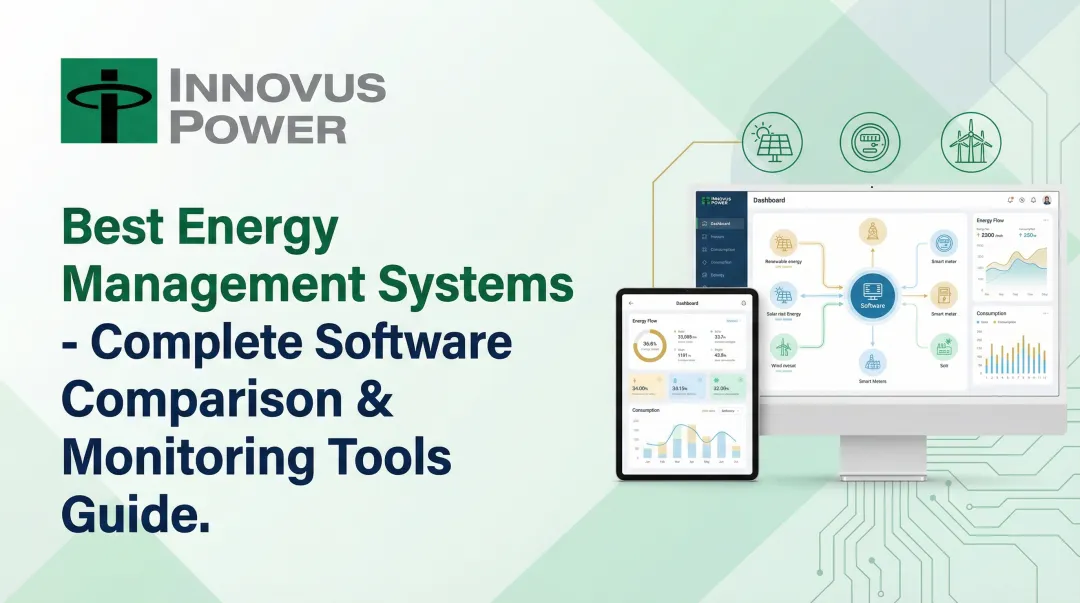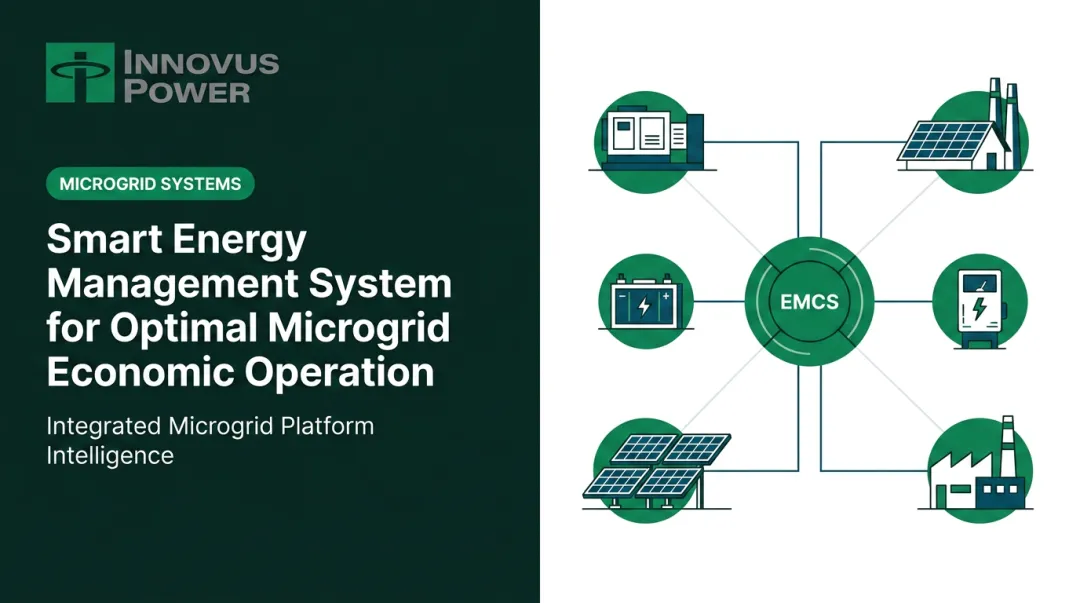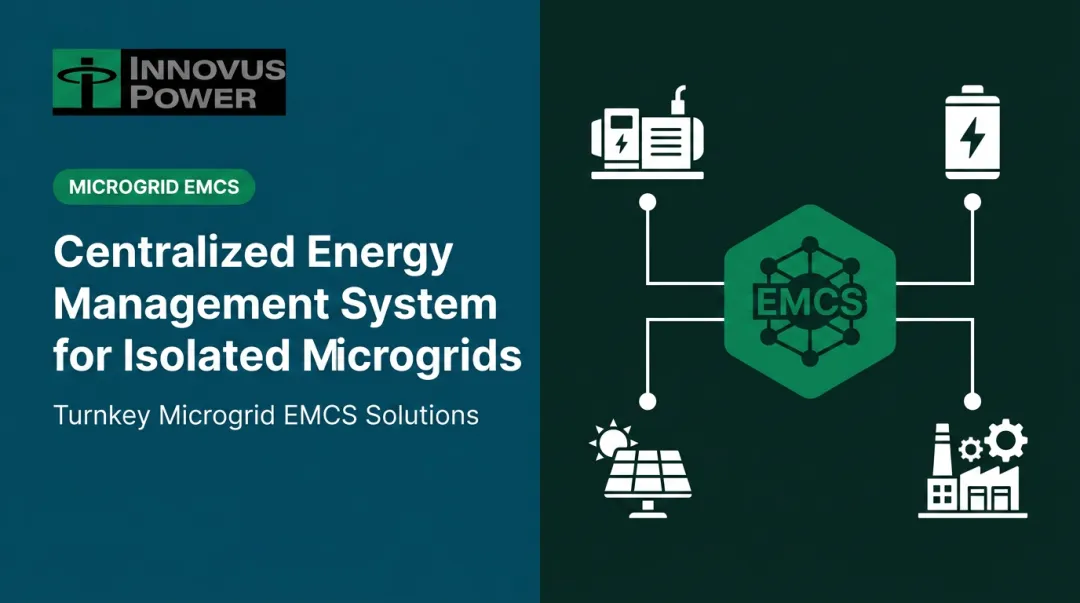
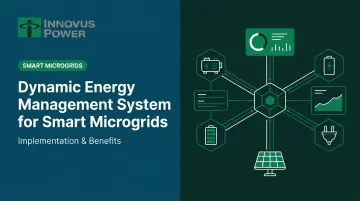
That's where a dynamic energy management system (DEMS) changes the equation. Rather than following fixed schedules or static rules, a DEMS continuously adapts power flows across every asset in a microgrid — renewables, storage, backup generation, and the utility grid — in real time.
This article covers what a DEMS is, how it works, its core components, implementation steps, key benefits, and which industries gain the most from deploying one.
Key Takeaways
- A DEMS continuously optimizes power flows across all microgrid assets in real time, where static rule-based systems simply can't keep up
- Both grid-connected and islanded operating modes must be handled seamlessly — a non-negotiable for reliable microgrid control
- Battery SOC management and transient power separation reduce wear on storage assets and extend system service life
- Remote communities, mining operations, and medical facilities have the clearest business case
- Implementation runs from site assessment through commissioning and live monitoring — complex sites require careful, phased planning
What Is a Dynamic Energy Management System for Smart Microgrids?
A DEMS is a real-time, adaptive software and control layer that continuously monitors, coordinates, and optimizes power flows across every energy asset in a microgrid. That includes renewable generators, battery storage, backup generators, and the utility grid connection — all balanced against live consumption data to maintain a constant match between generation and demand.
Static vs. Dynamic Energy Management
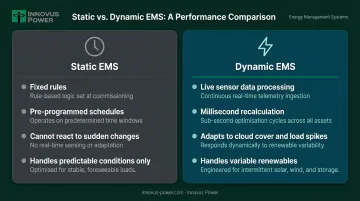
The distinction matters in practice. A static energy management system operates on fixed rules or pre-programmed schedules. It can handle predictable conditions reasonably well. But it cannot react when a cloud bank cuts solar output by 40% in 90 seconds, or when a large motor starts and spikes demand by 200 kW without warning.
A DEMS processes live sensor data — current measurements, state-of-charge readings, weather inputs, smart meter feeds — and recalculates the optimal dispatch strategy within milliseconds. As IRENA notes, maintaining the balance between consumption and generation in renewable-integrated mini-grids is inherently difficult because renewable output is variable. A dynamic system is designed specifically to handle that variability in real time.
Coordinating Distributed Energy Resources
A DEMS coordinates all distributed resources together, dispatching each based on availability, cost, and operator-configured priorities:
- Solar PV and wind/hydro generation — treated as priority sources when available
- Battery energy storage systems (BESS) — dispatched to absorb surplus or cover deficits
- Dispatchable generators — activated only when storage cannot meet demand alone
- Grid connection — used for cost optimization, export, or emergency backup
Each source contributes according to its availability, cost, and the priority rules configured by the operator.
Grid-Connected vs. Islanded Operation
A well-designed DEMS must handle two fundamentally different operating modes:
- Grid-connected mode: The microgrid exchanges power with the utility for cost optimization or renewable export
- Islanded/off-grid mode: The DEMS alone must maintain stable voltage and frequency without any grid support
The ability to transition reliably between these modes is what separates a robust system from one that trips offline when grid power is lost. For remote sites and critical facilities, that switchover must happen automatically and without interruption to the load.
How Does a Dynamic Energy Management System Work?
Real-Time Power Balance: Surplus and Deficit Scenarios
A DEMS continuously calculates net power demand — total load minus renewable generation — and dispatches the right assets to close the gap. A 2024 study in Scientific Reports frames this around two primary states:
- Surplus power scenarios (SPS): Renewable generation exceeds load. Surplus is routed to charge storage or export to the grid.
- Deficit power scenarios (DPS): Load exceeds renewable output. Storage discharges first; backup generation activates if storage is insufficient.
The control logic that navigates between these states determines how efficiently — and how reliably — the whole system performs.
Demand Response and Energy Pricing
A DEMS doesn't just balance watts. It balances costs. By integrating time-of-use tariffs and real-time pricing signals, the system can:
- Shift storage charge/discharge cycles to avoid peak pricing windows
- Reduce demand charges by flattening consumption spikes
- Participate in demand response programs when grid operators call for load reduction
FERC's 2025 demand response assessment reports 33,272 MW of demand response resources active in U.S. RTO/ISO markets in 2024, with industrial customers supplying 45% of retail potential peak savings. That scale reflects the real financial value of tariff-aware control logic.
Transient vs. Steady-State Power Management
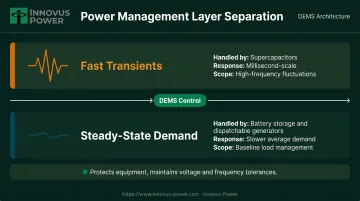
Advanced DEMS architectures separate two distinct power management challenges:
- Fast transients: High-frequency fluctuations handled by fast-response assets like supercapacitors. In one Innovus Power industrial deployment, an ultracapacitor storage system managed high load volatility, reducing required generator sets from six units to four while measurably improving frequency stability.
- Steady-state demand: Slower, average energy requirements handled by bulk battery storage or dispatchable generators
This separation protects equipment from stress and maintains tight voltage and frequency tolerances across all operating conditions.
Battery SOC Management and Asset Protection
Battery storage is only as valuable as its operating life. A DEMS monitors state-of-charge in real time and enforces safe operating limits automatically — without manual intervention. The system targets the two primary causes of accelerated degradation:
- Prevents overcharging by capping charge current as the battery approaches its upper SOC limit
- Prevents deep discharge by activating backup generation before storage reaches critical depletion
- Adjusts charge and discharge rates continuously to keep the battery within its design envelope
Innovus Power's proprietary GridGenius Energy Management Control System uses multi-variable optimization algorithms and vendor-agnostic control logic to coordinate all of these functions simultaneously — enabling up to 90–100% renewable energy penetration without curtailment while maintaining utility-grade power quality across both grid-connected and islanded operating conditions.
Key Components of a Smart Microgrid DEMS
A complete DEMS deployment involves three interconnected layers: generation and storage hardware, control and communications infrastructure, and the software intelligence that ties them together.
Energy Generation and Storage Hardware
The physical assets the DEMS must manage vary by site, but typically include:
- Solar PV arrays and/or wind or micro-hydro generators
- Battery energy storage systems (BESS) in various chemistries and configurations
- Dispatchable generators — diesel, natural gas, or hydrogen-fueled
- Fast-response assets such as supercapacitors for transient management
A hardware-agnostic DEMS must interface cleanly with whatever combination of assets is deployed, without favoring any particular vendor or technology.
Control Hardware and Communications Infrastructure
The control hardware and communications infrastructure bridges physical assets to the software layer, requiring:
- Bidirectional power converters and grid-forming/grid-following inverters
- Smart meters and current sensors across all generation and load points
- Communication protocols (Modbus, CAN bus, IEC 61850, and others) enabling real-time bidirectional data flow
- Reliable networking infrastructure, particularly critical for remote or harsh-environment sites
Software Intelligence Layer
The software layer is what separates a dynamic, adaptive DEMS from a conventional static control system. It performs:
- Real-time optimization and dispatch calculations
- Load and generation forecasting
- Remote monitoring dashboards for operator visibility
- Event logging and alarm management
- Configurable priority rules and performance targets
Operators interact with this layer to set control parameters, review performance trends, and adjust the system as load profiles evolve — all without requiring physical access to the site. When all three layers are properly integrated, the result is a microgrid that responds to real-world conditions automatically — balancing generation, storage, and load in real time.
Implementing a DEMS: Steps and Considerations
Site Assessment and Energy Audit
Every implementation starts with a thorough baseline. Innovus Power's Grid Design Services examine existing power certainty, quality, and cost at the site — evaluating load profiles (peak, average, and seasonal demand), existing generation and storage assets, grid connection quality or off-grid status, and site-specific constraints like space, fuel availability, or regulatory requirements.
For remote or complex sites — Arctic communities, marine operations, mining — this step carries the most weight. Grid backup is unavailable, and sizing errors carry direct operational consequences. An accurate energy audit directly shapes system sizing, dispatch strategy, and ultimately the project's levelized cost of energy.
System Design, Modeling, and Component Selection
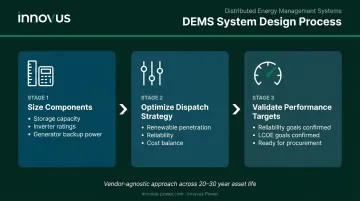
With baseline data in hand, engineers use modeling and simulation tools to:
- Size each component — storage capacity, inverter ratings, generator backup power
- Optimize dispatch strategy — balancing renewable penetration, reliability, and cost
- Validate performance targets — confirming the DEMS will meet reliability and LCOE goals before any hardware is procured
Innovus Power's proprietary modeling tools simulate hundreds of configurations to identify the lowest levelized cost of energy — using a vendor-agnostic approach that selects components on technical and economic merit rather than supplier relationships. Over a 20–30 year asset life, that independence can mean millions in avoided costs.
Integration, Commissioning, and Testing
The integration phase covers three parallel workstreams:
- Hardware installation — physical placement and interconnection of all generation, storage, and conversion equipment
- Software configuration — communication protocols, control hierarchies, operating rules, and sensor calibration
- Staged commissioning tests — verifying the DEMS correctly handles surplus generation, power deficits, and grid-to-island transitions before going live
California Energy Commission data from seven EPIC-funded microgrid projects confirms that multi-year implementation timelines are common for grant-funded projects. Thorough upfront modeling compresses that commissioning window and reduces costly on-site rework.
Ongoing Monitoring, Optimization, and Support
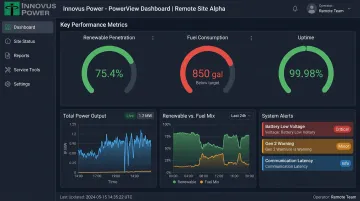
A DEMS is not a set-and-forget system. Ongoing 24/7 remote monitoring — as provided through Innovus Power's PowerView platform — allows operators and service teams to:
- Track performance metrics: renewable penetration, fuel consumption, uptime
- Detect anomalies and respond before they become failures
- Push firmware and control parameter updates as load profiles evolve
- Add new assets without disrupting existing operations
The system improves over its operational life precisely because it remains accessible and adjustable.
Benefits of Dynamic Energy Management in Smart Microgrids
Cost Reduction and Energy Savings
The strongest cost reduction evidence comes from remote and off-grid deployments. DOE reports diesel power in remote Alaska communities costs $0.50 to more than $1/kWh — a compelling baseline for any renewable displacement calculation. Bonaire's wind-diesel-battery transition reduced electricity rates from $0.50/kWh to $0.34/kWh after implementing a renewable microgrid with coordinated storage.
For grid-connected commercial and industrial customers, the value comes through peak demand charge reduction, tariff arbitrage, and demand response participation. Innovus Power's GridGenius-equipped systems have documented energy cost savings of 20–50% compared to conventional power approaches, with LCOE targets at or below utility rates for high-renewable-penetration configurations.
Reliability and Power Quality
Cost savings only hold when the system stays online. A DEMS maintains tight voltage and frequency stability even during load steps or generation interruptions, preventing outages through proactive dispatch rather than reactive response.
Reduced total harmonic distortion (THD) matters beyond uptime: superior power quality reduces wear on sensitive electrical and electronic equipment, directly extending service life and lowering maintenance costs. For medical facilities, where sophisticated devices require clean, consistent power, this is a design requirement. For precision manufacturing and greenhouse climate control, it protects both equipment and yield.
Environmental and Sustainability Impact
High renewable penetration is only achievable with coordinated energy management. NREL's REopt modeling work demonstrates 52–82% reductions in emissions and diesel fuel use for renewable-heavy microgrid configurations, delivering measurable progress against emissions targets that matter to mining operators, remote communities, and commercial facilities alike.
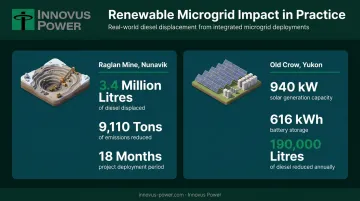
At Glencore's Raglan Mine in Nunavik, a renewable smart-grid pilot documented by NRCan displaced 3.4 million litres of diesel over 18 months, reducing emissions by 9,110 tons. Field results like these illustrate the tangible scale of impact:
- Raglan Mine, Nunavik: 3.4 million litres of diesel displaced; 9,110 tons of emissions reduced over 18 months
- Old Crow, Yukon: 940 kW solar and 616 kWh battery installation projected to cut diesel demand by 190,000 litres annually
Industry Applications of Dynamic Energy Management
Remote Communities, Military, and Off-Grid Critical Facilities
For sites where grid power is unavailable, unreliable, or prohibitively expensive, a DEMS does more than optimize — it provides the foundation of reliable power. Remote Arctic communities, island resorts, and military installations all share the same problem: diesel dependency creates fuel logistics risk, high operating costs, and emissions exposure.
The U.S. Army has committed to installing microgrids across all installations by 2035, with renewable generation and battery storage capacity to self-sustain critical missions by 2040. That timeline reflects a strategic recognition that energy resilience requires intelligent control, not just generation capacity.
Oil and Gas, Mining, and Heavy Industry
The same pressure driving military energy resilience is reshaping heavy industry. Mining and oil and gas operations across North America increasingly face demands to cut both fuel costs and Scope 1 emissions, and renewable-integrated microgrids with active DEMS control offer a credible path to both.
Operational benefits extend well beyond fuel savings:
- Reduced generator runtime cuts maintenance intervals and extends equipment life
- Better power quality prevents equipment damage from voltage sags and frequency deviations
- Lower diesel consumption reduces supply chain exposure at remote sites
Commercial, Industrial, Agricultural, and Medical Facilities
Where off-grid sites use DEMS for survival, grid-connected customers use it to reduce demand charges, improve power quality, and hit sustainability targets. Key applications include:
- Medical and extended care facilities: Seamless islanding capability is mission-critical when the grid fails. Sensitive medical devices require clean, stable power that a well-designed DEMS maintains without interruption.
- Precision manufacturing: Power quality directly affects yield and equipment longevity
- Controlled-environment agriculture: Greenhouse climate systems demand consistent power with minimal fluctuation
- Commercial and industrial operations: Demand response participation and peak shaving translate directly to lower monthly utility bills
Innovus Power serves all of these segments through GridGenius-equipped microgrid platforms that scale from 250 kW to 200+ MW, with vendor-agnostic design that ensures the right technology combination for each site's specific load profile and cost targets.
Frequently Asked Questions
What is the difference between a dynamic and a static energy management system?
A static EMS follows fixed rules or pre-programmed schedules and cannot adapt when conditions change unexpectedly. A dynamic EMS continuously processes live sensor data and recalculates optimal dispatch decisions within milliseconds — responding to cloud cover, load spikes, grid outages, or any other real-time event without manual intervention.
Can a DEMS operate in both grid-connected and islanded microgrid modes?
Yes. A well-designed DEMS handles both modes and manages the transition automatically, maintaining stable voltage and frequency whether the utility grid is available or not. This dual-mode capability is essential for sites that need backup power or operate in remote locations where grid access is unreliable or unavailable.
How does a DEMS handle the intermittency of solar and wind energy?
The DEMS continuously forecasts renewable output and pre-positions battery storage to absorb surplus or cover deficits. Backup generation activates only when storage cannot meet demand on its own, enabling renewable penetration rates of 90–100% at many sites.
What role does battery storage play in a dynamic energy management system?
Battery storage is the primary buffer between variable generation and consistent load supply. It allows the DEMS to smooth generation-load mismatches, store surplus renewable energy for later use, and provide fast-response power during sudden demand spikes or generation drops, reducing or eliminating generator runtime entirely.
How long does it typically take to implement a DEMS for a smart microgrid?
Timelines vary widely by site complexity, permitting requirements, system size, and existing infrastructure. California Energy Commission data from funded demonstration projects shows multi-year implementation timelines are common. Thorough upfront site assessment and simulation can substantially reduce commissioning time and risk.
Which industries benefit most from a dynamic energy management system?
Remote communities, military installations, mining, oil and gas, medical facilities, and commercial/industrial operations all have strong use cases — particularly where power reliability, diesel cost reduction, or high renewable integration are strategic priorities. The clearest economic cases involve sites currently paying $0.50/kWh or more for diesel-generated power.