
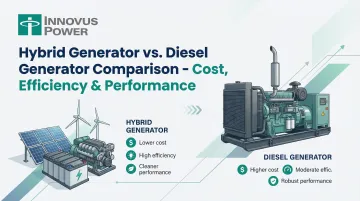
Introduction
For mining operations, oil & gas sites, remote communities, and critical facilities, reliable power isn't optional. Outages halt production, fuel costs keep climbing, and conventional diesel generators are increasingly difficult to justify on cost alone.
A diesel generator running at 25% load can consume significantly more fuel per kilowatt-hour than the same unit operating at 75% load — and maintenance problems accumulate in parallel. For remote sites where fuel delivery costs can be extremely high, those inefficiencies translate directly into avoidable expenditure measured in millions.
The generator decision reaches further than purchase price. It shapes fuel budgets, maintenance schedules, emissions exposure, and how well a site handles load variability over a decade or more.
This comparison breaks down hybrid and diesel generators across fuel efficiency curves, total cost of ownership, load performance, maintenance demands, and deployment fit — so you can evaluate which technology matches your site's operational reality.
Key Takeaways
- Hybrid generators combine engines, battery storage, and optional renewables under intelligent controls for superior efficiency at variable loads
- Diesel generators excel at high, consistent loads but carry escalating fuel and maintenance costs, especially below 40% capacity
- Hybrid systems reduce fuel consumption by 40–80% depending on load profile, dramatically lowering total lifecycle costs
- Choose diesel for short-term backup or high consistent loads; choose hybrid for long-duration, variable-load, or remote operations
- For remote or off-grid operations, hybrid systems consistently deliver lower levelized cost of energy over a 10–20 year horizon
Hybrid Generator vs. Diesel Generator: Quick Comparison
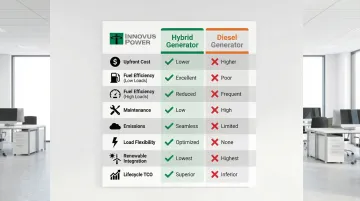
The table below summarizes how hybrid and diesel generators compare across the factors that matter most for long-term power decisions.
| Factor | Hybrid Generator | Diesel Generator |
|---|---|---|
| Upfront Cost | Higher initial investment (BESS, controls, power electronics) | Lower purchase and installation cost |
| Fuel Efficiency (Low Loads) | 40–60%+ improvement at partial loads | Severe efficiency penalty below 40% load |
| Fuel Efficiency (High Loads) | Competitive; engine runs at optimal point | Efficient at 75–100% rated capacity |
| Maintenance Requirements | Extended service intervals; reduced run-hours | Frequent servicing; wet stacking risk at low loads |
| Emissions Profile | Significantly reduced; near-zero during battery-only operation | High NOx, PM, CO₂; regulatory compliance challenges |
| Load Flexibility | Excellent across entire load range | Poor below 40%; optimal at 75–100% |
| Renewable Integration | Up to 90–100% renewable penetration possible | Limited to 40% penetration |
| Lifecycle TCO | Lower total cost despite higher upfront CapEx | Higher total cost driven by fuel and maintenance |
Definition note: "Hybrid generator" here refers to systems combining a combustion engine with battery energy storage and intelligent energy management — not dual-fuel engines running two fuel types simultaneously.
What is a Hybrid Generator?
A hybrid generator is a power system integrating a combustion engine (often variable-speed) with a battery energy storage system (BESS), power electronics, and an energy management control system (EMCS). This architecture enables the engine to operate only when needed and at its most fuel-efficient point, decoupling power generation from immediate load demand.
Variable-Speed Engine Advantage
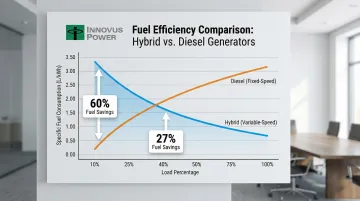
Unlike conventional diesel generators that run at fixed speed (1,800 RPM for 60 Hz, 1,500 RPM for 50 Hz) regardless of demand, a variable-speed engine slows down under reduced load, operating in a higher-efficiency range. Test data shows fuel efficiency improvements greater than 40% at low loads and greater than 60% at very low loads compared to standard diesel gensets.
At 10% load, variable speed operation achieves 27% fuel savings compared to fixed speed. By adjusting RPM to match load demand rather than maintaining constant grid frequency (handled by power electronics), variable-speed generators avoid the friction and combustion inefficiency associated with maintaining 1,800 RPM at light loads.
Battery Storage Role
The BESS handles rapid load fluctuations and peak shaving, allows the engine to run at optimal output rather than chasing every load change, and enables silent or emission-free operation during low-demand periods. Battery systems provide response times in milliseconds—effectively instantaneous compared to the seconds or minutes required for diesel generator startup.
This instant response ensures power quality for critical loads while the generator responds on a slower timescale without sacrificing reliability.
Renewable Energy Integration
Advanced hybrid systems accept solar, wind, or hydro inputs, enabling 90–100% renewable energy penetration during favorable conditions, with the engine serving as backup. In Kotzebue, Alaska, modeling shows that achieving 90% renewable penetration is technically feasible with sufficient battery storage, sharply reducing diesel reliance in Arctic environments.
Some hybrid configurations achieve over 55% annual fuel reduction by running the generator at optimal loading (e.g., 80%) to charge batteries and then shutting it down.
Use Cases of Hybrid Generators
Industries where hybrid generators dominate:
- Remote communities — Arctic and island installations where fuel delivery is expensive or logistically difficult
- Mining and oil & gas — variable 24/7 load profiles where conventional diesel runs at its least efficient
- Military forward bases — fuel delivery costs can be extremely high, making every efficiency gain critical
- Off-grid resorts and hotels — high power quality demands combined with sustainability requirements
- Agricultural facilities — greenhouses and processing operations with variable loads and renewable integration potential
Variable loads and high fuel delivery costs in these environments make hybrid systems particularly advantageous. Innovus Power's GridGenius EMCS serves as the intelligent energy management layer that orchestrates hybrid system components—dynamically dispatching the engine, storage, and renewables to deliver the lowest possible cost of energy.
What is a Diesel Generator?
A diesel generator is a compression-ignition engine connected to a synchronous AC alternator, operating at fixed speed to produce stable AC power. Diesel generators have been a standard for decades due to their reliability, high power density, and global fuel availability.
Core Strengths
Diesel generators offer rapid load acceptance, strong performance at high and consistent loads (75–100% of rated capacity), simple installation and maintenance, and independence from grid infrastructure. They're well-suited for emergency backup and temporary high-load applications where simplicity and proven reliability are paramount.
Key Limitations
Specific fuel consumption rises sharply at loads below 40%—resulting in wasted fuel and a maintenance condition known as "wet stacking" (unburned diesel accumulating in exhaust components). Manufacturers warn against operating diesel engines below 30% of rated capacity for extended periods.
At these low loads, the engine cannot maintain optimal operating temperatures, leading to incomplete combustion. This causes injector fouling, valve wear, and potential engine failure. Correcting wet stacking requires "load banking": running the generator at artificial full load to burn off deposits, consuming additional fuel without producing useful work.
Beyond wet stacking, diesel generators carry several structural drawbacks:
- High ongoing fuel costs with no path to renewable integration
- Significant emissions output (NOx, particulate matter, CO₂)
- No compatibility with solar, wind, or storage hybridization
Use Cases of Diesel Generators
Diesel generators remain relevant in scenarios requiring immediate, reliable power with minimal setup complexity:
- Emergency backup – Hospitals, data centers requiring short-duration power continuity
- Temporary construction – Job sites with consistent, heavy electrical loads
- Short-duration peak coverage – Facilities with stable fuel supply chains and predictable load profiles
- High consistent loads – Applications running at 75–100% capacity where diesel efficiency is competitive
Hybrid Generator vs. Diesel Generator: Which is Better?
Fuel Efficiency by Load Profile
The comparison shifts dramatically depending on how a generator is operated. At high, consistent loads (above 75%), conventional diesel generators perform well. However, most real-world operations involve variable loads—and this is where hybrid systems create measurable advantage.
At partial loads:
- Hybrid systems: 40%+ fuel savings at low loads, 60%+ at very low loads
- Diesel generators: Specific fuel consumption increases sharply below 40% load
Annual reductions:
- Hybrid systems with renewable integration: 33–55% annual fuel reduction
- Variable-speed technology alone: Up to 40% fuel consumption reduction compared to fixed-speed equivalents
Total Cost of Ownership and Levelized Cost of Energy
Upfront costs favor diesel (lower capital investment), but hybrid systems recover the gap through fuel savings, reduced maintenance hours, fewer engine starts, and longer engine life.
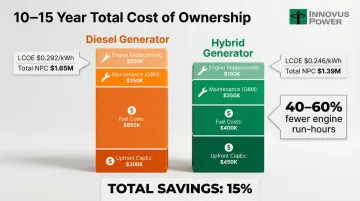
TCO comparison over 10–15 years:
In remote island scenarios, optimized hybrid systems demonstrated an LCOE of $0.246/kWh compared to $0.292/kWh for diesel-only systems—a 16% reduction. The hybrid system showed a Total Net Present Cost of $1.39 million versus $1.65 million for the diesel baseline.
The primary drivers: reduced fuel consumption (the largest lifecycle cost component in remote areas) and reduced engine replacement costs due to fewer run-hours.
Maintenance Burden Comparison
Diesel generators require frequent oil changes, filter replacements, and mechanical servicing—with wet stacking risk adding further intervention at low loads. Non-fuel O&M costs run approximately $405/kW over a 20-year lifecycle.
Hybrid systems cut engine run-hours by 40–60%+, stretching service intervals and reducing overall maintenance spend. For a typical microgrid, eliminating redundant diesel generators through hybrid design saves approximately $7,000/year in O&M costs per avoided unit.
Emissions and Regulatory Considerations
Maintenance costs are only part of the regulatory picture. Diesel generators produce substantial CO₂, NOx, and particulate emissions. EPA Tier 4 Final regulations require NOx and PM reductions of up to 90% compared to previous tiers, often requiring complex aftertreatment systems.
Operational context also matters: using a generator for peak shaving or demand response reclassifies it as "non-emergency." That triggers strict Tier 4 requirements and caps non-emergency runtime at approximately 100 hours/year for maintenance and testing.
Hybrid systems—particularly those with renewable integration—can reduce or eliminate diesel runtime during low-demand periods, keeping operations within permitted hours and avoiding costly aftertreatment requirements.
Situational Guidance
Choose a diesel generator if:
- Your operation requires short-term emergency backup
- You have consistent high loads (above 75% capacity)
- Fuel delivery costs are low and stable
- Regulatory emissions requirements are minimal
If your operation looks different from that profile, a hybrid system is likely the stronger fit.
Choose a hybrid generator if:
- Your operation involves variable loads
- You operate in remote locations with high fuel delivery costs
- You require long-duration runtime (prime power, not just backup)
- You have sustainability obligations or future plans for renewable energy integration
- You need millisecond-level power response for critical loads
Real-World Performance: Hybrid Systems in Demanding Applications
Remote Operations Scenario
Fuel cost is the single largest lifecycle cost driver for off-grid power, and this cost multiplies significantly in remote locations where fuel delivery is expensive or logistically complex. In Arctic sites, island communities, and mining camps, fuel delivery can cost multiples of the base fuel price.
A remote island microgrid study found that a hybrid PV/Diesel/Battery system reduced fuel consumption by 33% (from 112,335 L/yr to 74,801 L/yr) and CO₂ emissions by 33% compared to a diesel-only baseline. In locations where fuel delivery costs are amplified by logistics, these savings compound significantly.
Industrial Application: Mining and Oil & Gas
These sectors operate under variable, 24/7 load profiles—exactly the conditions where diesel generators are least efficient, and oil & gas operators increasingly face regulatory and cost pressure to cut emissions alongside fuel spend.
Documented performance across industrial deployments shows:
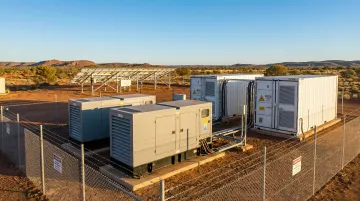
- Hybrid solar-diesel systems cut operational expenditure by 41–47% versus diesel-only sites
- Mining operations achieve fuel savings above 20% with partial renewable penetration
- Full solar or wind integration pushes fuel savings well above 50%
Critical Facilities and Mission-Sensitive Power
Hospitals, military installations, and data centers cannot tolerate power interruptions. Hybrid systems with battery storage provide millisecond-level response times—near-instantaneous compared to the seconds or minutes required for diesel startup.
This allows the generator to respond on a slower timescale without sacrificing reliability, while battery storage absorbs voltage spikes and sags that diesel governors cannot respond to quickly enough.
Innovus Power's microgrid systems are designed around these exact use cases. With over 30 years of field experience and proprietary GridGenius technology, Innovus Power configures vendor-agnostic hybrid systems for remote, industrial, and mission-critical applications — with documented fuel cost reductions up to 80%. A customized power assessment can identify the optimal configuration for your load profile, fuel access, and operational constraints.
Conclusion
Both generator types have legitimate roles. Diesel remains effective for simple, short-duration, or high-consistent-load applications. Hybrid systems are superior for operations with variable loads, remote fuel logistics, long runtimes, or sustainability mandates.
Evaluate your situation against four factors: load profile variability, fuel access and logistics, expected runtime, and long-term cost targets. For operations where power is mission-critical, intelligent hybrid generation delivers measurable benefits:
- Reduced fuel expenditure through load-matched generation
- Lower maintenance overhead with fewer engine running hours
- Improved reliability via redundant power sources
- A scalable platform that can integrate renewables over time
Companies like Innovus Power have built microgrid systems around exactly this architecture — pairing variable-speed generation with intelligent energy management to optimize across all four factors simultaneously.
The real decision is which configuration fits your load, your site, and your timeline — and whether the long-term savings justify the upfront investment for your operation.
Frequently Asked Questions
Which is better: hybrid generator or diesel generator?
Neither is universally better—the right choice depends on load profile, fuel access, and operational duration. Hybrid systems outperform diesel on lifecycle cost and variable-load efficiency; diesel is better for simple, short-duration, or high-consistent-load backup scenarios.
Are hybrid generators a good alternative to diesel generators?
In remote and long-duration applications, hybrid generators consistently outperform diesel on total cost of ownership—delivering fuel savings of 40–80%, reduced maintenance, lower emissions, and the ability to integrate renewables, while retaining diesel backup for reliability.
Which type of generator is most fuel-efficient: hybrid or diesel?
Hybrid generators are significantly more fuel-efficient across variable and low load conditions, with test data showing 40–60%+ fuel savings at partial loads. Diesel generators are relatively efficient only at high, consistent loads (above 75% rated capacity).
What is the upfront cost difference between hybrid and diesel generators?
Diesel generators have a lower upfront purchase and installation cost, while hybrid systems require additional investment in battery storage, power electronics, and control systems. However, hybrid systems typically recover this premium through fuel and maintenance savings within 2–4 years, depending on fuel prices and utilization rates.
How much fuel can a hybrid generator save compared to a diesel generator?
Fuel savings depend on load profile and system design, but properly sized hybrid systems can reduce fuel consumption by 40–80% compared to a conventional diesel generator—with the greatest gains seen in operations that frequently run at low or variable loads.