Introduction
Power outages aren't rare anomalies anymore. U.S. distribution customers averaged 662.6 minutes of interrupted power in 2024, according to EIA reliability data — and that's before factoring in the financial damage. A foundational DOE study estimated U.S. power interruption costs at $79 billion annually, with commercial customers absorbing roughly 72% of that burden.
Traditional backup solutions — diesel generators, standard UPS systems — weren't built for this reality. They kick in after the lights go out and do nothing to reduce the daily cost of electricity.
A business-grade microgrid takes a fundamentally different approach. It integrates generation, energy storage, and control software into a localized power system that delivers reliable, cost-efficient electricity regardless of grid availability — functioning as primary infrastructure, not a last-resort backup.
This article covers what makes a microgrid genuinely reliable, the business case for deploying one, how to evaluate providers, and what Innovus Power's GridGenius platform bring to the table.
Key Takeaways
- A reliable microgrid combines generation, storage, and intelligent control to maintain power regardless of grid conditions.
- Advanced systems can achieve up to 90–100% renewable energy penetration without curtailment.
- Vendor-agnostic design prioritizes system performance over any single manufacturer's product line.
- Industries from mining and oil & gas to medical facilities and remote Arctic communities depend on microgrids for uninterrupted operations.
- Evaluating a provider requires equal weight on track record, control software, and post-deployment support.
Why Traditional Backup Power Falls Short
Diesel generators are reactive by design. They sit idle until the grid fails, then start burning fuel. They offer no protection against utility rate increases, no reduction in daily energy costs, and no defense against the power quality issues that quietly damage equipment over time.
The numbers reinforce the problem. PNNL estimates annual O&M costs for a 300 kW standby generator at $8,000–$10,500, and that figure doesn't include fuel, testing, or the cost of failures caused by neglected maintenance. Meanwhile, commercial electricity rates have climbed from 10.29 cents/kWh in 2013 to 12.75 cents/kWh in 2024 — a 24% increase — with no sign of stabilizing.
Beyond outages, power quality disturbances compound the problem. EPRI estimates these cost U.S. businesses $145–$230 billion annually, with voltage-sensitive facilities experiencing nearly 16 equipment shutdowns per year. A diesel generator does nothing to address:
- Voltage sags that trip sensitive equipment mid-operation
- Harmonic distortion that degrades motors, drives, and electronics over time
- Frequency irregularities that cause erratic behavior in precision systems
For operations in critical sectors — mining, medical, oil and gas, remote communities — that kind of passive backup strategy carries real financial and operational risk every day the grid is running, not just when it fails.
What Makes a Microgrid Solution Truly Reliable
The Five Foundational Components
A business-grade microgrid isn't a single device — it's an integrated system. Every reliable deployment includes:
- Dispatchable generation — solar, wind, hydro, natural gas, diesel, or hybrid combinations
- Energy storage — battery or ultracapacitor systems that buffer supply-demand imbalances
- Energy Management Control System (EMCS) — the intelligence layer that coordinates all sources in real time
- Distribution infrastructure — the electrical backbone that delivers power to loads
- Point of Common Coupling (PCC) — the interface that governs connection to and separation from the utility grid
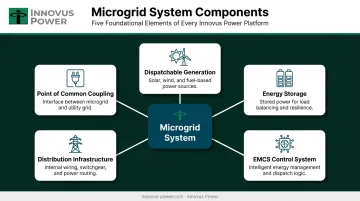
According to IEEE Standard 2030.7, the controller is the critical element — it handles grid connection, disconnection, and autonomous operation in islanded mode.
Islanding and Transition Speed
When the utility grid fails, a reliable microgrid doesn't wait. It islands, disconnecting from the grid and continuing to power operations independently. For facilities with sensitive or critical loads, transition speed is a critical specification.
NFPA 110 defines Type 10 emergency power as restoration within 10 seconds. Type U is uninterruptible: continuous power with zero gap. Medical facilities, data centers, and industrial operations with process-critical equipment need to identify which classification their loads require before specifying a system.
Power Quality Is a Reliability Metric
Uptime alone isn't the full measure of reliability. A microgrid that delivers unstable voltage or frequency can damage sensitive electronics, increase energy consumption, and shorten equipment lifespans — costs that compound over time without obvious attribution.
Reliable microgrids actively condition power output to maintain utility-grade specifications across all operating conditions. This matters particularly in manufacturing and healthcare environments, where equipment sensitivity to voltage variation is high.
Scalability and Renewable Penetration Depth
Business energy needs evolve. A microgrid that requires a full redesign to grow becomes a liability rather than an asset.
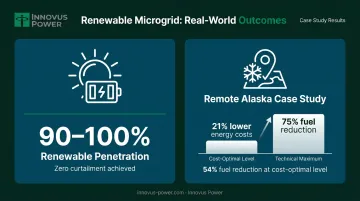
Modular architectures allow facilities to add generation or storage capacity incrementally (in fixed unit sizes) without replacing core infrastructure. Renewable penetration depth is equally important: advanced systems can achieve 90–100% renewable energy use without curtailment, meaning the control system optimizes clean energy dispatch rather than wasting excess generation or defaulting unnecessarily to fossil fuels.
NREL has demonstrated 100% renewable power at multi-megawatt scale. In remote Alaska, renewable integration delivered 54% fuel reduction and 21% lower energy costs as the cost-optimal outcome, with 75% fuel reduction technically achievable at higher capital investment.
Key Business Benefits of Reliable Microgrid Solutions
Cost Reduction and Energy Independence
On-site generation breaks the direct link between business operations and utility pricing volatility. Businesses that own or operate a microgrid can project their cost of energy years into the future — a stark contrast to absorbing utility rate increases with no control over timing or magnitude.
DOE data places continental U.S. microgrid costs at $2M–$5M/MW, with commercial deployments averaging around $4.0M/MW. These are capital investments, not operating expenses — and when renewable generation is maximized, fuel and power costs can drop by 50% or more depending on site conditions and renewable resource availability.
Operational Continuity
Every hour of unplanned downtime carries a direct cost — in lost production, regulatory exposure, or safety risk. Microgrids in islanded mode maintain operations through grid outages, severe weather, and cyberattacks on utility infrastructure without interruption.
For sectors where downtime means delayed surgeries, halted extraction operations, or spoiled agricultural product, the cost of a single outage can exceed years of energy savings.
Sustainability and ESG Goals
Climate Impact Partners reports that 45% of Fortune Global 500 companies planned net-zero targets by 2050 in 2024, up from 39% the year before. Renewable-integrated microgrids are among the most direct paths to meaningful emissions reduction — not just offsets.
For businesses with corporate sustainability commitments, customer expectations around environmental performance, or emissions reporting obligations, on-site renewable generation has shifted from a differentiator to a baseline requirement.
Superior Power Quality and Equipment Protection
Consistent, utility-grade power quality reduces harmonic distortion and voltage irregularities. This benefit is frequently overlooked in backup-only evaluations — but it compounds over time in measurable ways:
- Extends lifespan of motors, drives, and sensitive electronics
- Reduces unplanned maintenance from voltage-related wear
- Lowers overall energy consumption through cleaner load delivery
- Prevents premature equipment failure that appears unrelated to power quality
Industries That Depend on Microgrid Resiliency
For some businesses, power resiliency isn't a competitive advantage — it's a baseline operational requirement.
| Industry | Primary Driver |
|---|---|
| Military | Energy security; islanding from vulnerable grid |
| Oil & Gas / Mining | Remote locations; no grid access; high variable loads |
| Medical & Extended Care | Patient safety; regulatory compliance for continuous power |
| Remote Communities | Primary power infrastructure where grid connection is impossible |
| Agriculture & Greenhouses | Climate control; process continuity; irrigation systems |
| Resorts & Hotels | Guest experience; unreliable local utility grids |
| Sea & Rail Auxiliary Power | Containerized house loads; ship-to-shore operations |
Real deployments show what's at stake. Fort Hunter Liggett commissioned a renewable microgrid in 2024 and reported successful island-mode testing alongside a 63% reduction in energy-use intensity over the prior decade. Valley Children's Healthcare's planned renewable microgrid is estimated to cover 80% of hospital energy needs and save $15 million over 25 years.

When There Is No Grid to Fall Back On
These examples involve facilities that still have a utility connection as a fallback. Remote and off-grid deployments are a different challenge entirely. In Arctic communities, island locations, and maritime applications, connection to a utility grid is either unavailable or impractical. The microgrid isn't a backup — it's the only power system the site will ever have.
What to Look for When Evaluating Microgrid Providers
Vendor-Agnostic Design
Providers tied to specific equipment manufacturers face an inherent conflict of interest: they design systems around their product lineup, not around what's optimal for your site. Vendor-agnostic providers select solar, storage, generation, and control technologies based on site-specific performance requirements — which typically produces better outcomes at lower cost.
Two questions worth asking upfront: Does this provider have qualified relationships with multiple component manufacturers? Can they show deployments using different equipment combinations based on site needs?
Control Software Capability
The EMCS determines whether a system actually functions as an integrated microgrid. Evaluate providers on:
- Maximum renewable penetration the system can manage without curtailment
- How the platform handles renewable intermittency in real time
- Whether the control software is proprietary and proven in operational deployments (not just pilot projects)
- IEEE 2030.7 compliance and interoperability with third-party components
Proven Track Record and Ongoing Support
Ask providers for operational systems that demonstrate their performance claims — with verifiable results, not design concepts. Post-deployment support matters as much as installation. Look for:
- Documented performance data from live deployments
- 24/7 remote monitoring with active system management
- Capability to optimize the system after it's running
Modeling, Simulation, and Financial Transparency
Credible providers use advanced modeling tools to simulate site energy needs and project real financial outcomes before capital is committed. This protects against over-engineered or under-scoped designs and enables a side-by-side comparison between system configurations.
If a provider can't deliver a site-specific financial projection before you commit, treat that as a disqualifying gap.
How Innovus Power's GridGenius Platform Delivers Business Resiliency
Innovus Power has spent over 30 years building microgrid systems that give businesses direct control over their power — its reliability, cost, and long-term availability. That focus shapes every component of the GridGenius platform.
The GridGenius Platform
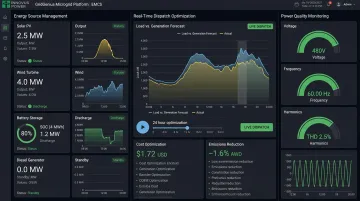
The GridGenius Microgrid Platform is a proprietary, vendor-agnostic system that manages generation, storage, and renewable energy sources through a single intelligent control layer. Its EMCS is designed to:
- Maximize renewable penetration up to 90–100% without curtailment
- Optimize energy dispatch dynamically across all generation sources
- Maintain utility-grade power quality specifications under all operating conditions
- Operate in both grid-forming and grid-following configurations
The platform's variable speed generator technology achieves up to 50% superior efficiency across all loads compared to conventional fixed-speed systems — a meaningful advantage when fuel costs and generator runtime are the dominant operating expenses.
Scalability Without Redesign
GridGenius is built on a modular architecture. Generation capacity is available in 250 kW increments, and renewable sources or storage systems can be added to existing deployments without rebuilding the core infrastructure. The control system manages expanded configurations automatically.
This matters for businesses whose energy profiles will change — whether through growth, electrification, or evolving sustainability targets.
Global Support and Long-Term Partnership
Scalable architecture only delivers value when paired with consistent operational support. Innovus Power provides 24/7 remote monitoring and management through its PowerView and FleetGenius software platforms, supporting deployments across North America, the Caribbean, remote Arctic locations, and internationally.
The company's Grid Design Services use proprietary modeling tools to evaluate site-specific power certainty, quality, and cost. Prospective customers receive a clear financial picture before making any investment decision — and ongoing support ensures the system continues performing as designed throughout its service life.
Frequently Asked Questions
Who are the leading microgrid providers?
Large-scale providers include Schneider Electric, Siemens, ABB, S&C Electric, and GE Vernova. Specialized vendors like Innovus Power differentiate through vendor-agnostic design, proprietary control platforms, and deep expertise in high-renewable-penetration and remote or off-grid deployments where OEM-bundled solutions may not be the right fit.
What is the difference between a microgrid and a traditional backup generator?
A microgrid is a complete, intelligent power ecosystem that operates proactively — it integrates multiple sources, storage, and smart controls to reduce daily costs and maintain continuous power. A generator is a reactive, single-source backup that does nothing for energy costs, emissions, or power quality under normal operating conditions.
Can a business microgrid operate completely off-grid?
Yes. Microgrids in islanded mode operate fully independently of the utility grid. This makes them essential for remote industrial sites, military bases, Arctic communities, maritime applications, and any location where grid connection is unavailable, unreliable, or a strategic vulnerability.
How much does a commercial microgrid cost, and what is the ROI?
DOE cites an average cost of $2M–$5M/MW for continental U.S. microgrids, with commercial deployments averaging around $4.0M/MW. Costs vary based on size, generation mix, and site complexity. Providers with proprietary modeling tools can deliver a site-specific financial projection — with projected fuel savings and payback period — before any capital is committed.
How long does it take to implement a microgrid for a business?
Typical phases include feasibility assessment, design, permitting, procurement, installation, and commissioning. Timelines vary by project complexity. Modular systems like Innovus Power's Rapid Deployment Flex Microgrid (RDFM), which ships in transportable 40-foot platforms, can compress deployment timelines compared to fully custom builds.
What industries benefit most from microgrid solutions?
Industries where downtime carries direct financial or safety consequences: military, oil & gas, mining, medical and extended care facilities, remote communities, resorts and hotels, agriculture, and commercial/industrial operations. In these sectors, a microgrid is operational infrastructure — not an optional upgrade.