Introduction
U.S. residential electricity rates hit 18.83 cents/kWh in early 2025—up over 10% year-over-year according to the EIA—and grid reliability isn't keeping pace. The EIA recorded 662.6 minutes of outage time per customer in 2024, meaning the average American lost power for over 11 hours.
Those figures are pushing remote communities, commercial operators, and industrial facilities toward off-grid solar. But the decision to go off-grid is only the beginning. Choosing the wrong system—undersized batteries, a mismatched inverter, or a solar array that can't carry winter loads—turns energy independence into a reliability nightmare.
This guide breaks down every component, every sizing decision, and every cost consideration you need to evaluate before specifying or procuring an off-grid solar system in 2025.
Key Takeaways
- Off-grid solar systems require five matched components — panels, battery bank, inverter-charger, charge controller, and backup generation
- Size your battery bank for 2–3 days of autonomy for standard commercial sites, or 5–7 days for mission-critical operations
- Lithium iron phosphate (LFP) batteries are the current storage standard — commercial-grade units are rated for 8,000+ cycles and a 15+ year design life
- Total cost of ownership is the right metric for comparing systems — upfront price alone misses fuel, maintenance, and replacement costs
- Large-scale or mission-critical off-grid applications require engineered microgrid solutions, not off-the-shelf kits
What Is an Off-Grid Solar System?
An off-grid solar system generates electricity from solar panels, stores it in a battery bank, and delivers usable AC power through an inverter — with no utility connection and no fallback unless a backup generator is added. The U.S. Department of Energy classifies these as stand-alone renewable energy systems, while NEC Article 710 governs them as "stand-alone electric power production sources operating in stand-alone mode with no utility interconnection."
How off-grid differs from other system types:
| System Type | Grid Connection | Battery Required | Net Metering |
|---|---|---|---|
| Grid-tied | Yes | No | Yes |
| Hybrid | Yes | Yes | Often |
| Off-grid | No | Yes | No |
Off-Grid System Scale Types
Three distinct scales define the off-grid market:
- Small-scale portable — Caravans, boats, and cabins using simple MPPT controllers and plug-in inverters. Typically under 3 kW solar and 10 kWh storage
- Residential standalone — Full homes requiring 8–20 kW of solar and 20–40+ kWh of battery storage
- Commercial and community microgrids — Mining sites, military installations, remote villages, and agricultural operations requiring engineered, monitored, and scalable systems from 250 kW and up
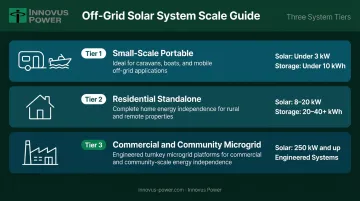
The gap between residential kits and commercial microgrids is significant, both in engineering complexity and in the consequences when something fails. This guide focuses on that upper tier — where design decisions, system integration, and long-term reliability actually matter.
Core Components of an Off-Grid Solar System
Every off-grid system, regardless of scale, relies on five functional building blocks. Reliability depends on sizing and matching each one correctly.
Solar Panels
Solar panels convert sunlight into DC electricity. Array capacity must be sized to meet daily consumption plus system losses—an undersized array undercharges the battery bank, particularly in winter.
Current high-output monocrystalline modules set a high bar for commercial and off-grid builds:
- JinkoSolar Tiger Neo N-type — 590–610W per module, 0.40% annual degradation, 30-year linear power warranty
- Canadian Solar HiKu PERC — 430–455W per module; suited to standard residential and mid-scale off-grid builds
Panels can be wired in series (higher voltage) or parallel (higher current) to match charge controller and inverter input specifications—the right configuration depends on your equipment's voltage and current limits.
Battery Bank
The battery bank powers the system at night and during cloudy periods. Capacity must account for daily consumption, desired days of autonomy, and depth of discharge limits.
LFP (lithium iron phosphate) is now the standard for off-grid storage. Here's why the specs matter:
- EG4 PowerPro WallMount — 14.3 kWh per unit, >8,000 cycles at 80% DOD, design life >15 years, lifetime production 82.6 MWh
- Pylontech US5000 — 4.8 kWh per unit, >8,000 cycles, 15+ year rated life
- Discover AES LiFePO4 — Up to 98% round-trip efficiency, designed for off-grid and mission-critical applications
Lead-acid is still an option for small, budget-constrained systems with low cycle demands—below roughly 500 annual cycles, the cost delta is manageable. Above that threshold, LFP's superior cycle life makes it the lower total-cost choice.
Inverter-Charger
The inverter-charger converts DC battery power to AC for loads, manages solar charging, and coordinates with a backup generator. Sizing must cover peak surge demand—not just average consumption.
Current inverter-charger options by application scale:
- Victron MultiPlus-II — 3,000 VA to 15,000 VA; strong ecosystem, widely deployed in residential off-grid
- OutBack Radian GS8048A — 8,000 VA continuous, 16,970 VA instantaneous; stackable architecture
- Schneider XW Pro — 6,800 W continuous, 12,000 W 60-second overload; residential and small commercial
- SMA Sunny Island 6048-US — 6,000 W; parallel systems to 18 kW
- EG4 18kPV — 18 kW PV input, 12 kW output, up to 10 units stacked for 120 kW AC
Charge Controller (MPPT)
The MPPT charge controller sits between the solar array and the battery bank. Victron's technical testing puts the MPPT efficiency advantage at approximately 19% over PWM at 25°C. That gap narrows in hot climates but widens in cold, temperate conditions—precisely where off-grid systems face their greatest demand. The controller achieves this by continuously tracking the panels' peak power point rather than using a fixed voltage.
For larger systems, multiple MPPT controllers can run in parallel. DC-coupled systems using external MPPT controllers offer greater solar array scalability than AC-coupled all-in-one units.
Backup Generator
A backup generator—diesel or propane—covers extended low-sun periods, system faults, or unusual load spikes. It charges the battery bank through the inverter-charger and provides continuity when solar production falls short.
Sizing should match the inverter-charger's AC input rating and battery charging capacity. For remote or unattended sites, auto-start capability is essential. Victron GX devices support automatic generator start/stop via internal relay control, which eliminates the need for on-site intervention during extended low-sun periods.
How to Choose the Best Off-Grid Solar System
The right off-grid system matches your energy profile, location, and long-term load requirements. Get any one of these six factors wrong and you're looking at shutdowns, oversized costs, or a system that can't grow with you.
Daily Energy Consumption & Peak Load
Start with a detailed load audit. The EIA reports average U.S. household electricity use at approximately 10,500 kWh/year—roughly 28.8 kWh per day. But averages mislead. Your actual load depends on what equipment runs simultaneously and when.
Two numbers matter most:
- Average daily consumption (kWh) — drives battery sizing
- Peak simultaneous demand (kW) — drives inverter sizing
Undersizing either leads to shutdowns and equipment stress. A load calculator or energy management system helps capture seasonal variation—winter heating and reduced solar hours consistently increase both load and generation shortfall.
Battery Storage Capacity & Chemistry
Sizing targets by application:
- Residential: 2–3 days of autonomy at 80–90% depth of discharge
- Critical commercial or remote: 5–7 days of autonomy
At commercial and industrial scale, modular lithium iron phosphate (LFP) or containerized battery systems allow capacity to be added incrementally — an important feature for sites expected to grow. Modular architectures simplify expansion without reconfiguring existing infrastructure.
Solar Array Size & Local Irradiance
The array must be large enough to fully recharge the battery bank on an average solar day at your location. Peak sun hours vary considerably by geography—use NREL's National Solar Radiation Database (NSRDB) or PVWatts to get site-specific values rather than relying on regional averages.
Key array sizing principles for off-grid applications:
- Oversize deliberately — excess summer production offsets reduced winter output
- Size to worst-case solar month, not annual average
- Account for panel degradation (typically 0.5–0.7% per year) over a 25-year horizon
- Factor in generator runtime costs when evaluating array expansion trade-offs
Inverter Type & System Architecture
DC-coupled vs. AC-coupled architectures have real trade-offs:
- DC-coupled — MPPT controller charges battery directly; better scalability, better redundancy (one failed MPPT doesn't take down the system), stronger black-start capability
- AC-coupled — Solar inverter feeds the AC bus; simpler for retrofits, but less flexible for off-grid expansion
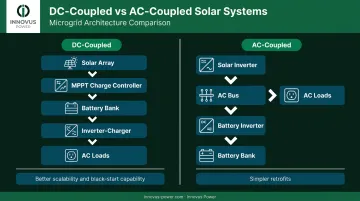
Modern off-grid inverter-chargers capable of both AC and DC coupling offer the most flexibility—a critical consideration for commercial-scale or mission-critical applications where future growth is likely.
System Scalability & Expandability
A well-designed system should grow without a full redesign. Key features to look for:
- Modular battery systems (rack-mount LFP)
- Stackable inverters (parallel operation)
- Charge controllers that can be added incrementally
- Control systems that support additional generation sources
Scalability matters most in commercial or community deployments where demand grows over time—new equipment, population growth, electrification of transport or heating.
Total Cost of Ownership & Levelized Cost of Energy
Upfront price is the wrong metric. Levelized Cost of Energy (LCOE)—total lifetime system cost divided by total energy produced—accounts for component lifespan, maintenance, efficiency, generator fuel, and battery replacement cycles.
Approximate installed cost ranges by system scale:
| System Scale | Estimated Cost Range |
|---|---|
| Small commercial / remote facility (up to 100 kW) | $150,000 – $500,000 |
| Mid-scale industrial or community (100 kW – 1 MW) | $500,000 – $3,000,000 |
| Large commercial / multi-site microgrid (1 MW+) | $3,000,000+ |
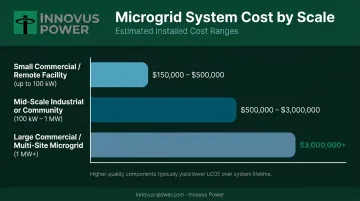
Higher-quality components typically yield lower LCOE despite higher upfront cost. A battery bank rated for 8,000+ cycles lasting 15 years costs significantly less per kWh delivered than a cheaper alternative requiring replacement in five — and that gap widens once you factor in installation labor and system downtime.
How Innovus Power Can Help with Off-Grid Microgrid Solutions
Most of this guide addresses residential and small commercial off-grid systems. But for organizations where power failure is not an option—remote arctic communities, military bases, mining operations, medical facilities, or large agricultural processors—the engineering requirements are fundamentally different.
Innovus Power has spent over 30 years developing engineered microgrid solutions for exactly these applications. Their work spans remote communities, military installations, mining operations, resorts, and commercial/industrial users across North America, the Caribbean, and beyond.
The GridGenius Platform
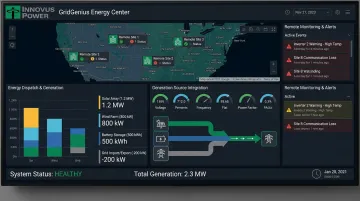
At the core of every Innovus microgrid is the GridGenius Energy Center—a configurable control system that manages power quality, energy dispatch, and generation source coordination across the full microgrid. Key capabilities include:
- Grid-forming or grid-following operation depending on application
- Variable speed engine management for fuel efficiency optimization
- Energy storage lifecycle management
- Integration of solar, wind, battery, ultracapacitor, and backup generation
- 24/7 remote monitoring and management via PowerView software
For organizations managing multiple sites, FleetGenius extends these capabilities to simultaneous multi-system monitoring and management from a single interface.
Why Engineered Solutions Differ from Off-the-Shelf Kits
What sets Innovus apart from packaged kit solutions:
- Selects components based purely on technical and economic merit for each site — no manufacturer bias
- Runs pre-build Grid Design Services to model multiple configurations before hardware is purchased
- Deploys variable speed generator technology that cuts fuel consumption by up to 50% across all load levels
- Achieves up to 90%+ renewable penetration without curtailment through intelligent dispatch coordination
- Delivers levelized energy costs at or below utility rates — verified across deployed systems
For a Caribbean agricultural processing facility facing 2+ utility outages monthly and high imported diesel costs, Innovus designed a solar plus battery storage system delivering 90% energy independence—addressing both reliability and the ongoing cost of fuel logistics.
Organizations operating in remote or high-stakes environments can contact Innovus Power directly to request a Grid Design Services assessment for their site.
Conclusion
The best off-grid solar system is defined by fit, not feature count. A well-matched system for a remote mining camp looks nothing like one for a hospital or a military forward operating base—and treating them as comparable leads to either wasted capital or chronic underperformance.
For commercial and mission-critical deployments, the right approach centers on a few non-negotiables:
- Accurate load auditing before any equipment is specified
- Vendor-agnostic system design that selects technology on merit, not supplier relationships
- Integrated energy management (EMCS) to optimize dispatch across generation, storage, and load
- Remote monitoring and support to catch performance issues before they become failures
Off-grid design isn't a one-time decision. Loads change, technology improves, and a system sized correctly today may need to scale within five years. Engaging experienced engineers from the start—particularly those with validated microgrid deployments—is what separates systems that perform for decades from those that require expensive redesigns within the first few years of operation.
Frequently Asked Questions
How big of a solar system do I need to go off-grid?
System size depends on your daily kWh consumption and your site's peak sun hours. As a starting point, a typical home requires 8–15 kW of solar paired with 20–40+ kWh of battery storage. A detailed load audit is the essential first step before any sizing calculation.
Can I run AC on an off-grid system?
Yes. Modern off-grid inverter-chargers from 2.4 kW to 20+ kW deliver pure sine wave AC power capable of running air conditioners, heat pumps, and high-surge appliances—provided the inverter is sized for both continuous load and startup surge demand.
What is the 120% rule for solar panels?
NEC 705.12(B)(2) allows a solar system's output current plus the busbar's existing overcurrent protection to total up to 120% of the busbar's ampere rating. This applies to grid-tied and hybrid load-side interconnections; off-grid stand-alone systems fall under NEC Article 710 instead.
What batteries are best for an off-grid solar system?
LFP (lithium iron phosphate) batteries are the current standard, rated for 8,000+ cycles and 15+ year design lives with round-trip efficiency up to 98%. Lead-acid remains viable for small, budget-constrained systems where lower cycle life expectations are acceptable.
What is the difference between off-grid and hybrid solar systems?
Off-grid systems have no utility connection and must generate and store 100% of their energy on-site. Hybrid systems keep a grid connection as backup, allowing smaller battery banks—but they don't provide true energy independence if the grid goes down.
How long does an off-grid solar system last?
Quality solar panels carry 25–30 year performance warranties. LFP battery systems are rated for 15+ years or 8,000+ cycles at 80% depth of discharge. Inverters typically last 10–15 years. Overall system lifespan depends on component quality, correct sizing, and regular maintenance.