Introduction
Grid reliability in North America is deteriorating. The U.S. Energy Information Administration reported that electricity customers averaged 11 hours of power interruptions in 2024 — the highest outage duration in a decade. At the same time, utility costs keep climbing and renewable mandates keep tightening.
For facilities that can't afford that exposure, a microgrid is no longer a luxury. It's infrastructure. And the controller is what makes that infrastructure work.
The microgrid controller is the intelligence layer — the system that decides when to pull from solar, when to dispatch storage, when to shed load, and when to island from the grid entirely. Choose the right platform and you cut costs, maximize renewables, and stay online when the utility fails. Choose the wrong one and the rest of your investment underperforms.
The market reflects this urgency. According to MarketsandMarkets, the microgrid controller market was valued at $6.8 billion in 2024 and is projected to reach $18.7 billion by 2029 — a 22.6% CAGR. What follows is a breakdown of the leading platforms, the criteria that actually matter, and where each solution fits.
Key Takeaways
- A microgrid controller manages all generation, storage, and load assets to maintain stable, efficient power in grid-connected and islanded modes.
- Top platforms include Innovus Power GridGenius, Schneider Electric EcoStruxure, S&C Electric GridMaster, ABB Ability Microgrid Plus, and Siemens SICAM.
- Most buyers underweight vendor-agnostic design and renewable penetration capability when evaluating controllers.
- Controller costs range from roughly $6,200/MW to $470,000/MW depending on scale and complexity; lifetime LCOE impact matters more than upfront price.
- Post-deployment support, scalability, and open communication protocols determine long-term performance.
What Is a Microgrid Controller and Why Does It Matter?
A microgrid controller is the hardware-software system that continuously measures power flows across all distributed energy resources (DERs) within a microgrid and dispatches generation, storage, and controllable loads to maintain voltage, frequency, and efficiency — whether the system is connected to the utility grid or operating independently.
The IEEE 2030.7-2017 standard defines the technical specifications and requirements for microgrid controllers, establishing the functional baseline any serious platform should meet. IEEE 2030.8 provides the companion testing procedures.
Core Functions That Directly Affect Cost and Reliability
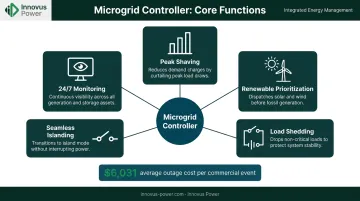
A capable controller does more than keep the lights on. Its dispatch logic determines:
- Peak shaving and demand charge reduction — reducing expensive demand peaks by coordinating battery discharge or load curtailment
- Renewable prioritization — maximizing solar or wind use before dispatching fossil-fuel generation
- Seamless islanding transitions — automatically separating from the grid during outages while maintaining stable power
- Load shedding — dropping non-critical loads to protect priority circuits during supply constraints
- 24/7 monitoring and diagnostics — providing operators with real-time visibility and remote management
The financial stakes are concrete. ORNL reported that power outages cost commercial and industrial customers an average of $6,031 per event in 2024. NREL's REopt modeling identified $171 million in potential savings from optimized dispatch for coincident peak demand charges alone. Choosing the wrong platform means leaving those savings on the table — or worse, accepting outage risk that a better dispatch algorithm would have prevented.
With dozens of platforms on the market (from utility-grade systems to application-specific controllers), the right choice depends on deployment context, energy mix, and long-term operational goals.
Top Microgrid Controllers for Modern Grid Management
These platforms were evaluated on renewable integration capability, communication flexibility, deployment track record, scalability, and ability to serve diverse end users. Each entry below covers the controller's core strengths, primary use cases, and what sets it apart — from remote Arctic communities to large commercial campuses.
Innovus Power GridGenius
Innovus Power is a North American manufacturer with over 30 years of experience developing intelligent microgrid solutions for remote, off-grid, and grid-tied applications. The company serves military, mining, oil & gas, utilities, and remote community sectors, with GridGenius functioning as the Energy Management Control System (EMCS) at the heart of every deployment.
What separates GridGenius from most competing platforms is its vendor-agnostic architecture. Rather than being optimized around a specific hardware ecosystem, GridGenius is purpose-built to integrate solar, wind, hydro, battery storage, and variable-speed generation from multiple manufacturers — without technology lock-in.
The platform can achieve up to 90–100% renewable energy penetration without curtailment, and its variable-speed generator technology delivers up to 50% efficiency gains over conventional fixed-speed generation.
Post-commissioning, GridGenius systems are backed by 24/7 remote monitoring and management through two integrated software tools: PowerView for individual system oversight and FleetGenius for managing distributed fleets across multiple sites.
| Attribute | Details |
|---|---|
| Key Features | Vendor-agnostic DER integration (solar, wind, hydro, BESS, variable-speed generation); proprietary modeling and simulation tools; variable-speed generator technology |
| Ideal Use Cases | Remote communities, Arctic deployments, military installations, mining, oil & gas, resorts, and commercial & industrial customers requiring energy independence |
| Notable Capability | Up to 100% renewable penetration without curtailment; up to 80% reduction in fuel and power costs; 24/7 remote monitoring worldwide |
Schneider Electric EcoStruxure Microgrid
EcoStruxure Microgrid covers the full management stack — from individual buildings to large industrial districts — and is backed by Schneider Electric's presence across approximately 100 countries serving commercial, industrial, and infrastructure sectors.
The most concrete recent milestone: Schneider launched EcoStruxure Microgrid Flex in Q2 2023, a standardized configured microgrid system designed to compress project timelines from years to months. Scale Microgrids was named as one of the first delivery partners. The platform targets hotels, retail, food and beverage, healthcare, and government facilities — particularly small and medium markets where speed of deployment matters.
EcoStruxure Microgrid Advisor, the cloud-based management layer, uses model predictive control for DER dispatch, time-of-use optimization, peak shaving, and demand response.
| Attribute | Details |
|---|---|
| Key Features | Cloud-based control via EcoStruxure Microgrid Advisor; AI-driven demand management; grid-tied and islanded modes; standardized deployment architecture |
| Ideal Use Cases | Commercial buildings, data centers, campuses, healthcare, hospitality, and large industrial districts |
| Notable Capability | Microgrid Flex compresses deployment timelines from years to months; strong third-party hardware integration |
S&C Electric GridMaster
S&C Electric is a century-old, employee-owned specialist in power switching and protection. Its GridMaster Microgrid Control System is the primary controller product — distinct from the PureWave product line, which covers community energy storage and UPS applications.
GridMaster is built around resilience-first applications, with a track record across utility, community, and campus microgrid deployments. S&C's core engineering strength in switching and protection translates directly into fast, reliable islanding capability — particularly relevant for hospitals, universities, and military installations where even brief power interruptions carry serious operational consequences.
| Attribute | Details |
|---|---|
| Key Features | Advanced switching and protection; community and campus microgrid architecture; utility-grade reliability engineering |
| Ideal Use Cases | Utilities, hospitals, military bases, universities, and community microgrids requiring maximum uptime |
| Notable Capability | Primary engineering focus on power reliability and fast islanding; century of switching and protection expertise |
ABB Ability Microgrid Plus
ABB operates in over 100 countries and brings deep intellectual property in grid synchronization and energy distribution. Its Ability Microgrid Plus controller offers modular, scalable design suited to both off-grid industrial sites and utility-managed distributed networks.
ABB's strength is in remote and off-grid industrial deployments — mining, oil & gas, islands, and remote communities — where real-time grid synchronization, renewable integration, and comprehensive DER portfolio management under a single control layer are operationally critical.
The platform covers conventional generation, renewables, and storage, with consulting and engineering services available as part of the deployment package.
| Attribute | Details |
|---|---|
| Key Features | Modular and scalable architecture; real-time grid synchronization; off-grid and grid-connected modes; engineering services included |
| Ideal Use Cases | Remote industrial sites, island communities, mining operations, and utility-managed distributed networks |
| Notable Capability | Comprehensive DER portfolio — from generation to storage to automation — managed under a single control layer |
Siemens SICAM Microgrid Suite
The SICAM Microgrid Suite serves campuses, transportation networks, military installations, and large industrial complexes globally — developed within Siemens' Smart Infrastructure segment and backed by more than 175 years of industrial engineering.
Siemens' differentiation is integration depth. The SICAM platform connects grid automation, building management systems, and distributed energy management in a single control framework — making it particularly suited for complex environments that need all three layers coordinated. Siemens SICAM also powers the JUWI Hybrid IQ controller platform for remote hybrid power applications, reflecting its adaptability for third-party deployments.
| Attribute | Details |
|---|---|
| Key Features | IoT integration with SICAM suite; digital control and automation; compatible with campus, transportation, and industrial environments |
| Ideal Use Cases | Smart city projects, military campuses, transportation networks, and large industrial facilities |
| Notable Capability | Deep integration between grid automation, building management, and distributed energy in a single platform |
How We Chose the Best Microgrid Controllers
Common Buyer Mistakes
Three mistakes show up repeatedly in controller selection:
- Over-weighting brand name at the expense of fit-for-purpose capability
- Choosing grid-tied-only platforms that can't maintain stable frequency and voltage in islanded mode
- Selecting vendor-locked systems that restrict future DER integration and increase long-term costs
Core Evaluation Criteria
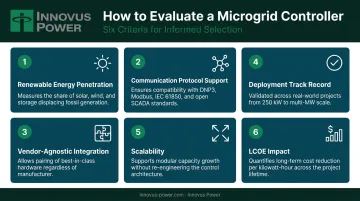
Each platform was assessed against six criteria:
- Renewable energy penetration — can the controller handle high solar/wind penetration without curtailment?
- Communication protocol support — does the platform support open protocols (Modbus, DNP3, IEC 61850) for broad hardware compatibility?
- Vendor-agnostic integration — is the platform architected for multi-vendor DER environments, or does it favor proprietary hardware?
- Proven deployment track record across relevant use cases: remote, industrial, military, and commercial
- Scalability — can the system grow as energy needs or site loads change?
- LCOE impact — what does the controller actually do to reduce the levelized cost of energy over the system's operating life?
Often Overlooked Factors
Certifications and support rarely make headlines in procurement — but they determine whether a deployed system keeps improving or stagnates after installation:
- IEEE 2030.7 conformance — ask vendors for written evidence of technical compliance, not just a general reference to the standard
- IEEE 2030.8 testing — the companion standard covers controller testing procedures and is a meaningful differentiator between vendors
- 24/7 remote monitoring — post-commissioning support determines long-term system performance, not just uptime at go-live
- Ongoing optimization capability — the ability to tune dispatch logic and update software post-deployment separates managed platforms from static installations
Conclusion
Choosing the right microgrid controller comes down to fit — your site's energy mix, reliability requirements, scalability needs, and long-term cost targets matter far more than brand recognition.
Vendor-agnostic platforms offer the greatest flexibility as your DER portfolio evolves. Technology lock-in that looks manageable at procurement becomes a real constraint five years later when you're adding battery storage or shifting fuel types.
When comparing options, evaluate controllers on:
- Renewable penetration capability and curtailment handling
- Post-deployment support structure and remote monitoring
- Scalability across expanding generation assets
- Real-world LCOE reductions, not just upfront specifications
For organizations seeking a vendor-agnostic microgrid control platform with over 30 years of deployment experience across North America and beyond, Innovus Power's GridGenius EMCS is designed to maximize renewable energy integration and minimize power costs across remote, industrial, military, and commercial applications. Contact Innovus Power to request a system consultation and feasibility assessment through its Grid Design Services.
Frequently Asked Questions
What is a microgrid controller?
A microgrid controller is the hardware-software system that monitors, manages, and dispatches all generation, storage, and load assets within a microgrid to maintain stable, efficient, and resilient power. It operates in both grid-connected and islanded (off-grid) modes, managing the transition between the two automatically.
How much does a microgrid controller cost?
Controller costs vary significantly by scale and complexity. According to NREL and EPA data, the range runs from roughly $6,200/MW to $470,000/MW, with a mean near $155,000/MW, against total microgrid costs of $2M–$5M/MW. LCOE over the system's operating life is a more meaningful metric than upfront controller cost alone.
What is the difference between a grid-connected and an off-grid microgrid controller?
Grid-connected controllers optimize energy flows between onsite DERs and the utility grid, managing demand charges, renewable use, and cost. Off-grid (islanded) controllers must independently maintain voltage and frequency without utility support — requiring more sophisticated dispatch logic, black-start capability, and tighter real-time control.
What key features should I look for in a microgrid controller?
Prioritize controllers that offer:
- Real-time DER dispatch and load management
- Open communication protocols (Modbus, DNP3, IEC 61850)
- Vendor-agnostic hardware compatibility
- Fast, reliable islanding transitions
- High renewable penetration capability
- 24/7 remote monitoring and post-commissioning support
Can a microgrid controller integrate solar, battery storage, and generators simultaneously?
Yes. Advanced controllers are specifically designed to coordinate multiple DER types — solar PV, battery energy storage, wind, and dispatchable generators — optimizing dispatch order and energy flows based on cost, emissions targets, and reliability priorities in real time.
What industries benefit most from advanced microgrid controllers?
Industries with critical reliability needs or limited utility access gain the most: remote communities, military installations, mining, oil & gas, healthcare, data centers, commercial and industrial facilities, and agricultural operations where renewable integration and fuel cost reduction drive real operational value.