According to Caterpillar's published data, a C15 364 ekW generator consumes 94.5 L/hr at full load but still draws 31.6 L/hr at just 25% load — meaning you're burning a third of full-load fuel to deliver a quarter of full-load power. Multiply that inefficiency across thousands of annual operating hours, and the cost difference becomes significant fast.
Variable speed AC generator technology solves this by letting the engine slow down as load drops — and using power electronics to keep the AC output clean and stable regardless of engine RPM.
Key Takeaways
- Variable speed AC generators reduce engine speed proportionally with load, cutting fuel consumption across all operating conditions
- Variable speed units deliver up to 50% greater fuel efficiency than fixed-speed generators at partial loads
- IRENA reports conventional generators require a 30–50% minimum stable load, limiting how much renewable energy a system can absorb
- Reduced operating RPM extends time between overhauls by approximately 20%, per MTU data
- Highest-impact deployments: remote communities, mining, military installations, hybrid microgrids
What Is a Variable Speed AC Generator?
A variable speed AC generator is a power generation unit where the engine speed varies with actual load demand, rather than locking to a fixed RPM to maintain output frequency.
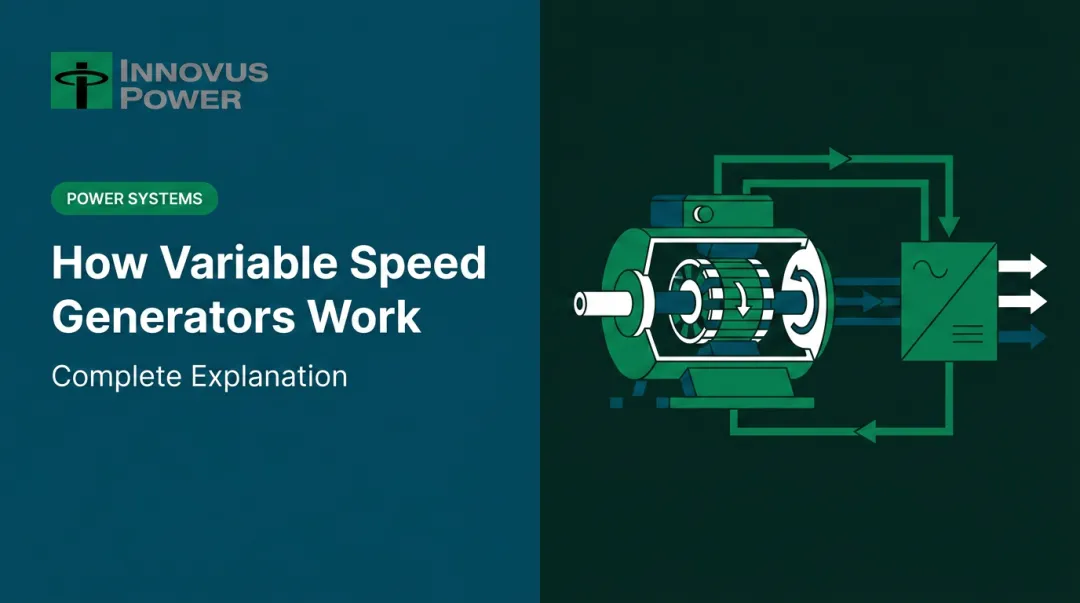
Power electronics — typically an inverter or AC-DC-AC converter — decouple engine speed from the grid frequency requirement, delivering stable 50 or 60 Hz output across the full engine speed range.
The principle mirrors a variable-speed drive on a pump motor: the motor slows when less flow is needed, saving energy without sacrificing output. A variable speed generator applies the same logic — on the generation side rather than the consumption side.
Common deployment contexts include:
- Remote and off-grid communities
- Hybrid solar-diesel or wind-diesel microgrids
- Mining and oil & gas facilities with 24/7 generation requirements
- Marine and rail auxiliary power systems
- Military forward operating bases
- Agricultural and commercial facilities with variable daily load profiles
Innovus Power's variable speed generator technology is designed to integrate with the GridGenius EMCS, enabling intelligent, load-responsive speed modulation rather than manual or threshold-based control — across marine, industrial, transportation, and defense deployments.
Key Advantages of Variable Speed AC Generators
Advantage 1: Superior Fuel Efficiency Across All Load Levels
A conventional fixed-speed generator must maintain its rated RPM — typically 1,500 RPM for 50 Hz or 1,800 RPM for 60 Hz — regardless of what load it's actually serving. A generator sized for 100 kW peak demand runs at full mechanical speed whether the actual load is 100 kW or 20 kW.
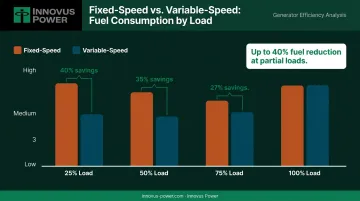
The Caterpillar C15 data illustrates this clearly. At 25% load, the unit consumes 31.6 L/hr. At 50% load, that climbs to 51.5 L/hr, and at 75% load, 71.8 L/hr. The fuel doesn't drop proportionally with load — a 75% reduction in output translates to only a 67% reduction in fuel consumption.
Variable speed units break this relationship. As load drops, engine speed drops with it, and fuel consumption tracks the load far more closely. A peer-reviewed analysis published in the Journal of Energy and Power Technology found fuel savings of 27% at 10% load, declining to 3.5% at 80% load, for variable-speed diesel-electric operation. A separate 2019 Energy Procedia study found that variable-speed diesel application can reduce fuel consumption by up to 40% compared with conventional hybrid diesel configurations.
Why this matters financially:
Fuel is the dominant operating cost in off-grid and remote power systems. RMI's minigrid cost breakdown identifies fuel as the largest single cost at 58% of total minigrid expenses. In the most isolated locations — remote Alaska communities, for example — diesel-generated electricity already costs $0.50 to more than $1/kWh according to the U.S. DOE. Every percentage point of fuel savings compounds directly into reduced operating expenditure over a generator's life.
Innovus Power's variable speed generators deliver up to 50% better efficiency across all load levels compared to fixed-speed alternatives — a difference that shows up in measurable fuel cost reductions starting in year one.
KPIs most affected: fuel consumption (L/kWh), specific fuel consumption (g/kWh), annual fuel spend, CO2 emissions per kWh, levelized cost of energy
Highest-impact scenarios: remote Arctic and island communities, mining and oil & gas sites with continuous generation needs, military forward operating bases, and any location where fuel delivery logistics add significant cost per liter
Advantage 2: Seamless Integration with Renewable Energy Sources
In a hybrid microgrid, the generator's job is to fill the gap between what renewables produce and what the load demands. Fixed-speed generators do this poorly, because they can't reduce output below a minimum stable load threshold — typically 30–50% of nameplate capacity, according to IRENA. When solar or wind output rises and load is low, the generator can't step back far enough. The excess energy has to go somewhere, and if storage is full, renewables get curtailed.
This minimum-load floor caps how much renewable capacity a site can actually use.
IRENA modeled this effect in Mahe, Seychelles: a base case with 65% minimum generator loading allowed only 29.1 MW of PV capacity. Reducing minimum loading to 50% allowed that figure to rise to 85.8 MW — nearly three times the renewable capacity from a single operational parameter change.
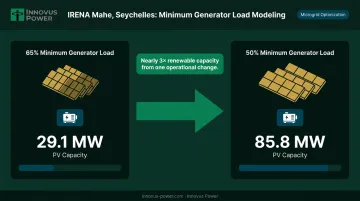
Variable speed generators can operate at much lower minimum loads, allowing solar or wind to supply more of the demand without the generator creating a curtailment floor. The outcome is higher renewable penetration, less fuel burn, and better utilization of existing renewable assets.
NREL's analysis of Unalakleet, Alaska found that high-penetration renewable pathways could cut fuel consumption by 54% while reducing energy costs by 21%. King Island, Australia, achieved a 65% annual renewable share and up to 100% instantaneous renewable penetration using low-load diesel integration, as documented by IRENA.
Innovus Power's GridGenius platform is designed for exactly this type of operation — supporting up to 90–100% renewable penetration by enabling the generator to modulate down to very low output levels while GridGenius coordinates dispatch across solar, storage, and generation in real time.
KPIs most affected: renewable energy fraction (%), fuel displacement rate, curtailment rate, CO2 reduction, battery cycling stress, overall system LCOE
Highest-impact scenarios: remote communities transitioning from diesel-only to hybrid renewable, island grids with solar investment, agricultural and greenhouse facilities, any site with renewable penetration targets above 50%
Advantage 3: Reduced Mechanical Wear and Lower Maintenance Costs
Fixed-speed generators run at rated RPM continuously — whether they're serving 100% load or 15% load. That constant high-speed operation creates wear on pistons, bearings, cooling systems, and fuel injectors at a rate that has nothing to do with the actual work being done.
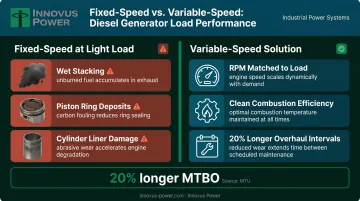
Light-load operation compounds the problem. Caterpillar's guidance explicitly states that running below 30% load causes:
- Wet stacking — unburned fuel accumulating in the exhaust system
- Piston ring deposits that accelerate cylinder wear
- Cylinder liner damage requiring premature overhaul
Caterpillar's recommended fix is to load gensets to at least 30% for 30 minutes every four hours of light-load operation. That's a workaround, not a solution.
Variable speed units address this differently. By reducing RPM under light loads, they reduce mechanical stress proportionally. MTU's data shows that variable-speed generator sets can increase time between overhauls by approximately 20% due to reduced operating speeds. They also avoid the wet-stacking failure mode entirely, since the engine operates at speeds matched to combustion efficiency rather than a fixed frequency target.
The real cost of remote maintenance:
In a remote or hard-to-access site, a maintenance event isn't just parts and labor. It involves logistics coordination, travel time, potential air freight for components, and often lost productivity during downtime. Extending overhaul intervals by even 20% can mean one fewer major service event over a multi-year deployment cycle — a saving that easily exceeds the incremental cost of variable speed technology.
KPIs most affected: mean time between overhauls (MTBO), maintenance cost per operating hour, unplanned downtime events, spare parts consumption, total cost of ownership
Highest-impact scenarios: remote Arctic or island sites, mining operations where generator downtime halts production, medical and critical infrastructure facilities where reliability is non-negotiable
Where Variable Speed AC Generators Deliver the Most Impact
Variable speed generators offer efficiency advantages in many contexts, but their value concentrates where load profiles fluctuate significantly, fuel delivery is expensive, or renewable integration is a stated goal.
| Application | Primary Driver |
|---|---|
| Remote communities (Arctic, islands) | Fuel cost, logistics, renewable transition |
| Mining and oil & gas | 24/7 operation, variable shift loads, downtime cost |
| Military forward operating bases | Fuel logistics, 1–5 MW continuous need |
| Marine and rail auxiliary power | Variable underway loads, space/weight efficiency |
| Resorts and hotels in remote locations | Load variability, fuel cost, guest reliability expectations |
| Hybrid renewable microgrids | Renewable penetration enablement, curtailment reduction |
| Medical and critical infrastructure | Power quality, reliability, controlled ramp behavior |
Nearly three-quarters of Canada's roughly 250 remote communities rely on diesel generators for electricity, according to Natural Resources Canada — a figure that underscores both the scale of the problem and the opportunity for variable speed and hybrid solutions.
That same case for reliability extends to medical facilities and data centers. The smoother, inverter-conditioned output of variable speed generators reduces voltage and frequency fluctuations compared to direct fixed-speed AC output — a meaningful advantage for sensitive diagnostic equipment, computing infrastructure, and life-safety systems.
What Happens When Fixed-Speed Generators Are Relied On Instead
The costs of fixed-speed operation in variable-load environments add up steadily.
IRENA notes that fuel consumption per kWh typically increases 3–7% at 50% loading compared to 100% loading for fixed-speed units. Most remote and industrial generators rarely run at full rated load for sustained periods — meaning this efficiency penalty isn't an exception, it's the baseline.
Sites with fixed-speed backup generators typically cannot exceed 30–40% renewable penetration without curtailment or oversized battery investment. The generator's minimum stable load requirement prevents it from stepping back far enough when solar or wind output is high — so renewable assets get installed and paid for, yet can't deliver their full potential.
Operating below 30% of rated capacity accelerates wear through wet stacking, incomplete combustion, and piston ring fouling — a pattern Caterpillar addresses directly in its guidance on generator underloading.
In remote deployments where the nearest qualified technician may be days away, an unplanned failure from preventable wear carries costs well beyond the repair bill itself.
How to Get the Most Value from Variable Speed AC Generators
Variable speed generators reach their full potential when integrated into an intelligent, load-responsive system.
The key integration requirement is an EMCS. When paired with an Energy Management Control System that monitors load demand, renewable output, and storage state of charge in real time, the generator's speed modulation can be optimized continuously.
Without that coordination layer, speed changes happen in response to simple thresholds rather than genuine system optimization.
Innovus Power's GridGenius EMCS and variable speed generator technology are specifically designed for this type of integrated, load-responsive operation. The GridGenius platform manages power flow across generation, storage, and renewables simultaneously — enabling up to 90–100% renewable penetration and up to 50% fuel savings compared to conventional fixed-speed configurations.
Three practical steps to maximize value:
- Right-size the generator to actual load profiles, not worst-case peak demand. Oversizing forces more low-load operation, which defeats the efficiency advantage.
- Track measurable baselines from commissioning: fuel consumption per kWh, renewable fraction, and maintenance interval data should be logged from day one to validate performance and identify drift.
- Plan for load growth: variable speed systems are flexible, but system design should account for anticipated load increases and any additional renewable or storage assets planned within the investment horizon.
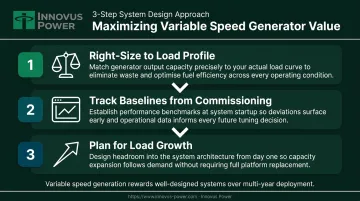
Variable speed generation is a long-term infrastructure investment. The compounding benefits (fuel savings, extended overhaul intervals, higher renewable utilization) accumulate over years of operation and reward systems that are well-designed from the start.
Frequently Asked Questions
What is a variable speed generator?
A variable speed generator adjusts its engine or prime mover speed to match actual load demand, using power electronics to maintain stable AC output frequency regardless of engine RPM. Unlike fixed-speed units that always run at full mechanical speed, variable speed units consume only the fuel the load actually requires.
How does a variable speed AC generator work?
An inverter or AC-DC-AC converter decouples the engine shaft speed from the output frequency, allowing the engine to slow down under light loads while still delivering clean, stable 50 or 60 Hz power to connected equipment. Power electronics manage frequency regulation while the engine operates at whatever speed delivers the best efficiency for that load level.
Is a variable speed AC generator worth it?
For applications with variable load profiles, costly fuel supply, or renewable integration targets, yes. The returns typically come from fuel savings, longer overhaul intervals, and reduced curtailment of renewable generation — though actual payback depends on load profile, fuel cost, and system configuration.
What is the difference between a fixed-speed and a variable speed generator?
Fixed-speed generators maintain constant RPM to hold output frequency, consuming near-peak fuel even at partial loads. Variable speed generators reduce engine speed as load drops and use power electronics to maintain frequency stability — delivering significantly better efficiency across the full load range.
What industries benefit most from variable speed AC generators?
Remote communities, mining, oil and gas, military installations, marine auxiliary power, and commercial microgrids see the highest returns — particularly where fuel is expensive to transport or where renewable penetration targets above 50% have been set.
How do variable speed generators support renewable energy integration?
Because variable speed generators can modulate output down to very low levels, they avoid the minimum stable load constraint of fixed-speed units. This allows solar or wind to supply more of the load without curtailment, enabling renewable energy penetration of 90–100% in hybrid microgrid configurations without wasting generated power.