The market reflects this. According to Fortune Business Insights, the global variable speed generator market is projected to grow from $7.9B in 2025 to $16.89B by 2034 — driven by rising fuel costs, tightening emissions regulations, and the rapid expansion of hybrid microgrids. IMO's EEXI and CII requirements, which took effect January 2023 for commercial shipping, are pushing marine operators toward more efficient generation architectures specifically.
Despite this growth, the internal mechanics of VSG technology remain widely misunderstood — leading to poor equipment selection, mismatched control configurations, and operational losses that could have been avoided. This guide breaks down exactly how variable speed generators work, step by step.
Key Takeaways
- VSGs automatically adjust engine RPM to match real-time load demand, rather than running at a constant speed
- Because RPM changes, output frequency also changes — power electronics (AC-DC-AC conversion) stabilize the final output
- Speed-load matching eliminates the chronic inefficiency of fixed-speed gensets at partial loads, delivering fuel savings of 20–50%
- VSGs are best suited to applications where loads are low or variable for most operating hours
- In hybrid microgrids, VSGs pair with energy storage and renewables — the control system dispatches each source based on load conditions, not a fixed schedule
What Is a Variable Speed Generator?
A variable speed generator is a power generation system where the engine automatically adjusts its rotational speed (RPM) in proportion to the load being demanded. The engine speed tracks demand — rather than spinning at a fixed RPM regardless of what's connected to it.
VSGs exist because fixed-speed generators have a fundamental efficiency problem. Natural Resources Canada notes that conventional diesel generators can suffer efficiency losses of up to 25% when ramped down, and are typically restricted to minimum loading of 30–50% to prevent carbon build-up or glazing.
In many real-world applications — standby power, marine vessels at anchor, remote community grids — generators spend the majority of their operating hours well below that threshold.
What a VSG Is Not
This distinction matters: a variable speed generator is not the same as a variable speed drive (VSD). A VSD controls the speed of an electric motor connected to a power supply. A VSG controls the speed of the engine doing the generating. These are different technologies operating at different points in the power chain, though they're sometimes used together.
Two Technical Approaches
Modern VSG systems use one of two implementation approaches:
- Power electronics (electrical) — converters decouple engine speed from output frequency, so the engine runs at any RPM while output holds stable at 50 or 60 Hz
- Mechanical devices — flywheels or cylinder deactivation absorb load variation without requiring precise electronic control
The electrical approach dominates commercial and industrial VSG systems today. It's more controllable, more scalable, and integrates cleanly with battery storage and renewable energy sources.
How Does a Variable Speed Generator Work?
A VSG continuously matches engine speed to actual load demand — and the stability of its output depends entirely on what happens between the engine shaft and the output terminals. Three stages make this work: load detection, speed matching, and power electronics conversion.
Load Detection and Initiation
The process begins with the control electronics continuously monitoring the electrical load connected to the generator. When demand rises or falls, sensors detect the change in current draw and signal the engine control unit to modify fuel injection and RPM accordingly.
This process is automated and near-continuous — not a manual throttle adjustment. The speed response must be fast enough to prevent voltage sag or frequency instability.
Undersized or poorly tuned control systems are a common failure point during rapid load changes. Control system configuration matters as much as the generator hardware itself.
Core Operation — Engine Speed Matching
As load decreases, the engine management system reduces fuel delivery, allowing RPM to fall to the optimal efficiency point for that load level. As load increases, RPM rises to meet demand. At every point, the engine runs at the speed that delivers the best fuel-to-output ratio for current conditions.
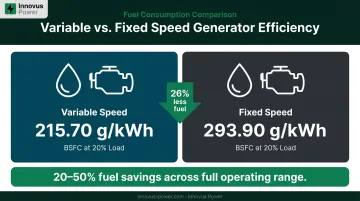
This matters because internal combustion engines have an efficiency "sweet spot" that shifts with load. The numbers illustrate the gap clearly: MDPI research on marine VSGs measured brake-specific fuel consumption (BSFC) at 20% base load — the variable-speed strategy achieved 215.70 g/kWh, while the fixed-speed rated-speed case consumed 293.90 g/kWh at the same load. That's a 26% reduction in fuel burn at that single load point, just from running the engine at the right speed.
Across a broader operating range, the advantage compounds. Variable-speed diesel generator systems can reduce fuel consumption by 20–50% depending on operating conditions, according to research published in MDPI Energies.
Power Electronics — Frequency Regulation
When engine RPM changes, the generator's raw AC output frequency changes with it. An engine running at 1,200 RPM doesn't produce 60 Hz — it produces a lower frequency. Most electrical loads can't handle variable-frequency power.
Power electronics solve this in two steps:
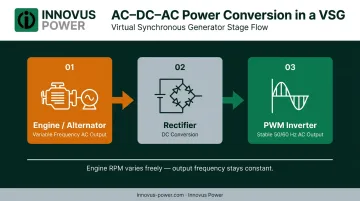
- Rectification — the variable-frequency AC from the generator is converted to DC by a rectifier
- Inversion — the stable DC passes through a high-power PWM (Pulse Width Modulation) inverter, which reconstructs clean AC output at the required frequency and voltage
The result: stable 50 or 60 Hz output, regardless of what the engine is actually doing. This AC-DC-AC conversion architecture is what makes VSG output safe for motors, controls, and sensitive electronics — and what enables VSG integration into microgrids and hybrid systems.
Without this stage, variable engine speed would cause frequency instability that damages connected loads.
Output Delivery
The output is stable, grid-quality AC power at the correct voltage and frequency. In standalone configurations, it powers site loads directly. In hybrid or microgrid configurations, it works alongside batteries, solar, or wind, with an energy management system coordinating dispatch.
The inverter-based output also delivers superior power quality compared to a raw fixed-speed genset — fewer harmonics, tighter voltage regulation, and better performance for sensitive equipment.
Variable Speed vs. Fixed Speed Generators
Fixed-speed generators maintain constant RPM regardless of load — typically 1,500 RPM for 50 Hz systems or 1,800 RPM for 60 Hz systems. The reason is structural: output frequency is directly tied to shaft speed. Maintaining 60 Hz requires maintaining 1,800 RPM, even when the connected load is 20% of rated capacity.
This creates a persistent inefficiency problem. At partial loads, the engine runs with excess air, incomplete combustion, and high specific fuel consumption per kilowatt-hour delivered. The MDPI marine research cited above puts numbers to this: 293.90 g/kWh at 20% load for a fixed-speed generator. Most of that energy exits as heat and exhaust rather than usable electricity.
Extended low-load operation in fixed-speed diesel generators also causes wet stacking — unburned fuel and oil accumulate in the exhaust system, leading to carbon deposits and accelerated component wear. Caterpillar identifies this as a direct consequence of operating below 30% rated output for extended periods.
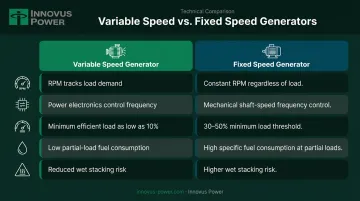
| Variable Speed | Fixed Speed | |
|---|---|---|
| RPM behavior | Tracks load demand | Constant regardless of load |
| Frequency control | Power electronics | Mechanical (shaft speed) |
| Minimum efficient load | As low as 10% (NRCan) | 30–50% before underloading risk |
| Partial-load fuel use | Significantly lower | High specific fuel consumption |
| Wet stacking risk | Reduced | Higher at sustained low loads |
The table above captures the core tradeoff. VSGs use power electronics to separate engine RPM from output frequency, giving the engine freedom to run at peak efficiency across any load level. Fixed-speed generators have no such decoupling: their mechanical architecture permanently locks engine speed to grid frequency.
Key Benefits of Variable Speed Generators
Fuel Efficiency and Emissions
The efficiency advantage is most pronounced at low and partial loads — which happen to be the operating conditions that dominate many real-world applications.
- Fuel savings of 20–50% vs. fixed-speed operation at low loads (MDPI Energies)
- MTU/Rolls-Royce reports up to 15% fuel reduction specifically in commercial ship applications
- MDPI Applied Sciences found onboard DC-grid systems with variable-speed generators reduce specific fuel oil consumption by up to 27% and carbon footprint by up to 30%
Lower fuel consumption directly reduces CO₂ and particulate emissions. For commercial shipping under IMO's CII rating system, and for off-road and stationary engines subject to EPA and EU Stage V requirements, this isn't just an operating cost issue — it's a compliance issue.
Extended Engine Life and Lower Maintenance
Running an engine at lower RPM under light loads reduces cylinder wear, bearing stress, and thermal fatigue compared to the same engine spinning at full speed doing the same work.
- MTU/Rolls-Royce reports up to 20% increase in time between overhauls (TBO) for variable speed generator sets
- MDPI Applied Sciences documents up to 30% lower maintenance costs for variable-speed diesel systems in onboard DC grids
- Reduced wet stacking risk means less carbon accumulation and fewer forced load-bank cycles
For remote or offshore operations where maintenance access is logistically difficult and downtime is expensive, TBO extension has real financial weight.
Innovus Power's VSG Technology
These efficiency and maintenance gains are central to how Innovus Power designed its GridGenius microgrid platform. The variable speed generator technology at its core achieves up to 50% superior efficiency across all load levels compared to conventional genset solutions.
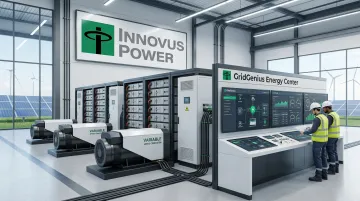
The GridGenius Energy Center manages engine speed dynamically, maintaining utility-grade power quality while optimizing fuel consumption in real time. In hybrid configurations where the generator operates primarily as backup or supplement to renewables, this advantage compounds — the generator runs most of its hours at low or partial load, exactly where variable speed delivers the greatest returns.
Where Variable Speed Generators Are Used
VSGs deliver their greatest value in applications where a high proportion of operating hours are spent at low or variable loads. In those environments, a fixed-speed generator wastes fuel continuously.
Primary application environments:
- Marine vessels : offshore supply vessels at anchor or low-activity positions, where fixed-speed operation at low loads is the norm for extended periods
- Remote community microgrids : residential demand fluctuates significantly throughout the day; NRCan documents a 590 kW converter-based VSG platform deployed in Aklavik, Northwest Territories, commissioned in February 2018, serving a community where fuel must be barged in seasonally
- Mining and industrial sites : auxiliary power with variable equipment loads, often in locations where fuel logistics add significant cost
- Hybrid microgrids with solar or wind : when renewables are primary, the genset operates only as a supplement, meaning it runs at low load for most hours
Those fuel logistics make efficiency numbers concrete rather than theoretical. The Pembina/WWF report documents electricity generation costs of CAD $0.60–$1.14/kWh in Nunavut — costs driven largely by diesel procurement and delivery in communities accessible only by barge or seasonal ice road. A 20–30% reduction in fuel consumption at those price levels changes project economics substantially.
Microgrid Integration
In modern hybrid microgrids, variable speed generators function as one dispatchable source among several, coordinated by an energy management system alongside batteries and renewables. The VSG's ability to operate efficiently at low loads is essential here — the generator may only be called on when renewable generation falls short, running at whatever partial load the gap requires.
Innovus Power's GridGenius Energy Management Control System (EMCS) is designed specifically for this kind of multi-source dispatch. It coordinates when and at what output level the VSG runs relative to solar, wind, and battery storage, optimizing for cost efficiency and emissions reduction across the full system.
Conclusion
Variable speed generators work by matching engine RPM to load demand in real time, running the engine at its most efficient speed for each operating condition, and using AC-DC-AC power electronics to deliver stable, frequency-correct output regardless of engine speed. That architecture directly eliminates the core inefficiency of fixed-speed operation, where engines spin at full speed regardless of actual load, and it's what drives the fuel and cost savings VSGs deliver over their operational lifetime.
For engineers and operators, understanding how VSGs work leads to better decisions across the project: evaluating whether a VSG fits a given load profile, sizing the power electronics correctly, configuring the control system for responsive but stable operation, and integrating the generator with renewables or storage in a hybrid microgrid.
Misunderstanding the technology typically surfaces as undersized converters, poorly tuned controls, or VSG deployment in applications where load profiles are consistently high and the efficiency benefit is minimal. Getting those fundamentals right — load profile analysis, converter sizing, and control tuning — is what separates a well-performing VSG installation from one that underdelivers. Innovus Power's microgrid systems are built around this principle, combining variable speed generation with intelligent control software to ensure the efficiency gains translate into measurable results in the field.
Frequently Asked Questions
What is the 80% rule for generators?
The 80% rule recommends against running generators above 80% of rated capacity continuously, preserving headroom for load surges and preventing overheating. Variable speed generators manage load more dynamically than fixed-speed units, reducing sustained overload risk by adjusting engine output in real time.
What is the 20/20/20 rule for generators?
The 20/20/20 rule advises against running diesel generators below 20% load for extended periods, as low-load operation causes wet stacking (unburned fuel accumulating in the exhaust). Variable speed generators mitigate this by running at lower RPM under light loads, improving combustion efficiency rather than spinning at full speed unloaded.
Can a 5,000W generator run a house?
A 5,000W generator can cover essential loads, such as refrigeration, lighting, and small appliances, but not all loads simultaneously. High-draw equipment like air conditioners will quickly push capacity limits. A variable speed unit at that rating handles partial-load conditions more efficiently than a fixed-speed equivalent, consuming less fuel when demand is low.
How long will a generator run on a 20 lb tank of propane?
Runtime depends on load level and the generator's consumption rate. A 5,000W unit typically delivers 6-7 hours at 50% load on a 20 lb propane tank, though this varies by model. Variable speed propane generators consume less fuel at partial loads than constant-speed equivalents, extending runtime when demand stays below peak.
What is the difference between a variable speed generator and a variable speed drive?
A variable speed generator adjusts the speed of the engine (prime mover) to match power generation demand. A variable speed drive (VSD) adjusts the speed of an electric motor that consumes power from a supply. They operate at opposite ends of the power chain and serve entirely different purposes, though they can be used together in the same system.
Can a variable speed generator integrate with solar or wind power in a microgrid?
Yes — VSGs are well-suited to hybrid microgrid applications because their low-load efficiency makes them practical as supplemental or backup generation. When solar or wind output drops, the VSG ramps up efficiently rather than idling at full speed. Innovus Power's GridGenius EMCS coordinates this dispatch automatically across all generation and storage sources.