Introduction
Fuel costs keep rising. Environmental regulations keep tightening. And the generators powering remote facilities, marine vessels, and off-grid industrial sites keep running at partial load — burning fuel and accumulating wear whether the load demands it or not.
That last point is where most of the real cost lives. A generator sized for peak demand but carrying 30–40% load through the majority of its operating hours isn't just inefficient: it creates a slow, compounding drain on fuel budgets, maintenance schedules, and equipment life.
According to the U.S. Army University Press, most U.S. Army generators run at just 30% of rated capacity, which reflects the partial-load reality common across off-grid and remote deployments broadly.
Variable speed generators (VSGs) directly address this. This article covers the measurable operational advantages of variable speed generation — fuel consumption, emissions output, maintenance intervals, and equipment longevity — and explains when and why those advantages matter most for remote and off-grid operations.
Key Takeaways
- VSGs adjust engine speed to match actual load, eliminating the fixed-speed inefficiency that wastes fuel at partial load
- Peer-reviewed research documents fuel savings of up to 27% at partial load
- Lower fuel burn cuts GHG emissions proportionally, with the largest gains at light loads where fixed-speed generators waste the most energy
- Variable speed operation eliminates wet stacking and cylinder glazing, extending time between overhauls by ~20%
- VSGs become significantly more valuable when integrated with an intelligent EMCS in a hybrid microgrid
What Is a Variable Speed Generator?
A conventional generator runs at a fixed speed (typically 1,500 RPM at 50 Hz or 1,800 RPM at 60 Hz) regardless of how much power is actually being drawn. MDPI Energies confirms that these fixed speeds are maintained to produce stable AC frequency, but the consequence is that the engine works at the same intensity whether the load is 10% or 100% of rated capacity.
A variable speed generator breaks that constraint. The engine speed adjusts dynamically to match actual electrical demand, operating at lower RPM under light loads and scaling up as demand increases. The electrical output is decoupled from engine speed through power electronics, so frequency and voltage remain stable regardless of where the engine is operating.
Where VSGs are typically deployed:
- Remote communities and off-grid sites with fluctuating daily load profiles
- Marine vessels during standby and low-speed transit phases
- Military installations and forward operating bases
- Industrial facilities with significant variation between peak and off-peak shifts
- Hybrid microgrids combining generator output with solar, wind, or storage
Each of these environments shares a common pressure: every liter of fuel consumed and every hour of unplanned downtime has a direct operational cost. That's what makes VSG technology valuable in practice — it delivers lower cost-per-kilowatt-hour, reduced emissions, and greater reliability in the conditions where those outcomes matter most.
Key Advantages of Variable Speed Generators
The advantages below are grounded in operational outcomes: fuel invoices, maintenance schedules, and emissions reports. Each one maps to a specific, measurable cost or risk category.
Advantage 1: Superior Fuel Efficiency Across All Load Levels
Fixed-speed generators are optimized for peak load. Under partial load — which describes the majority of real-world operating time in remote, off-grid, and standby applications — they run inefficiently, burning fuel the load doesn't require.
Variable speed generators solve this by reducing engine RPM when demand is low. The engine operates closer to its efficiency sweet spot at every load point rather than being locked into a speed calibrated for maximum output.
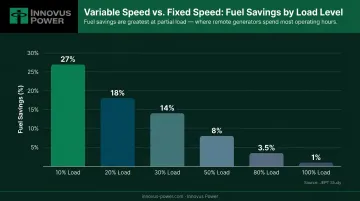
A peer-reviewed study published in the Journal of Energy and Power Technology reported up to 27% fuel savings at 10% load for a 2,350 kW diesel generator operating variable speed between 1,200–1,800 RPM. Savings decrease as load increases (3.5% at 80% load), which reflects the nature of the efficiency curve — the benefit is largest precisely where partial-load operation is most common.
A facility running at 30–40% of rated capacity for extended periods — remote operations, marine standby phases, off-peak industrial hours — compounds those savings across thousands of operating hours. Innovus Power's variable speed generator technology is designed to deliver up to 50% superior efficiency at all loads compared to conventional fixed-speed alternatives.
When this advantage matters most:
- Remote or off-grid sites with limited fuel resupply access
- Facilities with wide daily load swings
- Marine vessels in standby or low-speed transit
- Industrial sites carrying light loads during off-peak shifts
KPIs directly affected: fuel cost per kWh, annual fuel consumption, cost per operating hour, total cost of ownership over 5–10 year deployments.
Advantage 2: Meaningful Reduction in Emissions
Burning less fuel directly cuts combustion byproducts — CO₂, NOₓ, SOₓ, and particulate matter all decrease in proportion to fuel consumption.
The same JEPT study referenced above provides a GHG improvement table comparing fixed-speed and variable-speed operation for a 500 kW generator across load levels:
| Load Level | GHG Improvement (VSG vs. Fixed-Speed) |
|---|---|
| 10% | 27% |
| 20% | 18% |
| 30% | 14% |
| 50% | 8% |
| 80% | 3.5% |
| 100% | 1% |
Beyond the emissions math, there's a mechanism issue with fixed-speed partial-load operation. Caterpillar's technical documentation on generator set underloading confirms that extended low-load operation causes wet stacking — incomplete combustion that deposits unburned fuel and carbon in the exhaust system. Variable speed operation keeps combustion cleaner across the load range by matching engine conditions to actual demand.
Why emissions reductions matter operationally:
Organizations in regulated industries — oil and gas, marine, military — face tightening standards. IMO MARPOL Annex VI Regulation 13 applies NOₓ limits to marine diesel engines above 130 kW, and Tier III requirements apply in designated Emission Control Areas. VSG-driven emissions reductions directly support compliance without add-on aftertreatment costs.
For organizations with ESG reporting requirements or internal carbon reduction mandates, the GHG improvement data above provides a credible, documented basis for reporting.
When this advantage matters most:
- Marine and offshore applications under IMO/MARPOL standards
- Operations with internal or externally mandated carbon targets
- Remote communities where combustion quality affects local air quality
- Hybrid systems where lower emissions per kWh supports higher renewable penetration
Advantage 3: Extended Equipment Life and Lower Maintenance Costs
The same partial-load conditions that waste fuel also accelerate engine wear. At low loads, fixed-speed generators don't reach designed operating temperatures. The consequences are well-documented:
- Cylinder glazing — piston rings fail to seat properly, causing power loss and accelerated wear
- Oil dilution — unburned fuel bypasses rings into the crankcase, contaminating lubricant
- Carbon buildup — deposits form on injectors and exhaust valves, degrading performance
- Wet stacking — incomplete combustion leaves oily deposits in the exhaust system
Variable speed operation eliminates these conditions by matching engine speed to actual load. The engine works proportionally less when less is asked of it.
The maintenance impact is quantified. MTU/Rolls-Royce reports that reduced speed operation extends time between overhauls by approximately 20%, with their marine variable speed gensets reaching TBO up to 42,000 hours and achieving 20% lower maintenance costs overall.
For remote deployments, this matters beyond the direct cost. Fewer maintenance events mean fewer technician callouts to locations where travel is expensive and logistics are complex. Each avoided service trip compounds into significant savings over a multi-year deployment.
KPIs directly affected: mean time between failures (MTBF), maintenance cost per operating hour, annual service frequency, unplanned downtime incidents.
When this advantage matters most:
- Remote and Arctic deployments where maintenance logistics are expensive
- Continuous-operation facilities — mining, medical, military — where downtime has productivity or safety consequences
- Operations with limited on-site technical expertise
What Happens When You Stick with Fixed-Speed Generators?
Fixed-speed generators sized for peak demand spend most of their operating hours at partial load. That mismatch doesn't just hurt efficiency — it drives up costs across fuel, maintenance, and emissions simultaneously, often without operators tracing the problem back to the generator itself.
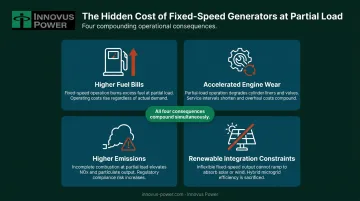
The consequences stack up over time:
- Higher fuel bills that scale with every hour of partial-load operation, representing the largest controllable cost in remote power systems
- Accelerated wear from high-speed operation under low load — more frequent maintenance, shorter equipment life, higher parts consumption
- Higher emissions that create real regulatory risk — permit violations, operational restrictions, and tightening standards across marine, industrial, and offshore sectors
- Renewable integration constraints — fixed-speed generators cannot easily accommodate variable solar or wind output; Applied Energy research confirms a minimum load floor of 30% is a standard manufacturer constraint, which forces curtailment of renewable generation
Variable speed generators eliminate this load-floor constraint entirely — and with it, the fuel waste, wear cycles, and emissions penalties that fixed-speed operation locks in.
How to Get the Most Value from Variable Speed Generators
VSGs deliver their full benefit when the generator is appropriately sized and load profiles are understood before deployment, not oversized for peak demand and left idling through most operating hours.
Start with a Load Profile Analysis
An energy demand audit or load profile analysis is the critical first step. It identifies the specific operating conditions — daily load swings, average vs. peak demand, duration at partial load — where variable speed operation produces the greatest savings. Innovus Power's Grid Design Services examines existing power certainty, quality, and cost to design an optimized solution for each site's actual requirements.
Integrate with an Intelligent EMCS
VSGs produce compounding value when operated as part of an intelligent energy management system rather than in isolation. When paired with an Energy Management Control System like Innovus Power's GridGenius platform, the generator's variable speed operation is coordinated with solar, storage, and wind inputs to maximize renewable penetration, minimize generator runtime, and maintain power quality automatically.
That tighter coordination between generation and renewable sources is where the efficiency gains compound. Research from Hamilton, Negnevitsky, and Wang in Energy Procedia found that variable speed diesel application can reduce diesel fuel consumption by up to 40% compared with conventional hybrid diesel applications.
Review Against Baseline Metrics Regularly
Load patterns evolve as facilities grow or change operations, so periodic optimization ensures the system continues performing as expected. Track outcomes regularly against three core baselines:
- Fuel consumption per operating hour
- Maintenance intervals and associated costs
- Emissions output relative to targets
Conclusion
Variable speed generators reduce fuel spend, lower emissions, and extend equipment life — three outcomes that compound over multi-year deployments. The advantages are most significant where generators most commonly operate: at partial load, for extended periods, in environments where fuel logistics and maintenance access are costly.
The return grows over time. Over successive years, fuel savings reduce operating costs, lower mechanical wear extends asset life, and reduced emissions shrink regulatory exposure. When VSGs are integrated with renewable sources and intelligent controls like GridGenius EMCS, each efficiency gain compounds the next — Innovus Power's variable speed technology delivers up to 50% superior efficiency across all load conditions, a performance gap that widens as deployments scale.
Variable speed generation isn't a one-time hardware decision. For organizations building a long-term power strategy in remote, off-grid, or variable-demand environments, it's the architecture that determines how much value every other efficiency improvement can actually deliver.
Frequently Asked Questions
What are the advantages of a variable speed generator?
Variable speed generators deliver lower fuel consumption at partial loads, reduced GHG emissions in direct proportion to fuel savings, longer time between overhauls, and lower maintenance costs from reduced engine wear. They also integrate more effectively with solar, wind, and storage in hybrid microgrid configurations.
How does a variable speed generator differ from a fixed-speed generator?
Fixed-speed generators run at constant RPM (1,500 or 1,800 RPM), regardless of how much power is needed. Variable speed generators adjust engine RPM to match actual load demand, operating more efficiently at partial load while maintaining stable output frequency through power electronics.
How much fuel can a variable speed generator save compared to a fixed-speed unit?
Peer-reviewed research published in the Journal of Energy and Power Technology documented up to 27% fuel savings at 10% load for a 2,350 kW diesel generator operating at variable speed. Savings are most significant when generators operate well below rated capacity for extended periods — the most common scenario in off-grid and remote deployments.
Are variable speed generators suitable for off-grid and remote locations?
VSGs are particularly well-suited to off-grid applications. Their efficiency advantage is greatest at partial loads , exactly where remote generators spend most of their operating time. The extended TBO also reduces costly technician callouts to remote or difficult-to-access sites.
Can variable speed generators integrate with solar and other renewable energy sources?
Yes. VSGs are compatible with hybrid microgrid configurations and, when managed by an intelligent EMCS like Innovus Power's GridGenius platform, they coordinate with solar, wind, and storage to maximize renewable penetration and minimize generator runtime — all while maintaining stable power quality.
Are variable speed generators more expensive to maintain than fixed-speed units?
Variable speed generators do involve additional power electronics compared to basic fixed-speed units. However, their longer time between overhauls (approximately 20% extended TBO per MTU/Rolls-Royce data) and reduced wear under partial load generally result in lower total maintenance costs over time.