Introduction
For energy managers, facility operators, and remote community power teams, an unexpected outage isn't just an inconvenience—it's a financial and operational crisis. Utility costs keep climbing, and the grid faces growing pressure from distributed renewables, industrial loads, and extreme weather events. Yet most monitoring systems were designed for a simpler era, before bidirectional power flows, battery storage, EV charging, and variable generation sources became the norm.
That gap has real consequences. The 2021 Texas winter storm made it unavoidable: demand forecasts missed actual load by 14%, freezing-related failures knocked out 44% of generation capacity, and over 4.5 million people lost power for days. Traditional monitoring systems couldn't anticipate the crisis or respond fast enough to contain it.
This article covers how AI-powered grid monitoring shifts power management from reactive to predictive—what the technology does, how it works within microgrid environments, and what it means for energy-intensive operations, remote facilities, and microgrid deployments where downtime carries real operational and financial costs.
Key Takeaways
- AI-powered grid monitoring replaces periodic manual inspections with 24/7 automated fault detection across every grid asset
- Predictive maintenance reduces unplanned downtime by 30–50% and cuts maintenance costs by 12–18%
- Advanced forecasting achieves 1.5% error rates, enabling precise demand response and renewable optimization
- Up to 90% renewable penetration without curtailment — demonstrated by platforms like Innovus Power's GridGenius EMCS
- Remote and off-grid microgrids can operate with reduced or no on-site staffing through AI-driven autonomous control
Why Traditional Grid Monitoring Falls Short
Conventional monitoring relies on periodic meter readings, manual inspections, and SCADA systems that generate data but offer limited predictive insight. Problems are discovered after they occur, not before they escalate into outages.
Legacy SCADA systems report data at slow rates—often once every four seconds—insufficient for modern control systems managing inverter-based resources that require millisecond-level responsiveness. These systems monitor current conditions but lack the advanced analytics to predict state changes or optimize dispatch in grids with high distributed energy resource (DER) penetration.
The 2021 Texas Winter Storm Uri put this gap in stark relief:
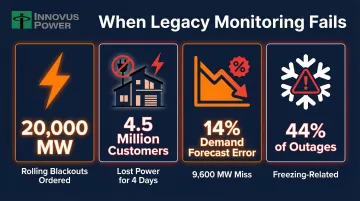
- ERCOT ordered 20,000 MW of rolling blackouts to prevent total grid collapse
- More than 4.5 million customers lost power, some for four days
- Demand forecasts underestimated actual load by 9,600 MW (14%)
- 44% of unplanned generation outages were freezing-related, revealing a lack of asset health visibility under stress
Uri wasn't an anomaly — it was a preview of what legacy monitoring can't handle. Modern energy environments with distributed solar, battery storage, EV charging, variable industrial loads, and bidirectional power flows require a fundamentally different approach: one that processes continuous data streams, identifies patterns in real time, and responds autonomously before small anomalies escalate into major failures.
What Is AI-Powered Grid Monitoring?
AI-powered grid monitoring uses machine learning, neural networks, and real-time sensor data to continuously assess grid health, detect anomalies, forecast load behavior, and trigger automated responses — replacing periodic human review with autonomous, always-on intelligence.
The Architecture:
Sensors and smart meters feed data into AI models—deployed at the edge or in cloud platforms—that process voltage, frequency, current, temperature, and power flow data in real time. These models identify patterns and deviations that signal impending failures or optimization opportunities.
As of December 2023, U.S. utilities operated 128.4 million advanced smart meters covering 76.8% of all electricity customers, creating the sensor infrastructure necessary for AI monitoring at scale.
Smart Grid vs. AI-Enhanced Management:
While smart grids introduced bidirectional communication and digital metering, AI grid monitoring adds a decision-intelligence layer that acts on that data:
- Predictive analytics that forecast equipment failures before they occur
- Autonomous decision-making that adjusts generation and storage dispatch
- Dynamic optimization that maximizes renewable utilization while maintaining stability
Monitoring vs. Control:
AI monitoring continuously observes and alerts operators to conditions requiring attention. AI-powered Energy Management Control Systems (EMCS) — like Innovus Power's GridGenius EMCS — take those insights further, adjusting generation dispatch, storage, and load in real time to maintain optimal performance.
Key AI Capabilities That Enable Smarter Energy Management
Predictive Maintenance and Anomaly Detection
Neural networks analyze sensor data from transformers, switchgear, cables, and inverters to identify early warning signatures of equipment degradation—abnormal temperature rise, harmonic distortion, unusual load patterns—before failure occurs.
The Financial Impact:
Unplanned downtime costs U.S. industrial manufacturers an estimated $50 billion annually. In automotive manufacturing, a single hour of downtime can cost $2.3 million.
AI-driven predictive maintenance delivers measurable ROI:
- Cuts unplanned downtime by 30-50%
- Lowers total maintenance costs by 12-18%
- Productivity gains of 25%, with breakdown frequency dropping by 70%
Asset-Specific Results:
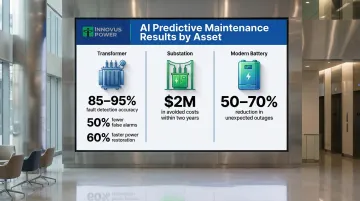
- Transformers: AI fault detection models achieve 85-95% accuracy, reducing false alarms by 50% and cutting power restoration times by up to 60%
- Substations: An EPRI predictive maintenance program demonstrated $2 million in avoided costs within two years
- Microgrids: AI monitoring of inverter and battery signals reduces unexpected outages by 50-70%
For remote operations where repair crews may be days away, predictive maintenance isn't just a cost-saving measure—it's what keeps the lights on. That same forecasting intelligence also applies to demand itself.
Load Forecasting and Demand Response
AI models use historical consumption data, weather inputs, and real-time signals to forecast load demand at sub-hourly intervals, enabling grid operators to pre-position generation and storage resources rather than react to supply-demand imbalances.
Superior Accuracy:
Advanced models like LSTM-RNN achieve Mean Absolute Percentage Errors (MAPE) as low as 1.5% for hourly forecasts, far outperforming traditional statistical methods.
AI-Driven Demand Response:
During peak load conditions, the system automatically sheds non-critical loads, dispatches stored energy, or signals flexible consumers to adjust usage—stabilizing the grid in seconds. By 2024, demand response participation in U.S. wholesale markets grew to 33,272 MW.
This precision enables facilities like hospitals to automate demand response, reducing peak loads while maintaining critical operations. The same forecasting logic that balances demand also determines how much renewable generation can safely flow onto the grid.
Renewable Energy Integration and Grid Balancing
Solar and wind intermittency creates voltage and frequency variability that traditional grids struggle to absorb. AI monitoring addresses this by continuously forecasting generation output and coordinating storage dispatch and generator ramping to compensate for fluctuations.
The Curtailment Problem:
Without intelligent control, excess renewable energy is increasingly wasted. Wind curtailment in the Southwest Power Pool increased sixfold since 2020, while CAISO curtailed 3.4 million MWh of wind and solar in 2024—a 29% increase from the previous year.
AI Optimization in Action:
AI algorithms—including reinforcement learning and genetic algorithms—schedule and dispatch multiple energy resources simultaneously to maximize renewable utilization while maintaining grid stability.
Research demonstrates tangible results:
- A hydrogen microgrid using LSTM and Krill Herd Algorithms reduced grid imports by 35.6% and lowered PV curtailment by 21.4%
- A deep reinforcement learning model applied to a Canadian microgrid increased "island mode" duration to 10.34%, compared to just 0.2% for rule-based algorithms
Systems like Innovus Power's GridGenius EMCS achieve up to 90% renewable penetration without curtailment by intelligently coordinating solar, wind, storage, and backup generation in real time.
The Real-World Benefits of AI-Powered Grid Monitoring
Reliability and Outage Prevention:
AI's shift from reactive to predictive operations cuts failures. Con Edison's machine learning system correctly identified 75% of feeders that would fail during a summer season, allowing targeted preventative maintenance. AI-powered self-healing mechanisms prevent nearly 45% of potential service disruptions.
Energy Cost Reduction:
AI-optimized dispatch reduces reliance on expensive peaking generation and fuel consumption. For remote operations dependent on diesel—where fuel can cost $9 to $16 per gallon in remote Alaska—the savings are concrete. Shungnak, Alaska reduced diesel consumption by 11% in the first year of solar-battery microgrid deployment, saving approximately $120,000.
This flattens long-term energy costs for industrial and remote operators especially exposed to fuel price volatility.
Power Quality Improvement:
Real-time monitoring of voltage stability, harmonic distortion, and frequency deviations enables systems to correct power quality issues before they damage sensitive equipment. This reduces equipment replacement costs and energy waste across manufacturing, data centers, and medical facilities. Voltage sags can damage precision equipment and cause premature failure — catching them early prevents both.
Operational Simplification:
AI monitoring centralizes insight across all grid assets into a single platform with automated alerts and reporting, reducing the need for on-site technicians and manual inspections. One GridGenius VSG can replace 2-3 fixed-speed synchronous gensets, streamlining powerhouse operations while extending maintenance intervals—particularly valuable for geographically distributed or remote operations.
AI Grid Monitoring in Microgrids and Remote Operations
AI monitoring is especially critical in microgrid contexts where remote communities, mining operations, military bases, and off-grid industrial sites cannot rely on utility backup when problems arise. Fault detection, autonomous load balancing, and predictive maintenance must happen without delay and often without on-site expertise.
The Remote Energy Challenge
Over 170 remote Indigenous communities in Canada rely on diesel, consuming over 90 million liters annually. In remote Alaska, diesel fuel prices range from $9 to $16 per gallon. For military forward operating bases, fuel delivery costs can exceed $400 per gallon in hostile environments.
Intelligent Control Systems
Innovus Power's GridGenius EMCS integrates AI-powered monitoring directly into microgrid control, enabling real-time optimization of solar, storage, generators, and grid-tied assets from a single platform. The system's PowerView software provides 24/7 remote monitoring support worldwide, without requiring on-site technical personnel.
In locations where repair crews may be days away, this prevents costly outages while driving down fuel costs through higher renewable energy output.
Real-world deployments show the impact:
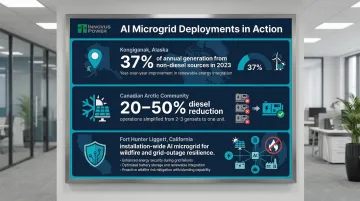
- Kongiganak, Alaska: Advanced control software enabled 37% of annual generation from non-diesel sources in 2023
- Canadian Arctic Community: A GridGenius VSG with solar integration reduced diesel consumption by 20-50% depending on season while simplifying operations from 2-3 fixed-speed gensets to a single continuously operating unit
- Fort Hunter Liggett, California: An installation-wide AI-enabled microgrid is being deployed to achieve energy resilience against wildfires and grid outages
In these environments, AI monitoring is not a performance upgrade. It is the foundation that keeps critical operations running when grid support is unavailable and failure is not an option.
Frequently Asked Questions
Is there a way to see power usage in real time?
Yes. Modern AI-powered grid monitoring systems use smart meters, IoT sensors, and energy management platforms to provide real-time dashboards showing consumption, generation, storage state, and power quality data—accessible from anywhere through platforms like Innovus Power's PowerView software.
What are the 5 components of a smart grid?
The five core components are:
- Smart meters and sensors for real-time data collection
- Advanced communication networks for two-way data exchange
- Energy management and control systems for optimization
- Distributed energy resources including generation and storage
- Data analytics and AI platforms that process grid data and enable autonomous decision-making
What is the difference between a smart grid and a microgrid?
A smart grid is a digitally enhanced version of the traditional utility grid—large-scale and interconnected across regions. A microgrid is a localized, self-contained energy system with defined electrical boundaries that can operate independently in "island mode" or connected to the main grid. AI-powered monitoring applies to both.
How does AI help prevent power outages?
AI detects early warning signs of equipment failure through continuous sensor data analysis, forecasts load and generation imbalances before they occur, and triggers automated corrective actions—such as dispatching storage or rerouting load—before faults escalate into outages.
What are the biggest challenges in implementing AI-powered grid monitoring?
The three most common barriers are:
- Data quality and integration — legacy systems often produce incomplete or siloed data
- Cybersecurity risks — connected IoT devices and two-way communications expand the attack surface
- Skills gaps — teams need expertise to interpret and act on AI-generated insights
Vendor-agnostic platforms with built-in remote management support, like Innovus Power's GridGenius EMCS, are designed to reduce each of these friction points.